
Overview of key peptide research compounds including BPC-157, CJC-1295, Ipamorelin and GHK-Cu, with focus on...
Latest posts
-
 Lyophilized Peptides: Stability, Reconstitution and Common Handling MistakesRead more
 -
 Treatment of Age-Related Visual Impairment with SS31 Peptide Targeting MitochondriaRead more
Age-related visual impairment is a prevalent condition that affects millions of people worldwide. With the aging...
-
 NAD+ IV Therapy: The Future of Anti-Aging? | Discover the Latest Research and BenefitsRead more
NAD+ IV therapy is a medical treatment that involves administering NAD+ directly into the bloodstream through...
-
 The use of KCF-18, a peptide originating from cytokine receptors, as a therapeutic approach for anti-inflammatory purposes through binding to proinflammatory cytokines.Read more
The use of peptides derived from cytokine receptors as a therapeutic strategy for anti-inflammation has been...
Blog categories
Search in blog
Archived posts
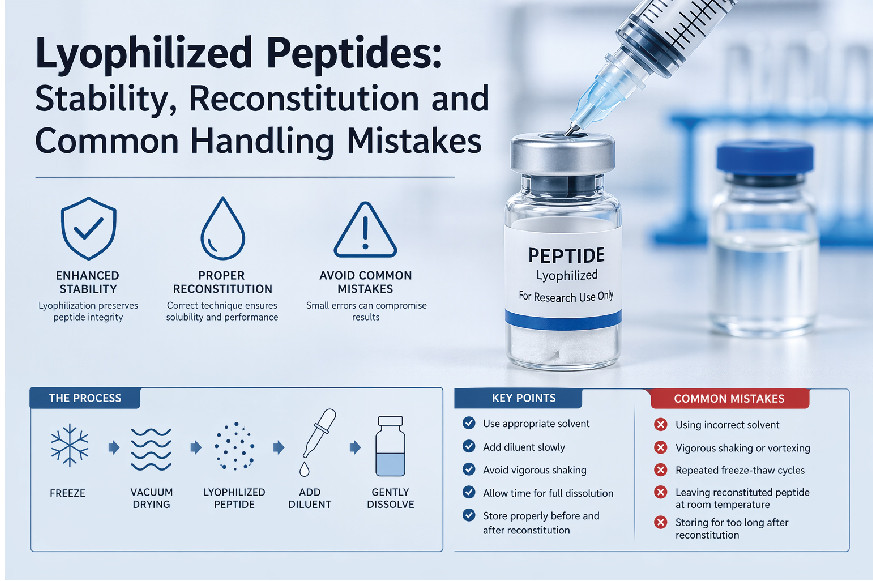
Lyophilized Peptides: Stability, Reconstitution and Common Handling Mistakes
Lyophilized peptides are widely used in laboratory research due to their improved stability and extended shelf life compared to liquid formulations. However, despite their apparent simplicity as dry powders, improper handling, reconstitution, and storage practices can significantly compromise peptide integrity and reproducibility in experimental workflows.
Understanding how lyophilized peptides behave, and how to manage them correctly, is essential for maintaining consistency in research environments.
Why Lyophilization Improves Stability
Lyophilization, or freeze-drying, is a dehydration process in which water is removed from the peptide under low temperature and vacuum conditions. This process preserves the structural integrity of the molecule while minimizing chemical reactions that typically occur in aqueous environments.
In solution, peptides are more prone to:
- hydrolysis
- oxidation
- aggregation
- microbial contamination
By removing water, lyophilization slows down these degradation pathways, allowing peptides to be stored for longer periods with reduced risk of structural breakdown.
However, stability does not mean indestructibility. External factors such as temperature fluctuations, light exposure, and repeated handling can still affect lyophilized material.
Reconstitution: More Than Just Adding Water
One of the most underestimated steps in peptide handling is reconstitution. While it may seem straightforward, the process can influence solubility, stability, and downstream usability.
Key variables include:
- solvent type
- temperature
- dilution volume
- mixing method
Some peptides dissolve readily in sterile water, forming clear solutions almost instantly. Others require more careful handling due to hydrophobic regions or structural tendencies to aggregate.
In such cases, issues may include:
- incomplete dissolution
- cloudiness
- surface adhesion
- slow solubilization
A common mistake is assuming all peptides behave the same. In reality, solubility is highly sequence-dependent.
Mixing and Mechanical Stress
Vigorous shaking is often used in laboratory settings to accelerate dissolution. However, for peptides, this can be counterproductive.
Excessive agitation may lead to:
- denaturation
- aggregation
- adsorption to container surfaces
Instead, best practice typically involves:
- gentle swirling
- slow inversion
- allowing time for gradual dissolution
In many cases, simply letting the vial sit after adding solvent results in a more stable and uniform solution.
Temperature Considerations
Temperature plays a dual role in peptide handling.
On one hand, slight warming can improve solubility, especially for peptides that dissolve slowly. On the other hand, elevated temperatures can accelerate degradation processes.
The balance lies in avoiding high heat and using mild temperature adjustments only when necessary.
Extreme temperature changes, particularly repeated freeze-thaw cycles, are among the most common causes of peptide degradation.
Storage Before and After Reconstitution
Lyophilized peptides are generally more stable than their liquid counterparts, but they still require proper storage conditions.
Before reconstitution:
- low temperature storage is recommended
- protection from moisture is essential
- minimizing repeated exposure to air improves longevity
After reconstitution:
- stability decreases significantly
- degradation processes resume in solution
- storage conditions become more critical
Repeated freeze-thaw cycles should be avoided whenever possible, as they can alter peptide structure and reduce consistency across experiments.
Common Handling Mistakes
In practical laboratory environments, several recurring errors can compromise peptide quality:
- using inappropriate solvents without considering peptide characteristics
- applying excessive mechanical force during mixing
- storing reconstituted solutions for extended periods
- exposing peptides to repeated temperature fluctuations
- assuming all peptides share the same solubility behavior
These issues often lead to inconsistent experimental results rather than immediate visible failure, making them difficult to detect without experience.
Practical Perspective
In real-world research settings, peptide handling is not just about following theoretical guidelines but understanding how materials behave under practical conditions.
Small variations in technique can produce measurable differences in solubility, stability and reproducibility.
For this reason, standardized handling protocols and careful observation remain essential.
Related Compounds
BPC-157 peptide
CJC-1295 w/o DAC peptide
Ipamorelin peptide
GHK-Cu peptide
Final Notes
All compounds discussed are intended strictly for research use. Handling should be performed by qualified personnel in controlled laboratory environments, with appropriate consideration of stability, storage and procedural consistency.
Posted in: Research / Peptide Research
Leave a comment