
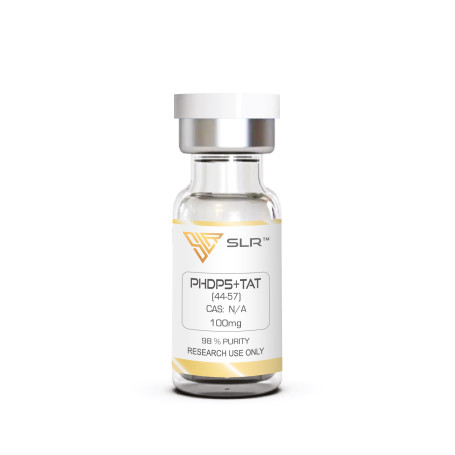
PHDP5+TAT (44-57) - 100mg
PHDP5 + TAT (44–57) is a synthetic peptide construct designed for advanced Alzheimer’s disease research, combining the PHDP5 sequence with a TAT cell-penetrating domain to enhance brain delivery and intracellular uptake. In preclinical Alzheimer’s disease models, PHDP5 has been reported to rescue learning and memory loss in Alzheimer’s disease, restoring cognitive performance to levels comparable to healthy controls. The mechanism is associated with inhibition of the pathological dynamin–microtubule interaction induced by tau, leading to recovery of synaptic vesicle endocytosis and neuronal communication. The addition of TAT (44–57) enables efficient penetration into brain tissue, including the hippocampus, following intranasal administration. While the peptide demonstrates strong effects on synaptic function and cognitive deficits in experimental Alzheimer’s models, its activity is primarily linked to tau-related dysfunction rather than direct amyloid plaque removal.
Description
SPECIFICATIONS
Product Code: PHT100D
Sequence: Glu-Lys-Lys-Tyr-Met-Leu-Ser-Val-Asp-Asn-Leu-Lys-Tyr-Gly-Arg-Lys-Lys-Arg-Arg-Gln-Arg-Arg-Arg
Modification: TAT cell-penetrating peptide conjugation
Molecular Formula: C154H260N58O37
Molecular Weight: 3.5 kDa
CAS: N/A
Purity: Technical / Research Grade ≥98%
Other details: No TFA Salt
Form: Lyophilized powder
Color: White
Storage temperature: -20°C
Source: Synthetic
Safety classification: Standard handling
DESCRIPTION
PHDP5 + TAT (44–57) is a modified synthetic peptide construct developed for advanced neurodegenerative research, combining the active PHDP5 sequence with the TAT (44–57) cell-penetrating peptide in order to improve delivery into brain tissue. The rationale behind this design is not generic peptide stabilization, but targeted functional delivery to the central nervous system, with the specific purpose of allowing the active peptide to reach neuronal structures involved in memory and synaptic transmission.
According to the Japanese preclinical studies, PHDP5 rescues learning and memory loss in Alzheimer’s disease models. In transgenic mouse models of Alzheimer’s disease and tauopathy, intranasal administration of the TAT-conjugated PHDP5 construct significantly improved spatial learning and memory performance, bringing treated animals close to wild-type control levels in Morris water maze testing. In practical terms, the peptide did not merely produce a mild laboratory signal, but was reported to reverse major deficits in learning and memory observed in diseased mice under controlled experimental conditions.
The mechanism described in the study is highly specific. In these models, abnormal tau accumulation promotes excessive microtubule assembly inside presynaptic terminals. This pathological process sequesters dynamin, a protein required for synaptic vesicle endocytosis. When dynamin is trapped by abnormal microtubule interactions, vesicle recycling becomes defective, synaptic transmission deteriorates, and neuronal communication begins to fail. Because efficient synaptic vesicle recycling is essential for learning and memory, this disruption has direct consequences on cognitive performance.
PHDP5 was developed to inhibit the pathological dynamin–microtubule interaction. By blocking this interaction, the peptide preserves the pool of free dynamin needed for vesicle endocytosis. In the published experimental work, this led to restoration of synaptic vesicle recycling, rescue of synaptic transmission, and subsequent improvement of learning and memory behavior in Alzheimer’s disease model mice. In other words, the peptide acts upstream at a mechanistic level, targeting one of the functional synaptic defects associated with tau-driven neurodegeneration.
This is why PHDP5 is particularly interesting: it is not presented merely as a generic “neuroprotective peptide,” but as a targeted modulator of a defined pathological interaction. The reported data indicate that the peptide can restore impaired endocytosis, rescue synaptic dysfunction, and reverse cognitive deficits in vivo, at least in the preclinical systems studied.
The role of the TAT (44–57) sequence is equally important. TAT is a well-known cell-penetrating peptide (CPP) rich in basic amino acids, especially arginine and lysine, which enhance binding to negatively charged cell-surface components and facilitate cellular uptake. In this construct, TAT was added specifically to increase penetration into cells and improve delivery to the brain. The Japanese group used this modification to allow intranasal administration and reported successful localization of the peptide in the hippocampal region, particularly in areas closely associated with memory processing. In functional terms, TAT gives PHDP5 the added value of brain accessibility, allowing the active peptide to reach the hippocampus more efficiently than the unmodified construct would be expected to do on its own.
So the contribution of TAT is not decorative or secondary. It provides a major delivery advantage:
- improved cell penetration
- enhanced intracellular uptake
- improved brain access after intranasal administration
- successful peptide detection in the hippocampus in preclinical models
This delivery improvement is one of the central reasons why the modified construct was able to produce strong in vivo effects on learning and memory in the animal studies. With regard to amyloid pathology, the available material you provided does not indicate that PHDP5 directly removes, dissolves, or clears amyloid plaques. The peptide was primarily developed around tau-related synaptic dysfunction and the dynamin–microtubule interaction. That said, in one of the mouse models used, the 3xTg-AD model, animals express not only tau-related pathology but also Alzheimer’s-associated amyloid-related genetic alterations. In that context, PHDP5 treatment still produced marked improvements in learning and memory performance. Therefore, the strongest and most defensible wording is that PHDP5 demonstrated significant functional cognitive rescue in Alzheimer’s disease models that include amyloid-related pathology, rather than claiming direct plaque removal.
So, to be explicit:
- PHDP5 has been reported to rescue learning and memory loss in Alzheimer’s disease model mice
- PHDP5 restores synaptic vesicle endocytosis and synaptic transmission impaired by tau-driven pathology
- PHDP5 works by inhibiting the pathological dynamin–microtubule interaction
- TAT (44–57) enhances brain delivery and cellular penetration, enabling the peptide to reach the hippocampus after intranasal administration
- PHDP5 showed strong behavioral improvement in transgenic Alzheimer’s models, including 3xTg-AD mice
- current evidence supports a strong effect on cognitive dysfunction and synaptic pathology, while direct amyloid plaque clearance has not been established in the material provided
From a research standpoint, this makes PHDP5 + TAT (44–57) a highly specialized peptide construct of interest for the study of:
- tau-related synaptic dysfunction
- Alzheimer’s disease model systems
- hippocampal delivery strategies
- restoration of learning and memory deficits
- modulation of dynamin-dependent vesicle endocytosis
- cell-penetrating peptide–assisted CNS delivery
Overall, the Japanese preclinical findings position PHDP5 + TAT (44–57) as a peptide construct with reported ability to restore impaired memory-related performance, rescue synaptic function, and achieve brain delivery through TAT-assisted penetration, making it particularly notable within advanced experimental Alzheimer’s disease research.
DISCLAIMER
This product is intended for lab research and development use only. These studies are performed outside of the body. This product is not medicines or drugs and has not been approved by the FDA or EMA to prevent, treat or cure any medical condition, ailment or disease. Bodily introduction of any kind into humans or animals is strictly forbidden by law. This product should only be handled by licensed, qualified professionals.
All product information provided on this website is for informational and educational purposes only.
Data sheet
| Image | Ref. | Unit price | Weight | Avail. | Buy |
|---|---|---|---|---|---|
 | PHT100D | €1,780.00 Discount by quantity 10+ €1,424.00 –20% 20+ €1,299.40 –27% 50+ €1,157.00 –35% 100+ €1,032.40 –42% 200+ €925.60 –48% | 0.000000 kg |  | |
| Total: 0,0 All prices with tax included. | |||||
Product is available Product is no longer in stock
 Product is no in stock, but is allowed to be back-ordered