
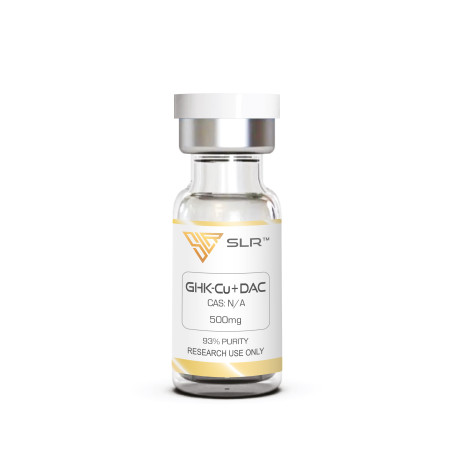
GHK-Cu + DAC - 500mg (Price on request)
Made to Order Compound ✦ Price available upon request. For inquiries: contactus
GHK-Cu with DAC is a modified version of the well-characterized copper tripeptide Gly-His-Lys (GHK), in which the peptide is conjugated with a stabilizing Maleimide-β-Ala linker designed to influence its persistence and interaction dynamics in experimental settings. Native GHK-Cu has been extensively studied for its involvement in tissue remodeling, extracellular matrix regulation, and cellular signaling processes.
The addition of a DAC-type linker is intended to enhance the stability of the peptide and extend its functional presence in biological systems, allowing for more sustained interaction with target pathways under controlled research conditions. This modification does not alter the core peptide sequence but may influence how the compound behaves in terms of degradation resistance, distribution, and temporal activity profile.
In laboratory and preclinical research, GHK-Cu has been associated with modulation of gene expression related to skin structure, cellular repair, inflammatory signaling, and oxidative balance. The DAC-conjugated form is therefore investigated as an extended-activity variant, suitable for studies requiring prolonged exposure and more stable peptide dynamics.
All observations related to GHK-Cu and its modified forms derive from in vitro systems, animal studies, or other experimental models and are intended exclusively for scientific research purposes.
Description
SPECIFICATIONS
Product Code: GCD500D
Sequence: Gly-His-Lys (GHK)
Complex: Copper(II) Complex
Modification: DAC-conjugated (Maleimide-β-Ala linker)
Molecular Formula: N/A (complex copper peptide conjugate)
Molecular Weight: N/A (to be confirmed)
CAS: N/A
Purity: Technical / Research Grade ≥93%
Other Details: No TFA Salt
Form: Lyophilized powder
Color: Blue
Storage Temperature: -20°C
Source: Synthetic
Safety Classification: Standard laboratory handling
DESCRIPTION
GHK-Cu with DAC is a modified form of the naturally occurring copper tripeptide complex composed of glycine, histidine, and lysine bound to copper, further engineered through the introduction of a DAC (Drug Affinity Complex or stabilizing moiety) designed to influence its pharmacokinetic behavior in experimental settings.
Native GHK-Cu is present in human plasma and has been widely studied for its role in cellular signaling, tissue remodeling, and extracellular matrix regulation. Circulating levels of endogenous GHK-Cu have been reported to decline with age, a phenomenon that has been observed in parallel with reductions in regenerative capacity across various biological systems.
The addition of DAC represents a structural modification aimed at altering the stability and persistence of the peptide under experimental conditions. While native GHK-Cu is characterized by a relatively short biological half-life due to rapid enzymatic degradation, DAC conjugation is designed to increase molecular stability and extend the duration of interaction with biological systems. This modification may allow for more sustained exposure of target tissues to the peptide in controlled research environments.
From a molecular standpoint, DAC attachment can influence several key parameters, including resistance to proteolytic degradation, altered distribution kinetics, and prolonged availability within extracellular and intracellular compartments. These characteristics are commonly explored in peptide engineering to enhance experimental consistency and reproducibility when studying bioactive compounds.
Experimental investigations across multiple laboratories have associated GHK-Cu with a broad range of biological activities in research settings. These include involvement in wound-healing processes, immune cell recruitment, antioxidant and anti-inflammatory signaling, stimulation of collagen and glycosaminoglycan synthesis in dermal fibroblasts, and support of angiogenesis-related pathways. The presence of DAC does not alter the fundamental peptide sequence but is intended to modulate how long and how effectively the peptide can exert its activity within experimental systems.
Gene-expression analyses indicate that GHK-Cu may influence the regulation of numerous genes associated with tissue remodeling, cellular defense, and extracellular matrix maintenance. These findings suggest a broad modulatory role at the molecular level under experimental conditions. The extended stability provided by DAC may allow researchers to observe these regulatory effects over longer time frames, potentially improving the ability to study temporal dynamics of gene expression.
Cosmetic and Skin Research Applications
GHK-Cu has been extensively studied in dermatological and cosmetic research. Controlled topical studies have reported associations with improvements in skin firmness, elasticity, wrinkle appearance, and overall skin quality. Histological evaluations in research contexts have indicated increased collagen markers and enhanced keratinocyte proliferation following topical exposure.
The DAC-modified version may be explored in experimental formulations where prolonged peptide presence is desirable, potentially supporting extended interaction with dermal structures under controlled conditions.
- Improved skin elasticity and firmness
- Increased dermal density markers
- Reduction in the appearance of fine lines
- Improved skin clarity and tone uniformity
- Enhanced keratinocyte proliferation
Hair Follicle Research
GHK-Cu and related analogues have been studied in experimental models examining hair follicle biology. Some laboratory findings suggest stimulation of pathways involved in follicular activity and dermal papilla signaling. The addition of DAC may allow for extended exposure in research systems designed to study time-dependent follicular responses.
Cancer-Related Research
In vitro studies have reported that GHK-Cu may influence gene expression patterns associated with metastatic behavior in colon cancer models. These observations support investigation of the peptide as a regulator of multiple biochemical pathways in experimental oncology research. The DAC modification may enhance the consistency of exposure during long-term cellular assays.
Stem Cell and Regenerative Research
Laboratory studies have demonstrated that GHK-Cu stimulates keratinocyte proliferation and increases expression of integrins and p63 protein in epidermal stem cells. Since p63 is associated with stem cell function, these findings suggest potential involvement in regenerative signaling pathways under experimental conditions. Prolonged peptide availability through DAC conjugation may support studies focused on sustained cellular activation and differentiation.
Nerve Regeneration Research
Experimental models have reported associations between GHK exposure and increased expression of nerve growth-related factors, integrins, and regeneration of myelinated nerve fibers when delivered via collagen-based systems. DAC-modified variants may be used in experimental settings requiring extended peptide presence to evaluate long-term neuronal responses.
Fibroblast and Cellular Stress Research
In vitro investigations indicate that GHK-Cu may support recovery of human fibroblasts exposed to oxidative or radiation-related stress. These observations suggest involvement in cellular repair and defense mechanisms. Enhanced stability via DAC may allow for prolonged interaction with stressed cellular systems, facilitating extended observation of recovery dynamics.
Inflammation and Wound Repair Research
Wound-healing models involve coordinated inflammatory signaling, cell proliferation, migration, and extracellular matrix remodeling. In laboratory studies, GHK-Cu reduced TNF-α–induced IL-6 secretion in dermal fibroblasts, indicating modulation of inflammatory pathways. The DAC modification may support sustained modulation of these pathways in extended experimental timelines.
DNA Repair Research
Experimental data suggest that GHK may restore viability in irradiated fibroblast models. These findings support investigation into DNA repair-related and genomic regulatory pathways under laboratory conditions. DAC conjugation may provide extended exposure windows for studying DNA repair mechanisms over time.
Pharmacokinetic and Stability Considerations of DAC
The primary purpose of DAC conjugation in peptide systems is to influence pharmacokinetic behavior. In research settings, DAC-modified peptides are often evaluated for:
- Increased resistance to enzymatic degradation
- Prolonged presence in biological environments
- More stable concentration profiles over time
- Reduced need for frequent re-exposure in experimental protocols
These characteristics can be particularly relevant in studies where transient peptide activity may limit the ability to observe cumulative or long-term biological effects. By extending the functional window of the peptide, DAC modification allows for a more continuous interaction with cellular pathways under investigation.
Conclusion (Research Context)
Overall, GHK-Cu with DAC represents a structurally modified form of a well-characterized endogenous peptide complex, designed to enhance stability and extend functional persistence in experimental systems. While the core biological properties of GHK-Cu remain central to its activity, the addition of DAC introduces an additional layer of control over exposure dynamics, making it a valuable tool for studying prolonged peptide interactions across a range of biological processes.
All observations described above originate from in vitro systems, animal studies, or other preclinical research contexts and are intended exclusively for scientific investigation
DISCLAIMER
This product is intended strictly for laboratory research and development use only. This material is not a medicine or drug and has not been approved by the FDA, EMA, or any regulatory authority for the prevention, treatment, or cure of any disease. Bodily introduction into humans or animals is strictly prohibited. Handling is restricted to qualified laboratory professionals.
All product information provided on this website is for informational and educational purposes only.
Data sheet
| Image | Ref. | Weight |
|---|---|---|
 | GCD500D | 0.000000 kg |