
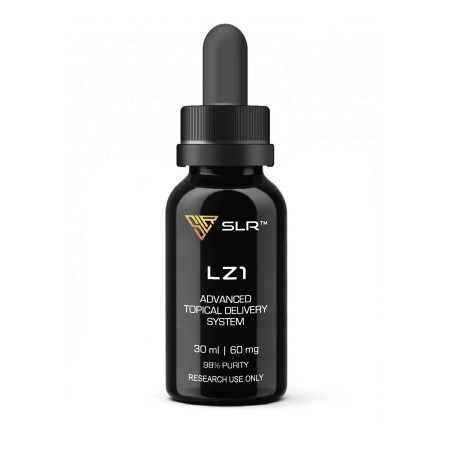
LZ1 - 30ml/60mg (Price on request)
Made to Order Compound ✦ Price on Request. Contact us
LZ1 is characterized as a 15-residue cationic antimicrobial peptide with:
- Strong activity against Gram-positive skin pathogens and certain antibiotic-resistant strains
- Negligible hemolytic activity and low cytotoxicity toward keratinocytes
- Observed anti-inflammatory effects through modulation of TNF-α and IL-1β pathways
- Documented antimalarial activity associated with inhibition of parasite energy metabolism
These properties make LZ1 a relevant compound for experimental research in antimicrobial mechanisms, inflammatory signaling, and skin biology.
Description
ADVANCED DELIVERY SYSTEM - STRUCTURED CARRIER TECHNOLOGY
This product utilizes a structured topical delivery architecture integrating membrane-interactive carrier matrices with controlled CPP-assisted transport modulation. The formulation is engineered according to the physicochemical profile of the research compound to support membrane interaction, diffusion behavior, and preservation of molecular integrity.
SPECIFICATIONS
Product Code: LZ1060D
Sequence: al-Lys-Arg-Trp-Lys-Lys-Trp-Trp-Arg-Lys-Trp-Lys-Lys-Trp-Val-NH₂
Molecular Formula: C113H167N33O15
Molecular Weight: ~2227,75 g/mol
CAS: 1423743-97-8
Purity: Technical / Research Grade ≥98%
Form: Liquid Solution
Color: Clear to slightly opalescent
Total Content: 30 mL / 60 mg
Concentration: 2 mg/mL
Vehicle / Carrier System: Proprietary carrier system
Storage Temperature: 4°C (Do not freeze)
Source: Synthetic
Safety Classification: Standard laboratory handling
DESCRIPTION
LZ1 is a synthetic cationic antimicrobial peptide (AMP) composed of 15 amino acids, originally designed as a derivative of a snake cathelicidin. The high content of lysine, arginine, and tryptophan gives LZ1 a strongly cationic and amphipathic structure, typical of α-helical peptides capable of interacting with microbial membranes.
Antimicrobial Spectrum
In vitro studies indicate that LZ1 exhibits broad-spectrum antibacterial activity, with particular effectiveness against Gram-positive bacteria. It demonstrates strong bactericidal activity against acne-associated pathogens such as Cutibacterium acnes (formerly Propionibacterium acnes), Staphylococcus epidermidis, and Staphylococcus aureus, with relatively low minimum inhibitory concentrations (MICs).
The mechanism of action is consistent with typical cationic AMPs: the positively charged residues promote electrostatic interaction with negatively charged bacterial membranes, followed by insertion of the hydrophobic face of the α-helix and disruption of membrane integrity.
LZ1 has also shown activity against antibiotic-resistant strains, including methicillin-resistant Staphylococcus aureus (MRSA), and demonstrates anti-biofilm effects as well as potential synergy with conventional antibiotics in certain experimental models. Importantly, LZ1 shows minimal hemolytic activity and low cytotoxicity toward human keratinocytes at concentrations relevant for antimicrobial activity.
Anti-Inflammatory Activity
Beyond direct antimicrobial effects, LZ1 has been observed to exert anti-inflammatory activity. In experimental acne models, LZ1 reduces the secretion of key pro-inflammatory cytokines such as tumor necrosis factor-alpha (TNF-α) and interleukin-1 beta (IL-1β) in response to Cutibacterium acnes.
This dual activity—targeting acne-associated bacteria while modulating inflammatory signaling—makes LZ1 a compound of interest in studies investigating inflammatory pathways in acne-related conditions. In systemic infection models, such as Plasmodium berghei–infected mice, LZ1 administration has been associated with reduced parasitemia and attenuation of infection-related inflammation, along with mitigation of liver function impairment, suggesting broader immunomodulatory effects in experimental settings.
Antimalarial Mechanism
LZ1 has also been investigated for antimalarial activity. In vitro studies show that it suppresses the asexual blood stage of Plasmodium falciparum, with an IC50 of approximately 3.045 μM. In murine models infected with Plasmodium berghei, LZ1 has been associated with reductions in parasitemia and prolonged survival in a dose- and time-dependent manner.
Mechanistic investigations indicate that LZ1 may selectively inhibit ATP production in parasite-infected erythrocytes by targeting pyruvate kinase activity, while sparing non-infected red blood cells. This suggests that its mechanism involves disruption of parasite metabolic processes rather than nonspecific host cell membrane damage.
Applications in Experimental Skin Biology
In experimental skin biology, LZ1 is primarily studied in models of inflammatory acne and infection-related skin inflammation. Its combined bactericidal and cytokine-modulating effects against Cutibacterium acnes and staphylococcal species make it a useful tool for investigating the interaction between skin microbiota, innate immune responses, and keratinocyte signaling pathways.
Technical and vendor literature also highlight potential applications in skincare-oriented experimental formulations aimed at improving skin condition in the presence of acne-associated bacteria and inflammation. However, these applications remain exploratory and are based on the peptide’s documented antimicrobial and anti-inflammatory profiles
REFERENCES
All information presented above is derived from in vitro experiments, animal studies, and other preclinical research models. These data are intended solely for basic scientific investigation of biological mechanisms and do not imply any therapeutic, diagnostic, preventive, or clinical use in humans or animals.
Y. Fang et al., "In Vitro and In Vivo Antimalarial Activity of LZ1, a Peptide Derived from Snake Cathelicidin" [PubMed]
Z. Zhang et al., "A Small Peptide with Therapeutic Potential for Inflammatory Acne Vulgaris" [PubMed]
A. Lesiak et al., "Significance of host antimicrobial peptides in the pathogenesis and treatment of acne vulgaris" [PMC]
DISCLAIMER
This product is intended for laboratory research and development use only. It is not a medicine or drug and has not been approved by the FDA or EMA to prevent, treat, or cure any medical condition. Bodily introduction into humans or animals is strictly prohibited. This product must be handled by qualified professionals.
All information provided is for educational and informational purposes only.
Data sheet
| Image | Ref. | Weight |
|---|---|---|
 | LZ1060D | 0.000000 kg |