
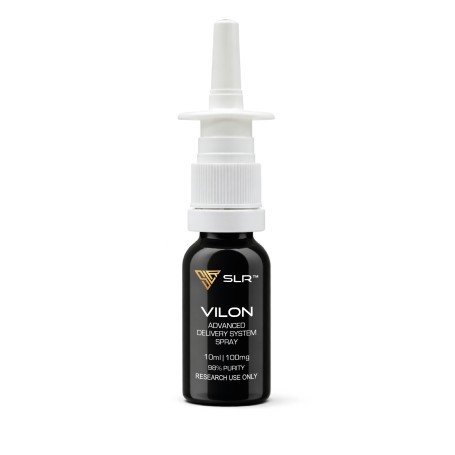
VILON - 10ml/100mg - Spray
Vilon is a thymus-derived bioregulatory peptide commonly described as the dipeptide Lys–Glu (KE). It is studied for its potential immune-modulating effects, particularly in the context of thymus-related immune function and T-cell regulation. Research suggests Vilon may support immune cell differentiation, normalize cytokine signaling, and contribute to immune homeostasis. These properties make it relevant in studies involving immunosenescence, age-related immune decline, chronic inflammation, infection susceptibility, and immune dysfunction. By supporting balanced immune regulation rather than excessive stimulation, Vilon has become a peptide of interest in research focused on immune resilience, systemic vitality, and longevity-related immune restoration.
FRESHLY PREPARED SOLUTION
Description
ADVANCED DELIVERY SYSTEM - CELL PENETRATING PEPTIDE TECHNOLOGY
This product utilizes advanced delivery technology incorporating calibrated cell-penetrating peptide (CPP) systems. The formulation is engineered to support efficient and targeted intracellular delivery of active ingredients, contributing to enhanced transport performance and bioavailability.
SPECIFICATIONS
Product Code: VIL100S
Sequence: H-Lys-Glu-OH
Molecular Formula: C11H21N3O5
Molecular Weight: 257.30 g/mol
CAS: 45234-02-4
Purity: Technical / Research Grade ≥98%
Other Details: No TFA Salt
Form: Liquid Solution
Color: Clear / Slightly opalescent
Total Content: 10 mL / 100 mg
Concentration: 10 mg/mL
Approximate Sprays per Bottle: ~82
Approximate Peptide per Spray: ~1.22 mg
Vehicle / Carrier System: Proprietary carrier system
Storage Temperature: 4°C (Do not freeze)
Source: Synthetic
Safety classification: Standard handling.
DESCRIPTION
Vilon is a short thymus-derived bioregulatory peptide that has attracted significant scientific interest due to its potential role in supporting immune system balance, cellular resilience, and age-related immune restoration. It belongs to the family of peptide bioregulators originally studied in the context of thymic function and immune signaling. Vilon is typically described as a small peptide with the sequence Lys–Glu, and it is often discussed as an analogue or simplified form of thymus-derived peptide complexes.
Because the thymus plays a central role in immune development and immune system coordination, peptides derived from thymic tissues have been widely investigated for their ability to influence immune cell differentiation, cytokine balance, and adaptive immune competence. Vilon has therefore become a peptide of growing interest in research involving immune aging, chronic inflammation, infection susceptibility, and systemic decline associated with weakened immune regulation.
The thymus and immune system regulation
The thymus is one of the most important organs of the immune system, responsible for the maturation and differentiation of T lymphocytes (T-cells). T-cells are essential for immune memory, immune surveillance, and regulation of immune responses against viruses, bacteria, and abnormal cellular growth.
During early life, thymic activity is high, producing large numbers of functional T-cells. However, thymic tissue naturally undergoes progressive involution with age, meaning it gradually decreases in size and functional output. This age-related thymic decline is strongly linked to reduced immune competence, increased infection risk, weaker vaccine responsiveness, and increased systemic inflammation.
Because of this, thymus-derived peptides such as Vilon have been explored as potential biological regulators capable of supporting immune system balance and improving immune function under conditions of age-related immune decline.
Mechanism of action and cellular activity
Vilon is discussed in peptide bioregulation research as a peptide capable of influencing gene regulatory and intracellular signaling mechanisms that control immune function. Short peptides such as Lys–Glu are often proposed to act at a fundamental level by modulating transcriptional activity and influencing the synthesis of proteins involved in immune cell development and inflammatory regulation.
In bioregulator theory, Vilon is believed to function as a signaling molecule that may enhance communication between immune cells and support immune system coordination. Rather than acting as a stimulant that forces immune activation, Vilon is typically described as a modulator, meaning it may contribute to restoring immune balance when immune signaling becomes impaired.
Research suggests that such peptides may support:
- differentiation and maturation of immune cells
- restoration of thymus-related immune signaling
- regulation of cytokine production
- improvement of immune surveillance mechanisms
Because cytokines and immune cell signaling determine the balance between effective defense and harmful inflammation, this regulatory profile is considered highly relevant in both aging and chronic inflammatory conditions.
Immune aging and immunosenescence research
One of the most important research areas for Vilon involves immunosenescence, the gradual decline of immune efficiency with age. Immunosenescence is characterized by reduced T-cell production, impaired immune memory, chronic low-grade inflammation, and weakened response to infections.
This decline contributes not only to increased infection susceptibility, but also to higher risk of inflammatory degeneration, slower tissue repair, and reduced ability to eliminate abnormal or damaged cells. Because Vilon is associated with thymus-related signaling pathways, it has been explored as a peptide that may support immune rejuvenation by enhancing immune cell differentiation and improving immune system coordination. These properties have made Vilon relevant in research focused on healthy aging, immune resilience, and reduction of age-associated immune dysfunction.
Inflammation regulation and cytokine balance
Chronic inflammation is increasingly recognized as a key driver of aging-related degeneration. Persistent inflammatory signaling contributes to vascular damage, metabolic dysfunction, neuroinflammation, and tissue fibrosis. Many chronic disorders, including cardiovascular disease, metabolic syndrome, and autoimmune-related conditions, involve excessive cytokine production and immune imbalance.
Vilon has been studied in contexts involving cytokine regulation, where its activity may help normalize inflammatory mediator output and support a more balanced immune response. By influencing immune signaling cascades, Vilon may reduce excessive inflammatory activity while preserving the immune system’s ability to respond effectively to pathogens.
This immune-balancing profile is particularly important because overactivation of the immune system can be just as damaging as immune suppression. Therefore, peptides capable of supporting immune regulation rather than simply increasing immune activation are considered valuable in inflammatory research models.
Infection susceptibility and immune defense research
Because T-cell activity is critical for controlling viral infections and coordinating adaptive immune responses, Vilon has been explored in research involving immune defense enhancement. Reduced thymic output and weakened adaptive immunity can lead to prolonged infections and reduced immune memory formation.
By supporting thymus-related immune function, Vilon has been discussed as a peptide potentially relevant in research involving:
- viral infection susceptibility
- weakened immune response to bacterial pathogens
- reduced immune recovery after illness
- immune exhaustion and chronic immune stress
In these contexts, Vilon is considered of interest not as a direct antimicrobial compound, but as a regulatory peptide that may improve immune responsiveness through improved cellular coordination.
Autoimmune-related research interest
Autoimmune disorders involve immune dysregulation, where immune cells mistakenly target healthy tissues. In many autoimmune conditions, immune signaling becomes imbalanced, with excessive inflammatory cytokine production and reduced regulatory control.
Because thymus-derived peptides are closely connected to immune system maturation and tolerance mechanisms, Vilon has been explored in immune balance research related to autoimmune conditions. The thymus is essential for establishing immune tolerance, and peptides influencing thymus signaling are therefore considered relevant in research exploring autoimmune-related immune dysfunction.
Although ongoing investigation is required, Vilon’s association with immune regulation has contributed to its relevance in studies focused on restoring immune balance rather than stimulating immune activity indiscriminately.
Tissue repair and systemic vitality research
Immune function is closely connected to tissue repair and regeneration. Inflammation is necessary for healing, but excessive inflammation can delay recovery and cause tissue damage. Because Vilon is discussed as a peptide capable of modulating immune signaling and cytokine production, it has been considered relevant in research contexts involving recovery from injury and restoration of systemic vitality.
Age-related immune decline often contributes to slower wound healing and increased vulnerability to chronic tissue degeneration. By supporting immune homeostasis, Vilon may indirectly contribute to improved tissue resilience and regenerative capacity.
Neuroimmune and systemic aging research
The immune system and nervous system are strongly interconnected. Chronic immune activation can contribute to neuroinflammation, cognitive decline, and altered neurotransmitter regulation. This is one of the reasons why immune-aging peptides have become relevant in broader longevity research.
Vilon has therefore been discussed as a peptide potentially relevant in neuroimmune aging contexts, where restoration of immune balance may reduce systemic inflammatory burden and contribute to improved long-term physiological stability.
Research perspective
Vilon is widely recognized as a compact thymus-derived bioregulator peptide with potential relevance in immune aging research and systemic inflammation regulation. Its small structure suggests a stable and highly targeted signaling profile, and its association with thymic immune pathways makes it particularly relevant in studies involving T-cell regulation, cytokine balance, and immune resilience.
As research into peptide bioregulators expands, Vilon continues to be investigated as a candidate for supporting immune homeostasis in aging-related decline and chronic inflammatory conditions. Its role as a modulator rather than a direct immune stimulant has positioned it as a peptide of interest in research focused on immune optimization and systemic longevity biology.
REFERENCES
All information presented above is derived from in vitro experiments, animal studies, and other preclinical research models. These data are intended solely for basic scientific investigation of biological mechanisms and do not imply any therapeutic, diagnostic, preventive, or clinical use in humans or animals.
V.K. Khavinson et al., "Effect of vilon on biological age and lifespan in mice" [PubMed]
T. Lezhava et al., "Bioregulator Vilon-induced reactivation of chromatin in cultured lymphocytes from old people" [PubMed]
N.N. Sevostianova et al., "Immunomodulating effects of Vilon and its analogue in the culture of human and animal thymus cells" [PubMed]
V.K. Khavinson et al., "Effect of vilon and epithalon on activity of enzymes in epithelial and subepithelial layers in small intestine of old rats" [PubMed]
V.K. Khavinson et al., "Immunohistochemical and morphometric analysis of effects of vilon and epithalon on functional morphology of radiosensitive organs" [PubMed]
S.V. Anisimov et al., "Studies of the effects of Vilon and Epithalon on gene expression in mouse heart using DNA-microarray technology" [PubMed]
I.V. Kniaz'Kin et al., "The effect of vilon on the thymus and spleen in a radiation model of premature aging" [PubMed]
N.A. Gavrisheva et al., "Effect of peptide Vilon on the content of transforming growth factor-beta and permeability of microvessels during experimental chronic renal failure" [PubMed]
V.K. Khavinson et al., "Effect of Vilon and Epithalon on glucose and glycine absorption in various regions of small intestine in aged rats" [PubMed]
B.I. Kuznik et al., "Effect of vilon on the immunity status and coagulation hemostasis in patients of different age with diabetes mellitus" [PubMed]
F. Avolio et al., "Peptides Regulating Proliferative Activity and Inflammatory Pathways in the Monocyte/Macrophage THP-1 Cell Line" [MDPI]
V.K. Khavinson et al., "A synthetic dipeptide vilon (L-Lys-L-Glu) inhibits growth of spontaneous tumors and increases life span of mice" [PubMed]
G.B. Pliss et al., "Effect of vilon and epithalone on induction and growth of induced bladder neoplasms in rats" [PubMed]
M.V. Kudriavtseva et al., "Effect of "vilon" on cirrhotically changed rat liver. Liver regeneration, and status of glycogen-forming function of hepatocytes" [PubMed]
E.V. Koplik et al., "Effect of dipeptide vilon on emotional stress resistance in rats" [PubMed]
S.K. Araj et al., "Overview of Epitalon—Highly Bioactive Pineal Tetrapeptide with Promising Properties" [PMC]
DISCLAIMER
This product is intendend for lab research and development use only. These studies are performed outside of the body. This product is not medicines or drugs and has not been approved by the FDA or EMA to prevent, treat or cure any medical condition, ailment or disease. Bodily introduction of any kind into humans or animals is strictly forbidden by law. This product should only be handled by licensed, qualified professionals.
All product information provided on this website is for informational and educational purposes only.
Data sheet
| Image | Ref. | Unit price | Weight | Avail. | Buy |
|---|---|---|---|---|---|
 | VIL100S | €249.00 Discount by quantity 10+ €199.20 –20% 20+ €174.30 –30% 50+ €154.38 –38% 100+ €139.44 –44% 200+ €124.50 –50% | 0.000000 kg |  | |
| Total: 0,0 All prices with tax included. | |||||
Product is available Product is no longer in stock
 Product is no in stock, but is allowed to be back-ordered