
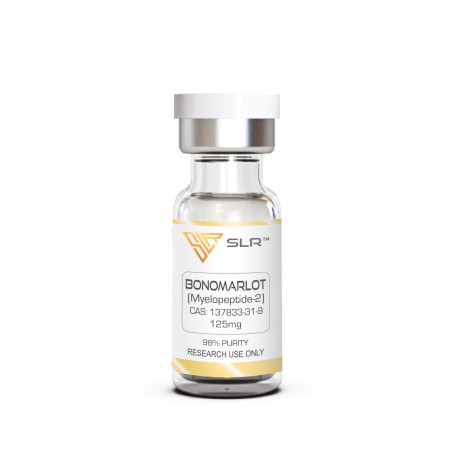
BONOMARLOT (Myelopeptide-2) - 125mg
Summary
Bonomarlot, also known as Myelopeptide-2 (MP-2), is a synthetic hexapeptide derived from bone marrow peptides and studied for its immunomodulatory properties in experimental settings. It has demonstrated the ability to restore T-lymphocyte proliferation and normalize key surface markers such as CD3 and CD4 under conditions of immune suppression induced by tumor-derived factors. These effects suggest a role in supporting cellular signaling pathways involved in T-cell activation and functional recovery. Due to its small size and hydrophobic composition, MP-2 may interact efficiently with cellular membranes and protein interfaces, contributing to its biological activity. Current data are limited to preclinical research models, where MP-2 is used as a tool to investigate immune regulation, cellular recovery mechanisms, and tumor-associated immunosuppression.
Description
SPECIFICATIONS
Product Code: BNM125
Other name: Myelopeptide-2
Sequence:: Leu-Val-Val-Tyr-Pro-Trp
Molecular Formula: C41H57N7O8
Molecular Weight: 775.93g/mol
CAS: 137833-31-9
Purity: Technical / Research Grade 98%
Other details: No TFA Salt, Contains DMSO (process-related)
Form: Lyophilized powder
Color: White
Storage temperature: -20°C
Source: Synthetic
Safety classification: Standard handling
DESCRIPTION
Bonomarlot, also known as Myelopeptide-2 (MP-2) is a synthetic hexapeptide with the sequence Leu-Val-Val-Tyr-Pro-Trp, originally identified in the supernatant of porcine bone marrow cell cultures. It belongs to a class of short regulatory peptides known as myelopeptides, which are studied for their potential role in modulating immune cell function and intercellular signaling within the hematopoietic and immune systems. From a structural perspective, MP-2 is characterized by a high content of hydrophobic amino acids, including leucine and valine, as well as the presence of aromatic residues such as tyrosine and tryptophan. This composition suggests a strong propensity for interacting with cellular membranes and protein interfaces, particularly in environments where hydrophobic interactions play a critical role. The presence of proline introduces conformational rigidity, which may influence the peptide’s spatial configuration and its ability to engage specific molecular targets.
MP-2 has been primarily investigated in experimental models focusing on immune regulation, particularly in the context of T-lymphocyte function. T cells are central components of the adaptive immune system, responsible for recognizing and responding to antigenic stimuli. Their activity can be significantly altered by factors released by tumor cells or other pathological conditions, leading to impaired immune responsiveness. In controlled in vitro studies, MP-2 has demonstrated the ability to modulate T-lymphocyte activity in environments where immune function is suppressed. Specifically, conditioned media derived from HL-60 leukemia cells has been shown to inhibit the proliferative response of human T lymphocytes stimulated with mitogens such as phytohemagglutinin (PHA). This type of suppression reflects mechanisms by which tumor cells can alter immune surveillance and reduce the effectiveness of immune responses.
When MP-2 is introduced into this experimental system, it has been observed to restore the proliferative capacity of T lymphocytes in a dose-dependent manner. This suggests that the peptide may counteract inhibitory signals or restore signaling pathways required for T-cell activation and division. The dose-dependent nature of this effect indicates a direct relationship between peptide concentration and the degree of functional recovery observed in immune cells. An important observation from these studies is that MP-2 appears to exert a recovery effect rather than a purely protective one. When T lymphocytes are first exposed to inhibitory factors and then treated with MP-2, the peptide is still able to restore their functional responsiveness. This indicates that MP-2 may influence intracellular signaling pathways or cellular states that have already been altered, rather than simply preventing the initial suppression.
Flow cytometry analysis has provided further insights into the effects of MP-2 on T-cell phenotype. Exposure to tumor-derived conditioned media has been associated with a reduction in the expression of key surface markers such as CD3 and CD4, which are essential for T-cell activation and immune function. In addition to reducing the number of CD3- and CD4-positive cells, the conditioned media induces the appearance of T lymphocytes with decreased receptor density, indicating a functional impairment at the cellular level. MP-2 has been shown to restore the expression of these surface markers, effectively reversing the phenotypic changes induced by tumor-derived factors. This suggests that the peptide may play a role in maintaining or re-establishing normal T-cell identity and functionality in experimental systems where immune cells are exposed to suppressive environments.
From a mechanistic standpoint, the exact molecular pathways through which MP-2 exerts its effects are still under investigation. However, several hypotheses have been proposed based on its observed activity. These include modulation of signaling cascades involved in T-cell activation, influence on receptor expression and stability, and potential interactions with membrane-associated proteins or intracellular signaling components. The ability of MP-2 to restore immune cell responsiveness in suppressed conditions makes it a valuable tool in research focused on immune dysfunction. This includes studies related to tumor-induced immunosuppression, where cancer cells release factors that inhibit immune cell activity, as well as broader investigations into immune regulation and cellular communication within the hematopoietic system.
In addition to its effects on T lymphocytes, MP-2 may also be relevant in studies exploring the interaction between bone marrow-derived factors and systemic immune function. The bone marrow is a central organ in the production and regulation of immune cells, and peptides derived from this environment may reflect endogenous regulatory mechanisms that influence immune homeostasis. The comparison between MP-2 and other myelopeptides, such as MP-1, further highlights the specificity of its activity. While both peptides originate from similar biological sources, MP-1 does not demonstrate the same ability to restore T-cell proliferation in the described experimental model. This suggests that small differences in amino acid sequence can lead to significant variations in biological activity, emphasizing the importance of structural features in determining peptide function.
MP-2 is also of interest in the study of cellular recovery mechanisms. The concept of restoring function in already impaired cells is distinct from simply protecting healthy cells from damage. This distinction is particularly relevant in experimental models of immune suppression, where the ability to reverse functional impairment can provide insights into therapeutic strategies and cellular resilience. In research contexts, MP-2 may be explored for its influence on:
- T-lymphocyte activation and proliferation
- immune cell signaling pathways
- restoration of immune function under suppressive conditions
- modulation of surface receptor expression
- interaction between tumor-derived factors and immune cells
It may also contribute to the understanding of how short peptides derived from physiological sources can influence complex biological systems. The study of such peptides provides insight into natural regulatory mechanisms and how they can be mimicked or modulated in experimental settings. The physicochemical properties of MP-2, including its hydrophobicity and small size, may also affect its distribution and interaction within biological systems. These characteristics can influence how the peptide associates with cellular membranes, penetrates tissues, or interacts with proteins, all of which are important considerations in experimental design.
It is important to note that all data related to MP-2 are derived from preclinical research, including in vitro studies and controlled experimental models. The peptide is used exclusively as a research compound to investigate biological mechanisms and does not represent an approved therapeutic agent. Ongoing research continues to explore the broader implications of MP-2 activity, including its role in immune modulation, cellular recovery processes, and the interaction between immune cells and their microenvironment. These studies aim to better understand how small peptide molecules can influence cellular behavior and contribute to the regulation of complex biological systems.
In summary, Myelopeptide-2 (MP-2) is a bone marrow-derived hexapeptide characterized by its ability to modulate T-lymphocyte function in experimental models of immune suppression. Its capacity to restore proliferative responses and normalize surface marker expression highlights its relevance in research focused on immune regulation, cellular recovery, and tumor-associated immune dysfunction
REFERENCES
All information presented above is derived from in vitro experiments, animal studies, and other preclinical research models. These data are intended solely for basic scientific investigation of biological mechanisms and do not imply any therapeutic, diagnostic, preventive, or clinical use in humans or animals.
L.A. Strelkov et al., "The bone marrow peptide (myelopeptide-2) abolishes induced by human leukemia HL-60 cell suppression of T lymphocytes" [ScienceDirect]
A.A. Mikhailova et al., "Myelopeptide-2 recovers interleukin-2 synthesis and interleukin-2 receptor expression in human T lymphocytes depressed by tumor products or measles virus" [PubMed]
A.A. Mikhailova et al., "Immunoregulatory effects of two bone-marrow hexapeptides (myelopeptides) in experimental models of immunodeficiency" [PubMed]
R.V. Petrov et al., "Bone marrow immunoregulatory peptides (myelopeptides): isolation, structure, and functional activity" [PubMed]
R. Petrov "Myelopeptides: new immunoregulatory peptides" [PubMed]
L.A. Fonina et al., "Synthesis and Properties of the retro-Analogue of Myelopeptide MP-2" [Springer Nature]
L. Baktybayeva et al., "Targeting Leukopoiesis: Pharmacological and Biotechnological Strategies for the Treatment of Leukopenia" [MDPI]
DISCLAIMER
This product is intendend for lab research and development use only. These studies are performed outside of the body. This product is not medicines or drugs and has not been approved by the FDA or EMA to prevent, treat or cure any medical condition, ailment or disease. Bodily introduction of any kind into humans or animals is strictly forbidden by law. This product should only be handled by licensed, qualified professionals.
All product information provided on this website is for informational and educational purposes only.
Data sheet
| Image | Ref. | Unit price | Weight | Avail. | Buy |
|---|---|---|---|---|---|
 | BNM125 | €248.00 Discount by quantity 10+ €210.80 –15% 20+ €178.56 –28% 50+ €148.80 –40% 100+ €131.44 –47% 200+ €114.08 –54% | 0.000000 kg |  | |
| Total: 0,0 All prices with tax included. | |||||
Product is available Product is no longer in stock
 Product is no in stock, but is allowed to be back-ordered