
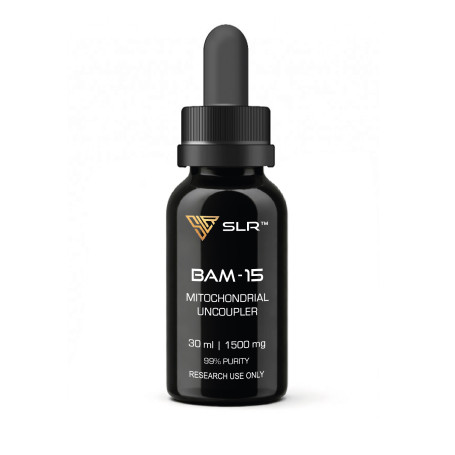
BAM-15 - 30ml/1500mg
Description
SPECIFICATIONS
Product Code: B15030S
Molecular Formula: C16H10N6O
Molecular Weight: 340.29 g/mol
CAS: 210302-17-3
Purity: Technical / Research Grade ≥99%
Form: Liquid Solution
Color: Clear / Slightly opalescent
Total Content: 30 mL / 30 mg
Concentration: 1 mg/mL
Vehicle / Carrier System: Proprietary carrier system
Storage Temperature: 4°C (Do not freeze)
Source: Synthetic
Safety classification: Standard handling
DESCRIPTION
BAM-15 is a synthetic small-molecule research compound classified as a mitochondrial uncoupler. It belongs to a broader class of substances that act at the level of mitochondrial energy handling by partially separating cellular respiration from ATP production. Instead of directing the full proton gradient toward ATP synthesis, mitochondrial uncouplers allow part of that energy to be dissipated as heat. For this reason, BAM-15 has attracted research interest in fields related to energy metabolism, mitochondrial function, metabolic efficiency, and cellular stress adaptation.
According to the material provided, BAM-15 was reported in 2014 by an international research consortium and was described as a next-generation mitochondrial uncoupler identified through screening for compounds with improved properties compared with earlier uncoupling agents. Classical mitochondrial uncouplers have historically drawn attention because of their strong metabolic effects, but also because of their narrow therapeutic margin and significant safety concerns. In this context, BAM-15 has been investigated as a compound designed to retain mitochondrial uncoupling activity while reducing some of the undesirable off-target effects associated with earlier molecules.
The core mechanism of BAM-15 is linked to its ability to create a functional “shortcut” within mitochondria. Under normal conditions, mitochondrial respiration is tightly coupled to ATP synthesis. BAM-15 partially disrupts this coupling, causing mitochondria to consume substrates and oxygen while producing less usable ATP per unit of respiratory activity. This shift increases cellular energy demand and promotes a faster metabolic turnover. In practical research terms, this makes BAM-15 relevant for studies focused on mitochondrial respiration, caloric expenditure, lipid metabolism, and metabolic stress responses.
The attached material highlights that, in cell culture experiments, BAM-15 increased the maximum rate of mitochondrial respiration compared with FCCP, another widely used uncoupler of similar potency. This observation suggests that BAM-15 may support a higher maximal metabolic rate under experimental conditions. Additional cell-based studies described in the provided material also reported reduced production of pro-inflammatory substances in multiple experimental settings, further expanding interest in BAM-15 as a mitochondrial research compound with broader implications for cellular signaling and stress modulation.
Because mitochondrial uncouplers reduce the amount of efficiently captured energy available to the cell, they also influence how cells respond to high energy demand. This is one reason BAM-15 has been explored in preclinical studies related to metabolic regulation, inflammation, and highly active cell systems. The material also notes that some research groups have considered whether mitochondrial uncoupling could be relevant in settings involving rapidly proliferating cells, although the extent to which these findings may translate into broader applications remains uncertain and requires further study.
The animal research summarized in the images places particular emphasis on the metabolic effects of BAM-15. In the original publication referenced in the material, BAM-15 was reported to protect mice from kidney damage under specific experimental conditions, providing early evidence that the compound was biologically active in vivo. In dietary models, mice fed a high-calorie diet and treated with BAM-15 were reported to show protection against weight gain, along with favorable changes in body composition and glycemic control. The material also states that these effects appeared to occur independently of weight reduction alone, suggesting that BAM-15 may influence multiple aspects of metabolic physiology in preclinical settings.
Further animal work described in the images reported decreased serum inflammatory lipids, improved metabolic readouts, and beneficial effects on body weight, glucose tolerance, and serum lipid parameters in comparison with several other common metabolic interventions tested in mice. The attached content presents BAM-15 as particularly effective in reducing body weight and improving several markers associated with metabolic dysfunction in these experimental models.
The material also mentions preclinical observations suggesting a possible positive effect on age-related muscle loss in mice, with several biomarkers of muscle status reportedly improving after exposure in a high-fat-diet setting. This adds to the broader picture of BAM-15 as a compound of interest not only for metabolic efficiency, but also for the study of how mitochondrial function may influence tissue maintenance during aging or metabolic stress.
Another important area described in the provided material is the potential anti-inflammatory research interest surrounding BAM-15. The images note that mitochondrial uncoupling may reduce mitochondrial reactive oxygen species, which are implicated in inflammatory processes such as sepsis and other disease-related conditions. In mouse studies referenced in the material, BAM-15 treatment was associated with reduced kidney damage and mortality after induction of sepsis, as well as decreased immune overstimulation after exposure to pro-inflammatory substances. A further study mentioned in the images describes BAM-15 loaded into targeted particles aimed at macrophages, where it appeared to reduce excessive immune activation in sepsis models. These findings have contributed to interest in BAM-15 as a mitochondrial research compound beyond classical metabolic applications.
The attached text also refers to experimental work in infectious disease research, particularly involving Toxoplasma gondii. According to the provided material, toxoplasma appeared more susceptible to BAM-15 than human cells in certain research settings, leading to discussion of whether BAM-15 might one day help inform alternative experimental strategies in that area. However, such observations remain firmly within the preclinical research domain and should not be interpreted as evidence of established therapeutic use.
An additional section in the supplied images discusses PCOS-related animal research. In a mouse model of polycystic ovary syndrome, BAM-15 treatment was associated with reductions in insulin resistance, cholesterol, fasting triglycerides, and hepatic damage markers, reaching levels closer to control animals. The same material notes that these positive changes were likely linked primarily to the compound’s weight-reducing and metabolic effects rather than to a specific targeted action on PCOS itself. This distinction is important and supports a cautious, mechanism-based interpretation of the available findings.
The overall conclusion presented in the attached material is that BAM-15 has shown remarkably positive effects in mice, and that it may be superior to earlier generations of mitochondrial uncouplers in certain respects, especially regarding its apparent safety profile in preclinical comparison. At the same time, the same material makes clear that earlier uncouplers were limited by serious safety concerns, including narrow therapeutic windows, overdose risk, and off-target toxicity. BAM-15 was therefore developed in the context of a search for better mitochondrial uncouplers, not as a clinically established ingredient.
Taken together, the information provided in the images supports describing BAM-15 as a research compound of significant interest for mitochondrial uncoupling, metabolic modulation, cellular respiration, and inflammation-related preclinical studies. Its profile appears to combine strong effects on mitochondrial respiration and caloric handling with broad interest across experimental models involving metabolism, inflammation, aging, and cellular stress. However, the available evidence presented in the attached material is primarily cell-based and animal-based, and does not establish approved therapeutic use in humans or animals.
In summary, BAM-15 is best understood as a preclinical mitochondrial uncoupler investigated for its effects on metabolic rate, energy handling, mitochondrial respiration, inflammatory signaling, and related biological pathways. It is a compound of interest for laboratory and mechanistic research, particularly where mitochondrial energy regulation plays a central role.
REFERENCES
All information presented above is derived from in vitro experiments, animal studies, and other preclinical research models. These data are intended solely for basic scientific investigation of biological mechanisms and do not imply any therapeutic, diagnostic, preventive, or clinical use in humans or animals.
C.L. Axelrod et al., "BAM15-mediated mitochondrial uncoupling protects against obesity and improves glycemic control" [PubMed]
Sing-Young Chen et al., "Head-to-head comparison of BAM15, semaglutide, rosiglitazone, NEN, and calorie restriction on metabolic physiology in female db/db mice" [PubMed]
G. Xiong et al., "BAM15 as a mitochondrial uncoupler: a promising therapeutic agent for diverse diseases" [PubMed]
Z. Liu et al., "Mitochondrial uncoupler BAM15 ameliorates liver lipid metabolism disorders by activating the AMPK pathway" [PubMed]
W.B. Jang et al., "Targeting Mitochondrial Dysfunction to Prevent Endothelial Dysfunction and Atherosclerosis in Diabetes: Focus on the Novel Uncoupler BAM15" [PubMed]
D.P. Shah et al., "Diverse actions of 15 structurally unrelated mitochondrial uncouplers in cells and mice" [PubMed]
S.J. Alexopoulos et al., "Mitochondrial uncoupler BAM15 reverses diet-induced obesity and insulin resistance in mice" [PubMed]
S. Zhong et al., "BAM15 inhibits endothelial pyroptosis via the NLRP3/ASC/caspase-1 pathway to alleviate atherosclerosis" [PubMed]
Y. Ma et al., "Mitochondrial uncoupler BAM15 enhances the function of CD7CAR-TCD7- cells and reduces the release of cytokines for the therapy of T-cell malignancies" [PubMed]
C.P. Dang et al., "BAM15, a Mitochondrial Uncoupling Agent, Attenuates Inflammation in the LPS Injection Mouse Model: An Adjunctive Anti-Inflammation on Macrophages and Hepatocytes" [PubMed]
Sing-Young Chen et al., "Targeting negative energy balance with calorie restriction and mitochondrial uncoupling in db/db mice" [PubMed]
N. Tsuji et al., "BAM15 treats mouse sepsis and kidney injury, linking mortality, mitochondrial DNA, tubule damage, and neutrophils" [PubMed]
M. Ma et al., "Combining RNA-seq, molecular docking and experimental verification to explore the mechanism of BAM15 as a potential drug for atherosclerosis" [PubMed]
W.S. Dantas et al., "Mitochondrial uncoupling attenuates sarcopenic obesity by enhancing skeletal muscle mitophagy and quality control" [PubMed]
Z.X. Gao et al., "The new mitochondrial uncoupler BAM15 induces ROS production for treatment of acute myeloid leukemia" [PubMed]
J.E. Quinlan et al., "Unsymmetric hydroxylamine and hydrazine BAM15 derivatives as potent mitochondrial uncouplers" [PubMed]
DISCLAIMER
This product is intendend for lab research and development use only. These studies are performed outside of the body. This product is not medicines or drugs and has not been approved by the FDA or EMA to prevent, treat or cure any medical condition, ailment or disease. Bodily introduction of any kind into humans or animals is strictly forbidden by law. This product should only be handled by licensed, qualified professionals.
All product information provided on this website is for informational and educational purposes only.
Data sheet
| Image | Ref. | Unit price | Weight | Avail. | Buy |
|---|---|---|---|---|---|
 | B15030S | €189.00 Discount by quantity 10+ €151.20 –20% 20+ €132.30 –30% 50+ €117.18 –38% 100+ €105.84 –44% 200+ €94.50 –50% | 0.000000 kg |  | |
| Total: 0,0 All prices with tax included. | |||||
Product is available Product is no longer in stock
 Product is no in stock, but is allowed to be back-ordered