
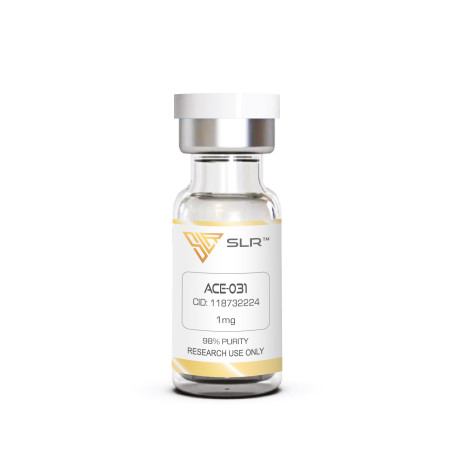
ACE-031 - 1mg
ACE-031 is a research compound employed in preclinical experimental systems to study myostatin pathway modulation and its involvement in skeletal muscle biology and tissue remodeling.
Description
SPECIFICATIONS
Product Code: ACE001
Sequence: H-Ala-Trp-Arg-Gln-Asn-Thr-Arg-Tyr-Ser-Arg-Ile-Glu-Ala-Ile-Lys-Ile-Gln-Ile-Leu-Ser-Lys-Leu-Arg-Leu- NH2
Molecular Weight: 2956.5 g/mol
PubChem CID: 118732224
Purity: Technical / Research Grade 98%
Other details: No TFA Salt
Form: Lyophilized powder
Color: White
Storage temperature: -20°C
Source: Synthetic
Safety classification: Standard handling
DESCRITPION
The type IIB activin receptor (ACVR2B) is a well-established molecular regulator involved in skeletal muscle development and tissue homeostasis. A soluble form of this receptor, commonly referred to as ACE-031, has been widely employed in preclinical research models to investigate myostatin- and activin-related signaling pathways.
Myostatin inhibition and muscle biology research (preclinical)
Myostatin is a known negative regulator of muscle growth. In animal models, genetic or pharmacological disruption of myostatin signaling has been associated with increased skeletal muscle mass across multiple muscle groups. In this context, soluble ACVR2B constructs such as ACE-031 have been used experimentally to bind myostatin and related ligands, thereby enabling the study of muscle hypertrophy mechanisms under controlled laboratory conditions.
Experimental models of muscle wasting (preclinical)
ACE-031 has been investigated in preclinical models of muscle atrophy and degeneration, including models designed to explore mechanisms relevant to inherited or acquired muscle-wasting conditions. These studies focus on understanding ligand-receptor interactions, downstream signaling cascades, and structural changes in muscle tissue, rather than therapeutic application.
Body composition and metabolic research (preclinical)
In controlled animal studies and exploratory experimental settings, modulation of ACVR2B signaling has been associated with changes in lean tissue mass, as well as experimental markers related to fat and bone metabolism. These observations are used to explore how myostatin-related pathways may influence muscle-adipose-bone crosstalk at the molecular and cellular level.
Skeletal muscle energetics and vascularization (preclinical)
Research conducted in murine models suggests that excessive myostatin signaling may negatively influence muscle energy metabolism, mitochondrial function, and local vascular supply. Experimental inhibition of myostatin using soluble receptor constructs has been associated, in laboratory settings, with:
- altered oxidative capacity of muscle fibers,
- modulation of lactate-related metabolic markers,
- and changes in muscle microvascular density.
These findings are interpreted as mechanistic insights into muscle bioenergetics, derived exclusively from in vivo and in vitro experimental systems.
Muscle force generation and contractile properties (preclinical)
Beyond effects on muscle size, ACE-031 has been used in preclinical biomechanics studies to investigate muscle force generation and contractile performance. In animal models, experimental modulation of ACVR2B signaling has been associated with measurable changes in maximal and overall contractile force output, without necessarily altering fatigue resistance. These studies aim to characterize structure–function relationships in skeletal muscle under experimental conditions.
Bone biology and musculoskeletal interaction (preclinical)
ACVR2B-based constructs have also been evaluated in animal models to explore their effects on bone density and skeletal integrity, independent of muscle hypertrophy. In these models, modulation of activin/myostatin pathways has been associated with site-specific changes in bone mineral density, providing insight into the molecular coupling between muscle signaling and bone remodeling.
Cancer-associated muscle wasting models (preclinical)
In cell culture systems and animal models, ACE-031 has been used to study mechanisms involved in cancer-associated muscle wasting (cachexia). Certain experimental cancer models demonstrate altered myostatin signaling and mitochondrial dysfunction in muscle tissue. Within these controlled systems, inhibition of myostatin activity has been associated with:
- reduced markers of muscle cell degradation,
- preservation of mitochondrial number and function,
- and modulation of inflammatory and metabolic signaling pathways.
These observations are strictly limited to experimental oncology research contexts and are used to investigate muscle–tumor metabolic interactions, not clinical outcomes.
Systemic metabolic signaling research (preclinical)
Experimental modulation of myostatin signaling in the presence of cancer models has additionally been associated with changes in insulin-related signaling, lipid handling, inflammatory markers, and bone turnover parameters. Such findings are used to explore system-level metabolic adaptations in disease-relevant laboratory models.
REFERENCES
All observations described above originate from in vitro systems, animal studies, or other preclinical experimental models. They are intended solely to support basic research into molecular, cellular, and physiological mechanisms and do not imply therapeutic, diagnostic, or preventive applications in humans or animals.
F. Morvan et al., “Blockade of activin type II receptors with a dual anti-ActRIIA/IIB antibody is critical to promote maximal skeletal muscle hypertrophy” [PubMed]
H. Q. Han, X. Zhou, W. E. Mitch, and A. L. Goldberg, “Myostatin/activin pathway antagonism: molecular basis and therapeutic potential” [PubMed]
K. M. Attie et al., “A single ascending-dose study of muscle regulator ACE-031 in healthy volunteers” [PubMed]
N. Béchir et al., “ActRIIB blockade increases force-generating capacity and preserves energy supply in exercising mdx mouse muscle in vivo” [PubMed]
DISCLAIMER
This product is intendend for lab research and development use only. These studies are performed outside of the body. This product is not medicines or drugs and has not been approved by the FDA or EMA to prevent, treat or cure any medical condition, ailment or disease. Bodily introduction of any kind into humans or animals is strictly forbidden by law. This product should only be handled by licensed, qualified professionals.
All product information provided on this website is for informational and educational purposes only.
Data sheet
| Image | Ref. | Unit price | Weight | Avail. | Buy |
|---|---|---|---|---|---|
 | ACE001 | €79.00 Discount by quantity 10+ €67.15 –15% 20+ €56.88 –28% 50+ €47.40 –40% 100+ €41.08 –48% 200+ €35.55 –55% | 0.000000 kg |  | |
| Total: 0,0 All prices with tax included. | |||||
Product is available Product is no longer in stock
 Product is no in stock, but is allowed to be back-ordered