
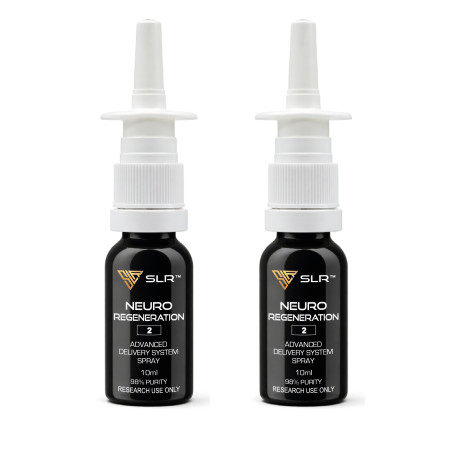
NEURO REGENERATION 2 - 10ml+10ml - Spray
NEUROTROPHIC ACTIVATION / SYNAPTIC PLASTICITY / NEURAL REPAIR
Neuro Regeneration 2 is a dual-phase peptide formulation developed to support research into synaptic plasticity, hippocampal neurogenesis, neuronal repair, and adaptive neurochemical regulation under conditions of neural stress. The formulation is structured in two complementary vials: Vial A focuses on neurotrophic signaling, activity-dependent plasticity, memory-related circuitry, and amyloid-associated synaptic resilience through FGL, Colivelin, P-21, and cAC-253; Vial B is oriented toward structural neural repair, oxidative and apoptotic stress adaptation, circadian support, and neurotransmitter-related regulation through Cortagen, Pinealon, and MIF-1. Together, the system is designed to investigate coordinated mechanisms involved in neuronal differentiation, synaptic maintenance, functional recovery, and long-term neural resilience.
FRESHLY PREPARED SOLUTION
Description
ADVANCED DELIVERY SYSTEM - CELL PENETRATING PEPTIDE TECHNOLOGY
This product utilizes advanced delivery technology incorporating calibrated cell-penetrating peptide (CPP) systems. The formulation is engineered to support efficient and targeted intracellular delivery of active ingredients, contributing to enhanced transport performance and bioavailability under controlled laboratory conditions.
SPECIFICATIONS
Product Code: NR2010L
VIAL A: NEUROTROPHIC / PLASTICITY / MEMORY SUPPORT
FGL - 60 mg
Sequence: pGlu-Val-Tyr-Val-Val-Ala-Glu-Asn-Gln-Gln-Gly-Lys-Ser-Lys-Ala
Molecular Formula: C71H116N20O25
Molecular Weight: 1631.81 g/m
CAS: 499993-62-3
Purity: Technical / Research Grade ≥98%
COLIVELIN - 100 mg
Sequence: H-Ser-Ala-Leu-Leu-Arg-Ser-Ile-Pro-Ala-Pro-Ala-Gly-Ala-Ser-Arg-Leu-Leu-Leu-Leu-Thr-Gly-Glu-Ile-Asp-Leu-Pro-OH
Molecular Formula: C119H206N32O35
Molecular Weight: 2645.13 g/mol
CAS: 867021-83-8
Purity: Technical / Research Grade ≥98%
P-21 - 100 mg
Sequence: Ac-DGGL-adamantane-G-NH₂
Molecular Formula: C30H54N6O5
Molecular Weight: 578.3 g/mol
CAS: 1246751-68-7
Purity: Technical / Research Grade ≥98%
Note: P-21 comprises an adamantyl group at the C- and/or N-terminal end. The compound was developed from the neurogenic undecamer Ac-VGDGGLFEKKL-NH₂ (Peptide 6). A truncated tetramer Ac-DGGL-NH₂ (Peptide 6c) retained neurogenic properties. Addition of an adamantane-based unnatural amino acid to the C-terminus via solid-phase peptide synthesis generated Ac-DGGLAG-NH₂ (P21).
cAC-253 - 20 mg
Sequence: CLGRLSQELHRLQTYPRTNTGSNTYC (Modifications: Cys-26 = C-terminal amide, Disulfide bridge between 1 - 26)
Molecular Formula: C126H202N42O40S2
Molecular Weight: 3009.36 g / mol
PubChem ID: 134160250
Purity: Technical / Research Grade ≥98%
VIAL B: NEURAL REPAIR / PROTECTION / NEUROCHEMICAL SUPPORT
CORTAGEN - 100 mg
Sequence: L-Ala-L-Glu-L-Asp-L-Pro
Molecular Formula: C17H26N4O9
Molecular Weight: 430.41 g/mol
CAS: 335591-03-2
Purity: Technical / Research Grade ≥98%
PINEALON - 100 mg
Sequence: Glu-Asp-Arg
Molecolar Formula: C15H26N6O8
Molecular Weight: 418.407 g/mol
CAS: 175175-23-2
Purity: Technical / Research Grade ≥98%
MIF-1 - 100 mg
Sequence: Pro-Leu-Gly
Molecular Formula: C13H24N4O3
Molecular weight: 284,36 g/mol
CAS: 2002-44-0
Purity: Technical / Research Grade ≥98%
General Properties
Other details: No TFA Salt
Form: Liquid Solution
Color: Clear / Slightly opalescent
Vial A
Total Content: 280 mg in 10 mL (28 mg/mL total peptide concentration)
Concentration per mL: FGL: 6 mg; Colivelin: 10 mg; P-21: 10 mg; cAC-253 2 mg
Approximate Sprays per Bottle: ~82
Approximate Peptide per Spray: FGL: ~ 0.73 mg; Colivelin: ~ 1.22 mg ; P-21: ~ 1.22 mg; cAC-253: ~ 0.24 mg
Vial B
Total Content: 300 mg in 10 mL (30 mg/mL total peptide concentration)
Concentration per mL: Cortagen: 10 mg; Pinealon: 10 mg; MIF-1: 10 mg
Approximate Sprays per Bottle: ~82
Approximate Peptide per Spray: Cortagen: ~ 1.22 mg; Pinealon: ~ 1.22 mg ; MIF-1: ~ 1.22 mg
Vehicle / Carrier System: Proprietary carrier system
Storage Temperature: 4°C (Do not freeze)
Source: Synthetic
Safety classification: Standard handling
DESCRIPTION
Neuro Regeneration 2 is a structured dual-phase formulation designed to support research into the coordinated biological processes involved in neuronal differentiation, synaptic plasticity, neurotrophic signaling, structural repair, and adaptive neural recovery under stress conditions. Neural dysfunction does not emerge through a single isolated mechanism. In experimental models of neurodegeneration, chronic stress, ischemic burden, trauma, protein aggregation, neuroinflammation, and age-associated decline, neuronal compromise typically progresses through an interconnected cascade involving:
- Impaired synaptic plasticity and reduced long-term potentiation (LTP)
- Loss of neurotrophic support and diminished neuronal differentiation
- Structural destabilization of synapses and dendritic networks
- Increased apoptotic pressure under amyloid, ischemic, or oxidative stress
- Disruption of neurotransmitter balance and activity-dependent signaling
- Reduced hippocampal neurogenesis and impaired circuit remodeling
- Slowed electrophysiological and structural recovery in damaged neural tissue
Effective neuroregenerative adaptation requires more than a single protective mechanism. It depends on coordinated regulation across multiple domains of neural biology, including:
- Neurotrophic pathway activation
- Activity-dependent synaptic strengthening
- Neurogenesis and neuronal maturation
- Anti-apoptotic signaling support
- Structural and electrophysiological recovery
- Neurochemical modulation
- Oxidative and inflammatory stress adaptation
Rather than focusing on a single pathway, Neuro Regeneration 2 is structured as a two-part system to explore how these domains interact when addressed in parallel through complementary formulations. The integrated design focuses on:
- Support of synaptic plasticity and LTP-associated signaling
- Activation of neurotrophic and differentiation-related pathways
- Promotion of hippocampal neurogenesis and neuronal maturation
- Modulation of amyloid-associated synaptic stress mechanisms
- Preservation of neuronal integrity under apoptotic and ischemic challenge
- Structural support for neural repair and recovery processes
- Regulation of neurochemical balance and adaptive CNS signaling
Neurotrophic Signaling, Synaptic Plasticity, and Activity-Dependent Strengthening
Learning, memory formation, and adaptive network remodeling depend on the ability of neurons to strengthen synaptic communication in an activity-dependent manner. This process involves coordinated regulation of:
- FGFR-related trophic signaling
- AMPA and NMDA receptor-associated plasticity mechanisms
- Synaptic protein maintenance
- Neurite outgrowth and synaptogenesis
- Long-term potentiation (LTP)
The first phase of this formulation is structured around peptides investigated for their role in neurotrophic signaling and synaptic strengthening, particularly within hippocampal and cortical systems.
FGL, an NCAM-derived peptide acting as a selective FGFR agonist, has been studied for its ability to enhance neurite outgrowth, synapse formation, and activity-dependent LTP, without producing indiscriminate baseline overstimulation. This selective profile is relevant because effective cognitive plasticity requires enhancement of physiological synaptic strengthening rather than generalized excitatory amplification.
P-21, a CNTF-derived synthetic peptide optimized with an adamantylated glycine moiety, has been investigated for hippocampal neurogenesis, neuronal maturation, synaptic protein restoration, and BDNF-associated support mechanisms. Experimental observations associate it with increased dentate gyrus activity, preservation of MAP2, and restoration of key synaptic elements such as synapsin I, GluR1, and NR1, all of which are central to memory encoding and circuit integrity.
Together, these mechanisms support:
- Activity-dependent synaptic reinforcement
- Structural plasticity within learning-related circuits
- Maintenance of receptor trafficking and synaptic architecture
- Neurogenic adaptation within hippocampal regions
Neuroregeneration is not only preservation of neurons, but restoration of the signaling logic that allows circuits to learn, adapt, and consolidate information.
Anti-Apoptotic Support and Amyloid-Associated Synaptic Stress Modulation
Under proteotoxic, ischemic, and amyloid-associated stress conditions, neurons are exposed to apoptotic pressure, inflammatory signaling, and progressive synaptic destabilization. In these settings, survival depends on coordinated modulation of intracellular stress pathways.
Colivelin and cAC-253 support investigation into resistance to amyloid-related synaptic impairment, preservation of plasticity, and modulation of neurodegenerative signaling pathways.
Neural Repair, Protection, and Neurochemical Modulation
The second phase of the formulation focuses on recovery-oriented mechanisms including structural repair, oxidative stress adaptation, and neurotransmitter balance.
Cortagen, Pinealon, and MIF-1 contribute to research into electrophysiological recovery, neuronal protection, circadian regulation, and modulation of dopaminergic and serotonergic systems.
Integrated Conclusion
Neuro Regeneration 2 is designed as a dual-system platform to explore the interaction between synaptic plasticity, neurotrophic signaling, structural repair, and neurochemical regulation, supporting advanced research into coordinated neural resilience and adaptive recovery processes.
REFERENCES
D. Asua et al., "Peptides Acting as Cognitive Enhancers" [PubMed]
R. Klein et al., "NCAM-Peptide FGL mobilizes endogenous neural stem cells after stroke" [Europe PMC]
B. Ojo et al., "FGL attenuates glial cell activation in the aged hippocampus" [PubMed]
M. Yamada et al., "Nasal Colivelin Treatment Ameliorates Memory Impairment Related to Alzheimer's Disease" [Nature]
M. Matsuoka et al., "Humanin and colivelin: neuronal-death-suppressing peptides for Alzheimer's disease and amyotrophic lateral sclerosis" [PubMed]
K. Oikawa et al., "The role of colivelin on hippocampal synaptic plasticity" [Journal]
W. Fu et al., "Role of microglial amylin receptors in mediating beta amyloid inflammation" [PubMed]
R. Soudy et al., "Cyclic AC253 improves cognitive deficits" [PubMed]
V. Khavinson et al., "Tetrapeptide stimulating neuronal activity" [USP]
Shabanov, Vislobokov "Neuronoprotective action of cortexin and cortagen" [Journal]
V. Khavinson et al., "Pinealon increases cell viability" [PubMed]
R.S. Khan et al., "Brain Activation by Peptide Pro-Leu-Gly-NH(2) (MIF-1)" [PubMed]
DISCLAIMER
This product is intendend for lab research and development use only. These studies are performed outside of the body. This product is not medicines or drugs and has not been approved by the FDA or EMA to prevent, treat or cure any medical condition, ailment or disease. Bodily introduction of any kind into humans or animals is strictly forbidden by law. This product should only be handled by licensed, qualified professionals.
All product information provided on this website is for informational and educational purposes only.
Data sheet
| Image | Ref. | Unit price | Weight | Avail. | Buy |
|---|---|---|---|---|---|
 | NR2010L | €1,380.00 Discount by quantity 10+ €1,104.00 –20% 20+ €966.00 –30% 50+ €855.60 –38% 100+ €772.80 –44% 200+ €690.00 –50% | 0.100000 kg |  | |
| Total: 0,0 All prices with tax included. | |||||
Product is available Product is no longer in stock
 Product is no in stock, but is allowed to be back-ordered