
REJUV RESEARCH 2
TELOMERE / SENESCENT CELL TARGETING
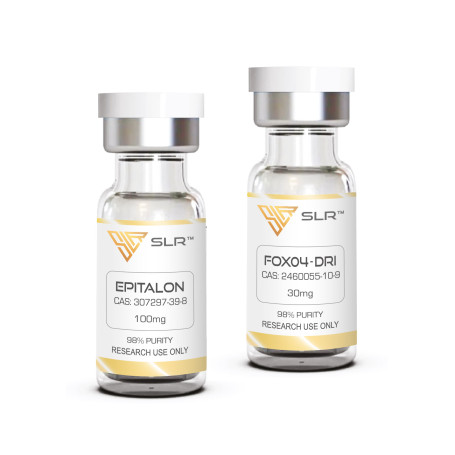
Epitalon - 100mg + FOX04 - DRI - 30mg
Epitalon + FOXO4-DRI is a research combination designed to explore two major biological pathways strongly associated with aging and cellular decline: telomere maintenance mechanisms and senescent cell signaling. Epitalon is widely studied for its potential involvement in telomerase-related pathways and circadian regulation, while FOXO4-DRI is a peptide of interest in senescence research due to its reported ability to interfere with FOXO4–p53 interactions in experimental models. This interaction has been associated with selective signaling effects in senescent cells, making FOXO4-DRI a key compound in research focused on senescent cell targeting and tissue homeostasis.
Together, this combination is positioned for advanced research into mechanisms linked to cellular aging, tissue regeneration pathways, and biological resilience.
According to experimental and preclinical research, this research set has been associated with the following areas of interest:
Telomere biology and telomerase pathway research
Senescent cell targeting and apoptosis-related signaling mechanisms
Support of tissue homeostasis in aging models
Investigation of cellular stress-response pathways
Research into age-related functional decline at tissue and organ level
Scientific interest in pathways related to immune regulation and systemic aging mechanisms
All information provided above refers exclusively to laboratory, experimental, or preclinical research contexts and is intended for scientific and educational discussion only.
Description
SPECIFICATIONS
Product Code: REJ002
EPITALON
Sequence: Ala-Glu-Asp-Gly
Molecular Formula: C14H22N4O9
Molecular Weight: 390.349 g/mol
CAS number: 307297-39-8
Purity: Technical / Research Grade 98%
Other details: No TFA Salt
Form: Lyophilized powder
Color: White
Storage temperature: -20°C
Source: Synthetic
Safety classification: Standard handling
FOX04 - DRI
Sequence: H-D-Leu-D-Thr-D-Leu-D-Arg-D-Lys-D-Glu-D-Pro-D-Ala-D-Ser-D-Glu-D-Ile-D-Ala-D-Gln-D-Ser-D-Ile-D-Leu-D-Glu-D-Ala-D-Tyr-D-Ser-D-Gln-D-Asn-D-Gly-D-Trp-D-Ala-D-Asn-D-Arg-D-Arg-D-Ser-D-Gly-D-Gly-D-Lys-D-Arg-D-Pro-D-Pro-D-Pro-D-Arg-D-Arg-D-Arg-D-Gln-D-Arg-D-Arg-D-Lys-D-Lys-D-Arg-D-Gly-OH
Molecular Formula: C228H388N86O64
Molecular Weight: 5358.05
CAS: 2460055-10-9
Purity: Technical / Research Grade 98%
Other details: No TFA Salt
Form: Lyophilized powder
Color: White
Storage temperature: -20°C
Source: Synthetic
Safety classification: Standard handling
DESCRIPTION
EPITALON
Epitalon is a short synthetic peptide that has been widely investigated in experimental and preclinical research settings for its involvement in melatonin regulation, telomerase-related pathways, and cellular aging mechanisms. Originally developed in Russia in the 1980s, Epitalon has been studied in animal models where it was associated with delayed onset of age-related changes in reproductive and immune parameters. Due to these observations, Epitalon has primarily attracted interest within the field of aging biology and longevity research, as well as in broader studies examining DNA stability and cellular regulation.
In vitro studies conducted on human somatic cells have provided experimental evidence suggesting that Epitalon may influence the activity of the enzyme telomerase. Telomerase is involved in the maintenance of telomeres, which are located at the ends of chromosomes and play a critical role in preserving chromosomal stability. Experimental activation of telomerase-related pathways has been associated with reduced accumulation of DNA replication errors over time, supporting the hypothesis that Epitalon may participate in mechanisms related to genomic integrity and long-term cellular function.
The effects observed in experimental models cannot be fully explained by telomere maintenance or free-radical modulation alone. For this reason, ongoing research has focused on understanding how this short peptide may influence gene expression and regulatory networks, potentially contributing to broader biological effects observed in aging-related studies.
Multiple lines of research suggest that Epitalon may influence immune-related pathways and the organism’s adaptive capacity following both acute stress and cumulative physiological challenges. These findings are consistent with its proposed role as a peptide regulator rather than a direct effector molecule.
Experimental studies conducted in rodents indicate that Epitalon exposure is associated with increased interferon-gamma expression in aged lymphocytes. Interferon-gamma is a key signaling molecule involved in immune regulation, including activation of macrophages, natural killer cells, and T lymphocytes, which are essential components of antiviral and immune surveillance mechanisms.
Research literature has identified several gene-level interactions associated with Epitalon exposure in experimental systems, including:
- Telomerase-related genes, associated with cellular lifespan regulation
- CD5, involved in immune cell differentiation pathways
- IL-2, associated with regulation of leukocyte activity
- MMP2, linked to extracellular matrix remodeling and inflammatory modulation
- Tram1, involved in protein synthesis processes
- Arylalkylamine-N-acetyltransferase (AANAT), associated with melatonin synthesis
- pCREB-related pathways, involved in circadian rhythm regulation and cellular signaling
As previously described, Epitalon has been associated with modulation of MMP2-related pathways in experimental models. MMP2 is a protein involved in connective tissue maintenance, including skin structure. Rodent studies suggest that Epitalon may influence fibroblast activity, which plays a role in the production and maintenance of extracellular matrix components such as collagen and elastin.
Experimental findings further indicate that Epitalon exposure may be associated with reduced caspase-3 activity. Caspase-3 is an enzyme involved in apoptotic signaling pathways. Modulation of this pathway has been linked, in experimental contexts, to enhanced cellular viability and prolonged functional integrity of fibroblasts and other structural cells.
In animal studies involving oncological research models, daily administration of Epitalon has been associated with alterations in tumor development dynamics and metastatic behavior. These observations have prompted further investigation into Epitalon’s interaction with cellular growth-regulatory pathways, although such findings remain confined to experimental and preclinical research contexts.
Additional experimental evidence suggests that Epitalon may influence expression of the PER1 gene in the hypothalamus. PER1 plays a role in circadian rhythm regulation, and altered expression of this gene has been observed in various pathological states. Modulation of circadian regulatory genes has therefore been explored as a potential factor influencing broader biological adaptation processes.
The pineal gland is responsible for melatonin synthesis, a hormone closely associated with circadian rhythms and aging-related processes. Research conducted in animal models indicates that Epitalon may influence melatonin synthesis and secretion by modulating the expression of AANAT and pCREB-related transcription pathways. These molecular mechanisms are central to circadian regulation of melatonin release. Studies in primate models have further suggested a normalization of melatonin production patterns under experimental conditions.
Finally, experimental studies conducted in animal models of retinal degeneration have reported functional and structural observations following Epitalon exposure. These studies suggest that the peptide may be involved in maintaining retinal cellular organization and bioelectrical activity, supporting its continued investigation in vision-related neurobiological research models.
FOX04 - DRI
Prolonged exposure to intense stress and the physiological processes associated with normal aging are linked to the accumulation of irreversible cellular damage, a phenomenon that may contribute to a progressive reduction in health span. Scientific research suggests that senescent cells, which permanently exit the cell cycle, can influence tissue function over time and may play a role in age-associated functional decline.
Senescent cells differ from apoptotic cells in that they are not efficiently removed from tissues and can persist for extended periods. These cells often develop a characteristic profile associated with sustained pro-inflammatory signaling, commonly referred to as the senescence-associated secretory phenotype (SASP). The long-term presence of such cells has been correlated, in experimental models, with disruptions in tissue homeostasis and the progression of age-related biological changes.
DNA damage that is not adequately repaired may contribute to cellular dysfunction, disease development, and accelerated aging. Although cells possess multiple DNA repair mechanisms, these systems are not fully efficient. When repair is insufficient, stress-response pathways such as senescence and apoptosis act as compensatory mechanisms to preserve tissue integrity. Unlike apoptotic cells, senescent cells can accumulate with age and are believed to influence the biological aging process.
FOXO4 is a transcription factor belonging to a larger family of genes involved in development, differentiation, and cellular regulation. FOXO4 participates in the control of several intracellular pathways, including oxidative stress signaling, cell cycle regulation, apoptosis, insulin signaling, and cellular senescence. Expression of FOXO4 has been detected in multiple tissues, including endocrine, metabolic, and reproductive organs.
FOXO4-DRI is a modified peptide derived from the FOXO4 protein in which naturally occurring L-amino acids are replaced with D-amino acids, resulting in enhanced molecular stability and reduced susceptibility to enzymatic degradation. Despite these structural modifications, the peptide retains the ability to interact with cellular signaling pathways and influence transcriptional processes.
In experimental research models, FOXO4-DRI has been shown to interfere with the interaction between FOXO4 and the tumor suppressor protein p53. p53 is a central regulator of cell cycle control and programmed cell death (apoptosis). By disrupting FOXO4–p53 binding, FOXO4-DRI appears to allow p53 to resume its DNA-binding activity, thereby enabling intrinsic apoptotic pathways to proceed.
Notably, this effect has been observed predominantly in senescent cells, which have lost normal functionality due to aging or stress-induced damage. Through selective targeting of these dysfunctional cells, FOXO4-DRI has been associated, in preclinical models, with improved tissue function and the promotion of cellular environments more favorable to renewal and differentiation. These processes have been linked to improved biological performance and markers associated with reduced biological aging in animal studies.
Preclinical investigations have reported that modulation of senescent cell populations may be achievable even after tissue damage has occurred, suggesting that restoration of tissue homeostasis is possible under certain experimental conditions. Additional studies have explored the relationship between FOXO proteins and insulin signaling pathways, which are involved in metabolism, oxidative stress regulation, and aging-related processes.
Research has also indicated that alterations in FOXO protein levels may be associated with neurodegenerative conditions in experimental settings. Reduced FOXO activity has been observed in models of neurodegeneration, prompting scientific interest in the potential role of exogenous FOXO-derived peptides in maintaining regulatory balance within the central nervous system.
Age-related endocrine changes have likewise been examined in preclinical research. In cellular and animal models, FOXO4-DRI exposure has been associated with improved functional markers in aging Leydig cells, which are responsible for testosterone production. These findings have contributed to ongoing research interest in the role of senescence modulation in age-associated hormonal decline.
All information presented above is derived exclusively from laboratory studies, animal models, and exploratory research. It is provided for scientific and educational purposes only and does not constitute medical advice, diagnostic guidance, or therapeutic claims.
REFERENCES
All information presented above is derived from in vitro experiments, animal studies, and other preclinical research models. These data are intended solely for basic scientific investigation of biological mechanisms and do not imply any therapeutic, diagnostic, preventive, or clinical use in humans or animals.
EPITALON
V. Khavinson et al., "Pineal-regulating tetrapeptide epitalon improves eye retina condition in retinitis pigmentosa" [PubMed]
I.A. Vinogradova et al., "Effect of Ala-Glu-Asp-Gly peptide on life span and development of spontaneous tumors in female rats exposed to different illumination regimes" [PubMed]
T.A. Dzhokhadze et al., "[Functional regulation of genome with peptide bioregulators by hypertrophic cardiomyopathy (by patients and relatives)]" [PubMed]
I.N. Alimova et al., "Effect of Epitalon and Vilon treatment on mammary carcinogenesis in transgenic erbB-2/NEU mice" [PubMed]
N.S. Lin'Kova et al., "Peptide Ala-Glu-Asp-Gly and interferon gamma: their role in immune response during aging" [PubMed]
D.A. Sibarov et al., "Epitalon influences pineal secretion in stress-exposed rats in the daytime" [PubMed]
N.S. Lin'Kova et al., "Peptide Regulation of Skin Fibroblast Functions during Their Aging In Vitro" [PubMed]
I.F. Labunets et al., "Effect of epithalamin on circadian relationship between the endocrine function of the thymus and melatonin-producing function of the pineal gland in elderly people" [PubMed]
D.A. Sibarov et al., "Effects of intranasal administration of epitalon on neuron activity in the rat neocortex" [PubMed]
V.N. Anisimov et al., "Epithalon decelerates aging and suppresses development of breast adenocarcinomas in transgenic her-2/neu mice" [PubMed]
G. Kossoy et al., "Effect of the synthetic pineal peptide epitalon on spontaneous carcinogenesis in female C3H/He mice" [PubMed]
N.I. Chasilova et al., "Short peptides stimulate skin cell regeneration during ageing" [PubMed]
O.V. Korkushko et al., "Effect of peptide preparation epithalamin on circadian rhythm of epiphyseal melatonin-producing function in elderly people" [PubMed]
V.K. Khavinson et al., "Effect of regulatory peptides on gene transcription" [Springer Nature Link]
V. Khavinson et al., "AEDG Peptide (Epitalon) Stimulates Gene Expression and Protein Synthesis during Neurogenesis: Possible Epigenetic Mechanism" [PubMed]
V.N. Anisimov et al., "Effect of Epitalon on biomarkers of aging, life span and spontaneous tumor incidence in female Swiss-derived SHR mice" [PubMed]
G. Kossoy et al., "Epitalon and colon carcinogenesis in rats: proliferative activity and apoptosis in colon tumors and mucosa" [PubMed]
V.N. Anisimov et al., "Inhibitory effect of the peptide epitalon on the development of spontaneous mammary tumors in HER-2/neu transgenic mice" [PubMed]
V.K. Khavinson et al., "Epithalon peptide induces telomerase activity and telomere elongation in human somatic cells" [PubMed]
V.N. Anisimov et al., "Pineal peptide preparation epithalamin increases the lifespan of fruit flies, mice and rats" [PubMed]
V.K, Khavinson et al., "Short cell-penetrating peptides: a model of interactions with gene promoter sites" [PubMed]
V. Khavinson et al., "Peptide Epitalon activates chromatin at the old age" [Europe PMC]
FOX04 - DRI
G. Murtaza et al., "FOXO Transcriptional Factors and Long-Term Living" [PubMed]
M.P. Baar et al., "Targeted Apoptosis of Senescent Cells Restores Tissue Homeostasis in Response to Chemotoxicity and Aging" [PubMed]
C. Zhang et al., "FOXO4-DRI alleviates age-related testosterone secretion insufficiency by targeting senescent Leydig cells in aged mice" [PubMed]
C. Zhang et al., "FOXO4-DRI alleviates age-related testosterone secretion insufficiency by targeting senescent Leydig cells in aged mice" [PubMed]
S. Lee et al., "FoxO integration of insulin signaling with glucose and lipid metabolism" [PubMed]
W. Hu et al., "Roles of forkhead box O (FoxO) transcription factors in neurodegenerative diseases: A panoramic view" [PubMed]
Y. Huang et al., "Senolytic Peptide FOXO4-DRI Selectively Removes Senescent Cells From in vitro Expanded Human Chondrocytes" [PubMed]
A.L. Bulteau et al., "Age-Dependent Declines in Proteasome Activity in the Heart" [PubMed]
Y. Sun et al., "FOXO4 Inhibits the Migration and Metastasis of Colorectal Cancer by Regulating the APC2/β-Catenin Axis" [PubMed]
P. Krimpenfort et al., "Rejuvenation by Therapeutic Elimination of Senescent Cells" [PubMed]
DISCLAIMER
This product is intendend for lab research and development use only. These studies are performed outside of the body. This product is not medicines or drugs and has not been approved by the FDA or EMA to prevent, treat or cure any medical condition, ailment or disease. Bodily introduction of any kind into humans or animals is strictly forbidden by law. This product should only be handled by licensed, qualified professionals.
All product information provided on this website is for informational and educational purposes only.
Data sheet
| Image | Ref. | Unit price | Weight | Avail. | Buy |
|---|---|---|---|---|---|
 | REJ002 | €399.00 Discount by quantity 10+ €327.18 –18% 20+ €287.28 –28% 50+ €247.38 –38% 100+ €219.45 –45% 200+ €199.50 –50% | 0.000000 kg |  | |
| Total: 0,0 All prices with tax included. | |||||
Product is available Product is no longer in stock
 Product is no in stock, but is allowed to be back-ordered