
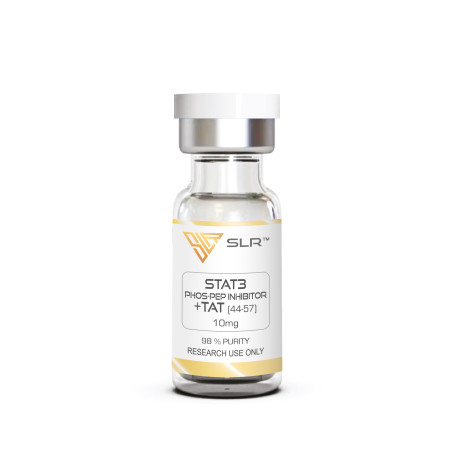


STAT3 PHOSPHOPEPTIDE INHIBITOR + TAT (44-57) - 10mg/30mg (Price on request)
Made to Order Compound ✦ Price available upon request. For inquiries: contact us
The STAT3 Inhibitor Peptide has been explored in experimental and preclinical research for its potential relevance across multiple cancer-related models, including:
Multiple Myeloma
Leukemia
Glioblastoma
Breast and Lung Cancers
By selectively interacting with STAT3-associated signaling pathways, this peptide has been investigated for its ability to modulate cellular survival mechanisms and related biological processes, while being evaluated for its differential effects between transformed and non-transformed cells under controlled research conditions.
Description
SPECIFICATIONS
Product Code: SPT103D
Sequence: Ac-Gly-(pTyr)-Leu-Pro-Gln-Thr-Val-Gly-Tyr-Gly-Arg-Lys-Lys-Arg-Arg-Gln-Arg-Arg-Arg-NH₂
Modification: TAT cell-penetrating peptide conjugation
Molecular Formula: N/A (complex modified peptide)
Molecular Weight: To be confirmed
CAS: N/A
Purity: Technical / Research Grade ≥98%
Other details: No TFA Salt
Form: Lyophilized powder
Color: White
Storage temperature: -20°C
Source: Synthetic
Safety classification: Standard handling
DESCRIPTION
STAT3 (Signal Transducer and Activator of Transcription 3) is a crucial transcription factor involved in cell proliferation, survival, immune modulation, and inflammation. In multiple experimental cancer models, including multiple myeloma, leukemia, glioblastoma, breast, and lung cancer, STAT3 has been reported to be abnormally activated, contributing to tumor progression, drug resistance, and immune evasion.
The STAT3 Inhibitor Peptide is investigated as a competitive inhibitor that interacts with the SH2 domain of STAT3, potentially interfering with its phosphorylation and dimerization under experimental conditions. This may lead to modulation of downstream signaling pathways associated with cellular proliferation, survival, and response to external stimuli.
In this modified construct, the peptide is conjugated to the TAT (44–57) cell-penetrating peptide, a well-characterized CPP sequence rich in basic amino acids such as arginine and lysine. The purpose of this modification is not to alter the intrinsic inhibitory activity of the STAT3 phosphopeptide, but to significantly improve its ability to enter cells and reach intracellular targets where STAT3 signaling occurs.
One of the main limitations of phosphopeptide-based inhibitors is their poor membrane permeability, primarily due to their polarity and the presence of the phosphate group. The addition of the TAT sequence is specifically intended to overcome this limitation by enhancing cellular uptake and intracellular delivery under experimental conditions.
The TAT (44–57) sequence facilitates interaction with negatively charged components of the cell membrane, promoting internalization through energy-dependent and independent mechanisms. As a result, the conjugated construct may achieve higher intracellular concentrations compared to the non-modified peptide, improving its experimental utility in cell-based systems.
In practical terms, the inclusion of TAT provides several functional advantages:
- improved cellular penetration
- enhanced intracellular delivery
- increased access to cytosolic and nuclear signaling pathways
- greater experimental consistency in assays involving STAT3 inhibition
This delivery enhancement is particularly relevant for a target such as STAT3, which operates inside the cell and requires intracellular access for effective pathway modulation. Therefore, the TAT-conjugated version is designed to address one of the key limitations of peptide-based inhibitors: delivery efficiency.
Benefits of STAT3 Inhibition (Research Context)
- Inhibition of Tumor-Associated Signaling – May interfere with STAT3-related pathways involved in cellular proliferation and survival in experimental models.
- Modulation of Drug Resistance Mechanisms – Investigated for its potential role in altering STAT3-associated resistance pathways.
- Induction of Apoptosis-Related Pathways – Studied for its involvement in pathways linked to programmed cell death in vitro.
- Immune and Inflammatory Modulation – May influence inflammatory signaling and immune-related pathways associated with STAT3 activity.
STAT3 Inhibition in Cancer Research
Multiple Myeloma Research: Multiple myeloma (MM) has been associated in literature with persistent STAT3 activation, contributing to altered proliferation, immune evasion, and resistance mechanisms. STAT3 inhibition is being explored in experimental settings for its ability to:
- Modulate STAT3 signaling pathways involved in cellular proliferation.
- Influence sensitivity to chemotherapeutic agents in preclinical models.
- Affect inflammatory signaling associated with disease progression.
Leukemia Research: STAT3 has been implicated in both acute and chronic leukemias, where it is associated with stem cell maintenance, resistance mechanisms, and immune interactions. The STAT3 Inhibitor Peptide is being studied in:
- Acute Myeloid Leukemia (AML) – for its potential to influence proliferation and apoptosis-related pathways.
- Chronic Lymphocytic Leukemia (CLL) – for its possible role in modulating response to targeted therapies.
- Acute Lymphoblastic Leukemia (ALL) – for its interaction with pathways involved in leukemia stem cell survival.
Glioblastoma Research: Glioblastoma multiforme (GBM) is characterized by aggressive growth and resistance to treatment, with STAT3 signaling involved in multiple aspects of tumor biology. The STAT3 Inhibitor Peptide is being investigated for its potential to:
- Modulate glioblastoma stem cell-associated pathways.
- Influence angiogenesis-related signaling.
- Affect cellular response to radiation in experimental systems.
- Interact with mechanisms involved in tumor invasion.
Breast and Lung Cancer Research: STAT3 signaling is frequently associated with tumor progression, metastasis, and resistance mechanisms in breast and lung cancer models. Inhibition of STAT3 is being studied for its ability to:
- Modulate pathways involved in metastatic processes.
- Influence responsiveness to chemotherapy and immunotherapy in preclinical settings.
- Affect inflammatory signaling linked to tumor microenvironment.
- Interact with apoptosis-related mechanisms in STAT3-dependent cells.
STAT3 inhibitors are currently being investigated in research models of aggressive cancers such as triple-negative breast cancer (TNBC) and non-small cell lung cancer (NSCLC), where resistance to therapy remains a major focus of study
Summary:
The Role of STAT3 Inhibition in Cancer Research. The STAT3 Inhibitor Peptide represents a research tool for studying STAT3-dependent signaling pathways, with potential applications in experimental models of:
- Multiple Myeloma – modulation of proliferation and treatment response pathways.
- Leukemia – investigation of stem cell-related and resistance mechanisms.
- Glioblastoma – analysis of invasion, angiogenesis, and cellular adaptation processes.
- Breast & Lung Cancer – exploration of metastasis and therapy-response pathways.
This peptide is primarily used in preclinical and in vitro research settings to investigate the role of STAT3 as a central regulator of multiple interconnected biological pathways
DISCLAIMER
This product is intendend for lab research and development use only. These studies are performed outside of the body. This product is not medicines or drugs and has not been approved by the FDA or EMA to prevent, treat or cure any medical condition, ailment or disease. Bodily introduction of any kind into humans or animals is strictly forbidden by law. This product should only be handled by licensed, qualified professionals.
All product information provided on this website is for informational and educational purposes only.
Data sheet
Choose product attributes:
| Image | Ref. | mg | Weight |
|---|---|---|---|
 | SPT103D | 10 mg | 0 kg |
| | SPT103D | 30 mg | 0 kg |