
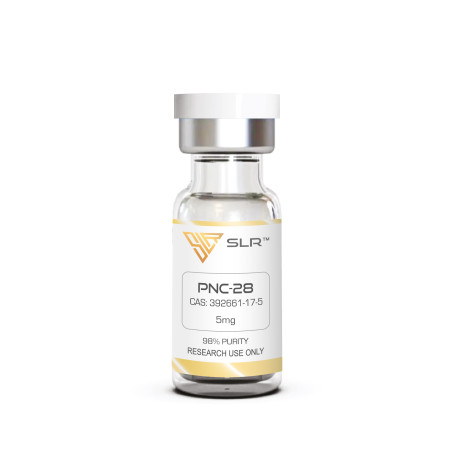
PNC-28 - 5mg
PNC-28 is a synthetic peptide derived from the p53 protein, specifically from its MDM2-binding domain, and engineered with a penetratin sequence to enable efficient cellular uptake. It is studied for its ability to interact with dysregulated cellular pathways commonly found in transformed cells, particularly involving the MDM2 regulatory system. In experimental models, PNC-28 has been associated with the induction of non-apoptotic cell death mechanisms, characterized by loss of membrane integrity rather than classical programmed cell death. This feature makes it of particular interest in research settings where resistance to apoptosis is observed.
Due to its unique mechanism and intracellular activity, PNC-28 is primarily used as a research tool in studies related to tumor biology, cellular stress responses, and alternative cell death pathways.
Description
SPECIFICATIONS
Product Code: P28005
Sequence: Glu-Thr-Phe-Ser-Asp-Leu-Trp-Lys-Leu-Leu-Lys-Lys-Trp-Lys-Met-Arg-Arg-Asn-Gln-PheTrp-Val-Lys-Val-Gln-Arg-Gly
Molecular Formula: C164H255N47O37S
Molecular Weight: 3509.13 g/mol
CAS: 392661-17-5
Purity: Technical / Research Grade 98%
Other details: No TFA Salt
Form: Lyophilized powder
Color: White
Storage temperature: -20°C
Source: Synthetic
Safety classification: Standard handling
DESCRIPTION
PNC-28 is a synthetic peptide derived from the tumor suppressor protein p53, specifically from the region involved in binding to MDM2 (residues 17–26). This domain plays a central role in the regulation of p53 activity, a key protein responsible for maintaining genomic stability, regulating cell cycle progression, and responding to cellular stress. To enhance intracellular delivery, PNC-28 is conjugated with a penetratin sequence, a well-characterized cell-penetrating peptide that facilitates efficient translocation across cellular membranes. This structural feature allows PNC-28 to access intracellular targets and interact with regulatory proteins involved in tumor cell survival and proliferation.
PNC-28 has attracted significant interest in experimental research due to its ability to selectively interact with molecular pathways commonly dysregulated in transformed cells. One of its primary targets is MDM2, a negative regulator of p53 that is frequently overexpressed in various tumor cell types. By interacting with this regulatory system, PNC-28 influences downstream signaling pathways associated with cell viability and stress response. Unlike many conventional compounds that rely on apoptosis (programmed cell death), PNC-28 has been observed in preclinical models to induce a form of cell death characterized by membrane disruption and loss of cellular integrity. This process is consistent with necrotic-like mechanisms rather than classical apoptosis. The distinction is particularly relevant in research contexts where tumor cells exhibit resistance to apoptosis, a common feature in aggressive or treatment-resistant models.
Experimental studies have shown that PNC-28 can affect a wide range of human tumor cell lines, including those with altered p53 function or mutations in oncogenic pathways such as Ras signaling. This suggests that its activity may not depend strictly on intact intracellular p53 pathways, making it a subject of interest in models where conventional p53-dependent mechanisms are impaired. A key aspect of PNC-28 under investigation is its apparent selectivity. In controlled in vitro conditions, the peptide has demonstrated differential activity between transformed and non-transformed cells, suggesting a potential preference for cellular environments characterized by altered membrane composition or dysregulated signaling. This property has led to further exploration of its role in targeting abnormal cellular states while preserving normal cellular structures in experimental settings.
From a mechanistic perspective, PNC-28 is believed to interact with membrane-associated or intracellular forms of MDM2 present in transformed cells. This interaction may trigger structural changes at the cellular level, leading to loss of membrane integrity and subsequent cell death. The exact molecular sequence of events is still being investigated, but current evidence supports a mechanism distinct from classical receptor-mediated apoptosis pathways. The ability to bypass apoptosis is particularly relevant in research models of cancer biology. Many tumor cells develop resistance to apoptotic signaling through mutations or alterations in key regulatory proteins. By inducing an alternative form of cell death, PNC-28 provides a useful experimental tool for studying non-apoptotic pathways and their role in cellular response to stress and transformation.
PNC-28 is often compared to PNC-27, another peptide derived from p53. While both share a common origin and are designed to target tumor-associated pathways, they differ in their specific mechanisms of action. PNC-27 has been reported to interact with HDM2 at the cell membrane, leading to pore formation and rapid membrane lysis. In contrast, PNC-28 is associated with intracellular interactions involving MDM2 and induces cell death through a mechanism that does not rely on pore formation. These differences make the two peptides complementary in research contexts. While PNC-27 is primarily associated with direct membrane disruption, PNC-28 provides insight into intracellular regulatory mechanisms and alternative cell death pathways. This distinction has led to theoretical considerations regarding their combined use in experimental models, where targeting multiple pathways simultaneously could enhance the understanding of tumor cell vulnerability.
Although the combined use of PNC-27 and PNC-28 has not been extensively documented in the literature, their complementary mechanisms suggest potential synergy in controlled experimental settings. By engaging both membrane-associated and intracellular targets, such combinations may offer a broader perspective on how transformed cells respond to multi-pathway stress conditions. In research applications, PNC-28 is primarily studied in the context of tumor biology, cellular stress response, and mechanisms of cell death. It is used as a model compound to investigate how specific protein interactions can influence cellular fate, particularly in environments characterized by dysregulated growth signaling. Its relevance extends to experimental models involving:
- tumor cell signaling pathways
- resistance to apoptosis
- membrane integrity and cellular permeability
- intracellular protein-protein interactions
- stress-induced cellular responses
Additionally, PNC-28 has been explored in studies related to microenvironmental factors that influence cell survival, including hypoxia, metabolic stress, and altered signaling cascades. These conditions are commonly observed in transformed cells and provide a relevant framework for evaluating peptide activity in controlled laboratory settings. It is important to note that all current data regarding PNC-28 are derived from preclinical models, including in vitro systems and experimental biological studies. The peptide is used exclusively as a research tool to investigate cellular mechanisms and does not represent an approved therapeutic agent. Due to its unique structural and functional characteristics, PNC-28 continues to be studied as part of broader efforts to understand how targeted peptide-based systems can interact with complex cellular pathways. Its ability to engage non-apoptotic mechanisms of cell death, combined with its cell-penetrating capability, makes it a valuable subject in the exploration of alternative biological responses to cellular transformation.
Ongoing research aims to further clarify its molecular targets, optimize its stability and delivery, and better understand the conditions under which it exhibits selective activity. These investigations contribute to a deeper understanding of how peptide-based systems can be used to model and study complex biological processes related to cellular regulation and stress response. In summary, PNC-28 is a p53-derived peptide engineered for intracellular activity, characterized by its interaction with MDM2 and its ability to induce non-apoptotic cell death in experimental models. Its unique mechanism, combined with its cell-penetrating properties, positions it as a relevant compound for research focused on tumor biology, cellular stress mechanisms, and alternative pathways of cell death.
REFERENCES
All information presented above is derived from in vitro experiments, animal studies, and other preclinical research models. These data are intended solely for basic scientific investigation of biological mechanisms and do not imply any therapeutic, diagnostic, preventive, or clinical use in humans or animals.
J. Michl et al., "PNC-28, a p53-derived peptide that is cytotoxic to cancer cells, blocks pancreatic cancer cell growth in vivo" [PubMed]
M.R. Pincus et al., "Poptosis or Peptide-Induced Transmembrane Pore Formation: A Novel Way to Kill Cancer Cells without Affecting Normal Cells" [PubMed]
E. Sarafraz-Yazdi et al., "Ex vivo Efficacy of Anti-Cancer Drug PNC-27 in the Treatment of Patient-Derived Epithelial Ovarian Cancer" [PubMed]
T. Yamada et al., "p28, an anionic cell-penetrating peptide, increases the activity of wild type and mutated p53 without altering its conformation" [PubMed]
J. Michl et al., "PNC-28, a p53-derived peptide that is cytotoxic to cancer cells, blocks pancreatic cancer cell growth in vivo" [IJC]
C. Soriano-Correa et al., "The role of ETFS amino acids on the stability and inhibition of p53-MDM2 complex of anticancer p53-derivatives peptides: Density functional theory and molecular docking studies" [PubMed]
R. Ghavimi et al., "In silico design of two novel fusion proteins, p28-IL-24 and p28-M4, targeted to breast cancer cells" [PubMed]
M.A. Warso et al. "A first-in-class, first-in-human, phase I trial of p28, a non-HDM2-mediated peptide inhibitor of p53 ubiquitination in patients with advanced solid tumours" [PubMed]
E. Sarafraz-Yazdi et al., "Mechanism of action of PNC-27/-28 anti-cancer peptides" [aacrjournals]
W.B. Bowne et al., "The penetratin sequence in the anticancer PNC-28 peptide causes tumor cell necrosis rather than apoptosis of human pancreatic cancer cells" [PubMed]
DISCLAIMER
This product is intendend for lab research and development use only. These studies are performed outside of the body. This product is not medicines or drugs and has not been approved by the FDA or EMA to prevent, treat or cure any medical condition, ailment or disease. Bodily introduction of any kind into humans or animals is strictly forbidden by law. This product should only be handled by licensed, qualified professionals.
All product information provided on this website is for informational and educational purposes only.
Data sheet
| Image | Ref. | Unit price | Weight | Avail. | Buy |
|---|---|---|---|---|---|
 | P28005 | €135.00 Discount by quantity 10+ €110.70 –18% 20+ €97.20 –28% 50+ €83.70 –38% 100+ €74.25 –45% 200+ €67.50 –50% | 0.000000 kg |  | |
| Total: 0,0 All prices with tax included. | |||||
Product is available Product is no longer in stock
 Product is no in stock, but is allowed to be back-ordered