
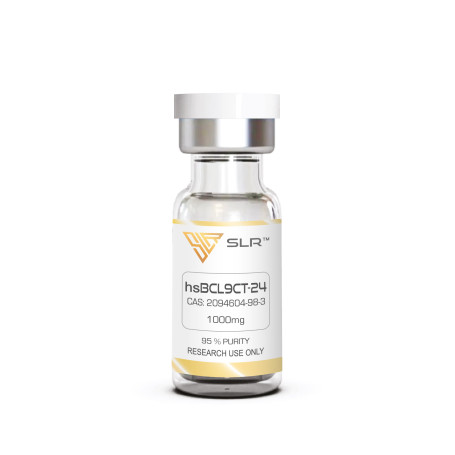
hsBCL9CT-24 - 1000mg
hsBCL9CT-24 is a synthetic research peptide associated with the investigation of Wnt/β-catenin signaling and the β-catenin/BCL9 interaction. β-Catenin is the central transcriptional effector of the canonical Wnt pathway, which regulates cellular proliferation, differentiation, and tissue homeostasis. Persistent activation of this pathway can support abnormal growth and tumor-associated transcriptional programs.
Within the nucleus, β-catenin cooperates with transcription factors and coactivators, including BCL9, to regulate Wnt-responsive genes. Interfering with the β-catenin/BCL9 interface is therefore an experimental approach for investigating the molecular mechanisms that sustain oncogenic Wnt signaling.
Research involving hsBCL9CT-24 has contributed to the study of peptide-based inhibitors targeting this interaction. This field explores how disruption of β-catenin-associated transcriptional complexes may influence tumor cell behavior and the surrounding immune microenvironment.
Description
SPECIFICATIONS
Product Code: HSB1000D
Sequence: Ac-Leu-Gln-Thr-Leu-Arg-X-Ile-Gln-Arg-X-Leu-NH2 (X=(S)-2-(4'-pentenyl)-Ala)
Molecular Formula: C68H122N20O15
Molecular Weight: 1459.82 g/mol
CAS: 2094604-98-3
Purity: Technical / Research Grade ≥95%
Form: Powder
Color: White
Storage temperature: -20°C
Source: Synthetic
Solubility: Soluble in water (H₂O) and DMSO
Target: Wnt/β-catenin (β-cat) pathway inhibitor
Safety classification: Standard handling
DESCRIPTION
hsBCL9CT-24 is a synthetic peptide used in research concerning the Wnt/β-catenin pathway and the protein interactions that regulate β-catenin-dependent transcription. Its scientific context centers on the interaction between β-catenin and B-cell lymphoma 9 (BCL9), a transcriptional coactivator involved in the organization and activity of nuclear signaling complexes.
The β-catenin/BCL9 interface has attracted interest as an experimental target because it offers a way to investigate the transcriptional functions of β-catenin through a specific protein–protein interaction. Peptide-based approaches in this field examine whether interference with coactivator recruitment can suppress signaling programs associated with abnormal proliferation and tumor progression.
The Canonical Wnt/β-Catenin Pathway
The canonical Wnt pathway participates in embryonic development, tissue organization, cellular differentiation, and the maintenance of adult tissues. Its activity is regulated through mechanisms that control the availability and localization of β-catenin.
In the absence of an activating signal, cytoplasmic β-catenin is normally subject to regulated degradation. Wnt signaling can stabilize β-catenin, allowing it to accumulate and enter the nucleus. There, it associates with transcription factors of the T-cell factor/lymphoid enhancer factor (TCF/LEF) family and additional regulatory proteins to influence the expression of Wnt-responsive genes.
These transcriptional responses depend on the cellular environment, the genetic background, and the composition of the nuclear protein complex.
Aberrant Signaling and Tumor Biology
Persistent activation of Wnt/β-catenin signaling is implicated in multiple cancer types. Alterations in pathway components, including APC and CTNNB1, can disrupt normal regulation and promote sustained β-catenin-dependent transcription.
Such changes may support proliferative programs, altered differentiation, and the maintenance of stem-like cellular states. Colorectal cancer and hepatocellular carcinoma are prominent research contexts in which dysregulated Wnt signaling is investigated.
These associations provide the biological rationale for studying inhibitors of β-catenin-associated transcription. They do not imply that every tumor with Wnt pathway activation will respond equally to a particular inhibitor.
The Role of BCL9 in Nuclear Transcriptional Complexes
β-Catenin does not function in isolation. Its transcriptional activity depends on interactions with DNA-binding transcription factors and coactivators that help assemble functional regulatory complexes.
BCL9 interacts with β-catenin and contributes to the organization of these complexes. The binding interface between the two proteins is therefore a focus of research into approaches that interfere with oncogenic transcription.
Blocking this interface is conceptually different from eliminating β-catenin altogether. It aims to interfere with a defined molecular interaction, although functional selectivity must be demonstrated experimentally rather than assumed from the intended target.
Peptide-Based Targeting of the β-Catenin/BCL9 Interface
Protein–protein interactions often involve extended binding surfaces that can be challenging to address with conventional small molecules. Peptides provide an alternative research approach because they can reproduce selected structural features of natural protein-binding regions.
Research involving hsBCL9CT-24 has explored this strategy in the context of β-catenin/BCL9 inhibition. Published studies include hydrocarbon-stapled constructs designed to constrain peptide conformation and investigate disruption of the target interaction.
For experimental interpretation, the exact structure matters: findings obtained with a particular stapled construct should be matched to that construct rather than transferred automatically to a differently specified sequence.
β-Catenin Signaling and the Tumor Microenvironment
The effects of oncogenic signaling extend beyond tumor cell proliferation. Tumor-associated transcriptional programs can also influence the signals exchanged between malignant cells, stromal cells, and immune populations.
Preclinical research associated with hsBCL9CT-24 has examined the relationship between β-catenin pathway inhibition and immune-cell composition within tumors. This includes investigations involving regulatory T cells, dendritic cells, and cytotoxic T cells, together with experimental combinations involving immune checkpoint blockade.
These studies support continued investigation of the connection between Wnt signaling and tumor immunity. Their outcomes remain dependent on the molecular construct and experimental model used.
REFERENCES
All information presented above is derived from in vitro experiments, animal studies, and other preclinical research models. These data are intended solely for basic scientific investigation of biological mechanisms and do not imply any therapeutic, diagnostic, preventive, or clinical use in humans or animals.
M. Feng et al., "Pharmacological inhibition of β-catenin/BCL9 interaction overcomes resistance to immune checkpoint blockades by modulating Treg cells" [PubMed]
Z. Wei et al., "Bcl9 Depletion Modulates Endothelial Cell in Tumor Immune Microenvironment in Colorectal Cancer Tumor" [PMC]
Weiming You et al., "Turning a Targeting β-Catenin/Bcl9 Peptide Inhibitor into a GdOF@Au Core/Shell Nanoflower for Enhancing Immune Response to Cancer Therapy in Combination with Immune Checkpoint Inhibitors" [PMC]
Z. Wei et al., "Inhibition of BCL9 Modulates the Cellular Landscape of Tumor-Associated Macrophages in the Tumor Immune Microenvironment of Colorectal Cancer" [PMC]
DISCLAIMER
This product is intended for lab research and development use only. These studies are performed outside of the body. This product is not medicines or drugs and has not been approved by the FDA or EMA to prevent, treat or cure any medical condition, ailment or disease. Bodily introduction of any kind into humans or animals is strictly forbidden by law. This product should only be handled by licensed, qualified professionals.
All product information provided on this website is for informational and educational purposes only.
Data sheet
| Image | Ref. | Unit price | Weight | Avail. | Buy |
|---|---|---|---|---|---|
 | HSB1000D | €5,850.00 | 0.000000 kg |  | |
| Total: 0,0 All prices with tax included. | |||||
Product is available Product is no longer in stock
 Product is no in stock, but is allowed to be back-ordered