
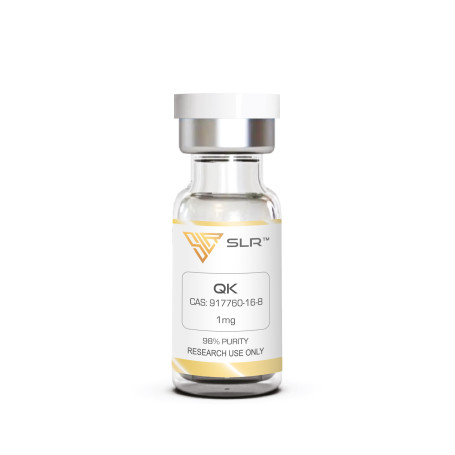
QK - 1mg
QK is a synthetic peptide designed to mimic the activity of Vascular Endothelial Growth Factor (VEGF), one of the primary regulators of angiogenesis (the formation of new blood vessels). Unlike full-length VEGF, QK is a smaller and more stable molecule that retains the ability to bind endothelial receptors (particularly VEGFR-1), activating key biological pathways involved in vascular growth. Its primary effect is the stimulation of angiogenesis, through:
endothelial cell proliferation and migration
formation of new capillary structures
improvement of microcirculation
These properties make QK highly relevant in research related to:
tissue regeneration
wound healing
ischemic conditions (reduced blood flow)
endothelial function and vascular health
In summary, QK is a targeted angiogenic mimetic, useful for studying controlled vascular growth in experimental settings, offering improved stability and control compared to natural VEGF.
Description
SPECIFICATIONS
Product Code: QK0001
Sequence: Ac-Lys-Leu-Thr-Trp-Gln-Glu-Leu -Tyr-Gln-Leu-Lys-Tyr-Lys-Gly-Ile-NH2
Molecular Formula: C94H146N22O23
Molecular Weight: 1951,09 g/mol
CAS: 917760-16-8
Purity: Technical / Research Grade 98%
Other details: No TFA Salt
Form: Lyophilized powder
Color: White
Storage temperature: -20°C
Source: Synthetic
Safety classification: Standard handling
DESCRIPTION
QK is a synthetic peptide designed as a functional mimetic of Vascular Endothelial Growth Factor (VEGF), one of the key regulators of angiogenesis and vascular development. It is derived from a specific α-helical region of VEGF responsible for receptor binding, allowing it to reproduce the essential biological activity of the full-length protein in a simplified and more stable form.
VEGF plays a central role in vascular growth, tissue perfusion, and regenerative signaling. However, due to its structural complexity and rapid degradation, its direct use in experimental settings can be limited. QK was developed to overcome these limitations by preserving the functional domain required for receptor interaction while improving stability and controllability.
Because angiogenesis is a critical process involved in tissue repair, ischemic adaptation, and metabolic support, QK has become a peptide of significant interest in research fields related to regenerative biology and vascular function.
Biological role and physiological relevance
The vascular system is essential for maintaining tissue viability, as it provides oxygen, nutrients, and signaling molecules necessary for cellular function. When tissues are damaged or exposed to hypoxic conditions, the body activates angiogenic pathways to restore adequate blood supply and support recovery. VEGF is one of the primary mediators of this response, and QK has been engineered to replicate its activity by directly interacting with endothelial cell receptors. Through this mechanism, QK supports processes that are fundamental to vascular remodeling and tissue regeneration.
Endothelial cells play a central role in angiogenesis. Their activation leads to proliferation, migration, and structural organization into new vascular networks. These processes are essential not only for wound healing but also for maintaining functional microcirculation in tissues exposed to stress or damage. Because impaired vascularization is a common factor in many pathological conditions, peptides capable of enhancing microcirculatory function are increasingly studied for their broader biological relevance.
Mechanism of action: vegf receptor mimetic activity
The primary mechanism of QK is based on its ability to mimic the receptor-binding domain of VEGF and interact with VEGF receptors, particularly VEGFR-1 (Flt-1). Upon binding, QK activates intracellular signaling pathways associated with endothelial cell activation and angiogenic response. This interaction triggers a cascade of biological events including endothelial cell proliferation, migration, and differentiation. These processes ultimately lead to the formation of new capillary structures and expansion of existing vascular networks.
Unlike full-length VEGF, which can produce complex and sometimes less controlled signaling effects, QK provides a more targeted and predictable activation of angiogenic pathways. Its smaller structure allows for greater stability and facilitates its use in controlled experimental environments.
Angiogenesis and microvascular development
One of the most relevant biological effects of QK is its ability to promote angiogenesis, the formation of new blood vessels from pre-existing vasculature. This process is essential for tissue repair and regeneration, as damaged or ischemic tissues require increased blood flow to restore oxygen supply and support metabolic activity. Experimental research has shown that QK stimulates endothelial cell proliferation and migration, as well as their organization into tubular structures that resemble capillary networks. These events are fundamental steps in the development of new microvascular systems.
By increasing vascular density, QK may improve tissue perfusion and enhance the delivery of oxygen, nutrients, and signaling molecules. This creates a more favorable environment for cellular repair and regeneration, particularly in tissues where blood supply is limited or compromised.
Tissue repair and regenerative processes
Tissue repair is a complex and coordinated process that involves inflammation control, cellular migration, extracellular matrix remodeling, and vascular growth. QK contributes to this process primarily through its ability to enhance angiogenesis and improve microcirculation. Adequate blood supply is a limiting factor in many regenerative processes. By promoting vascularization, QK supports cellular metabolism and provides the structural and biochemical environment necessary for tissue reconstruction.
This effect is particularly relevant in conditions characterized by impaired healing capacity, such as chronic wounds or ischemic damage. Improved vascular support may accelerate recovery and enhance the overall efficiency of regenerative processes.
Anti-ischemic and perfusion-related effects
Ischemia occurs when tissues are deprived of adequate blood flow, leading to reduced oxygen availability and metabolic stress. Restoration of perfusion is essential to prevent cellular damage and support functional recovery. Through its angiogenic activity, QK may contribute to the formation of new vascular pathways that help restore blood flow in ischemic tissues. Increased microvascular density can improve oxygen delivery and reduce the impact of hypoxic conditions.
This has led to growing interest in QK in experimental models focused on ischemic injury, where improving vascularization plays a key role in preserving tissue integrity and function.
Endothelial function and vascular health
Endothelial cells are essential for maintaining vascular homeostasis, regulating blood flow, and controlling the exchange of molecules between blood and tissues. Dysfunction of the endothelium is associated with numerous pathological conditions, including cardiovascular disease and chronic inflammation. QK may support endothelial function by promoting cellular activation and responsiveness. By enhancing endothelial activity, it may contribute to maintaining vascular integrity and adaptability under stress conditions. Improved endothelial performance is closely linked to better circulation, tissue oxygenation, and overall vascular health.
Research applications and experimental context
QK is primarily used as a research compound in studies focused on angiogenesis, regenerative medicine, and vascular biology. Its ability to replicate VEGF activity in a more stable and simplified form makes it a valuable tool for investigating controlled vascular growth. It has been studied in experimental models involving tissue repair, wound healing, bone regeneration, and microvascular development. Advanced delivery systems, including nanoparticle-based formulations, have also been explored to enhance its stability and targeting. QK is considered a targeted angiogenic peptide capable of reproducing key biological functions of VEGF while offering improved stability and experimental control. Its role in promoting endothelial activation, vascular growth, and tissue perfusion places it at the center of research related to regenerative processes and vascular function. Because angiogenesis is a fundamental mechanism involved in both physiological repair and pathological progression, QK represents a powerful tool for studying controlled vascular growth and its impact on tissue regeneration, ischemia, and systemic biological balance
REFERENCES
All information presented above is derived from in vitro experiments, animal studies, and other preclinical research models. These data are intended solely for basic scientific investigation of biological mechanisms and do not imply any therapeutic, diagnostic, preventive, or clinical use in humans or animals.
G. Santulli et al., "In vivo properties of the proangiogenic peptide QK" [PubMed]
A. Takeuchi et al., "Identification of Qk as a Glial Precursor Cell Marker that Governs the Fate Specification of Neural Stem Cells to a Glial Cell Lineage" [PubMed]
A.P. Christensen et al., "Conjugation of Proangiogenic Peptide to Enhance a Soft Tissue Bioink" [PubMed]
N.W. Pensa et al., "Sustained delivery of the angiogenic QK peptide through the use of polyglutamate domains to control peptide release from bone graft materials" [PubMed]
T. Flore at al., "Tethering QK peptide to enhance angiogenesis in elastin-like recombinamer (ELR) hydrogels" [PubMed]
Y Yang et al., "Electrospun PELCL membranes loaded with QK peptide for enhancement of vascular endothelial cell growth" [PubMed]
L.D. D'Andrea et al., "Targeting angiogenesis: structural characterization and biological properties of a de novo engineered VEGF mimicking peptide" [PubMed]
Q. Xu et al., "Vascular Endothelial Growth Factor-Mimetic Peptide and Mitochondria-Targeted Antioxidant-Loaded Hydrogel System Improves Repair of Myocardial Infarction in Mice" [PubMed]
Z. Li et al., "Fabrication of BMP-2-peptide-Deferoxamine- and QK-peptide-functionalized nanoscaffolds and their application for bone defect treatment" [PubMed]
DISCLAIMER
This product is intendend for lab research and development use only. These studies are performed outside of the body. This product is not medicines or drugs and has not been approved by the FDA or EMA to prevent, treat or cure any medical condition, ailment or disease. Bodily introduction of any kind into humans or animals is strictly forbidden by law. This product should only be handled by licensed, qualified professionals.
All product information provided on this website is for informational and educational purposes only.
Data sheet
| Image | Ref. | Unit price | Weight | Avail. | Buy |
|---|---|---|---|---|---|
 | QK0001 | €85.00 Discount by quantity 10+ €69.70 –18% 20+ €61.20 –28% 50+ €52.70 –38% 100+ €46.75 –45% 200+ €42.50 –50% | 0.000000 kg |  | |
| Total: 0,0 All prices with tax included. | |||||
Product is available Product is no longer in stock
 Product is no in stock, but is allowed to be back-ordered