
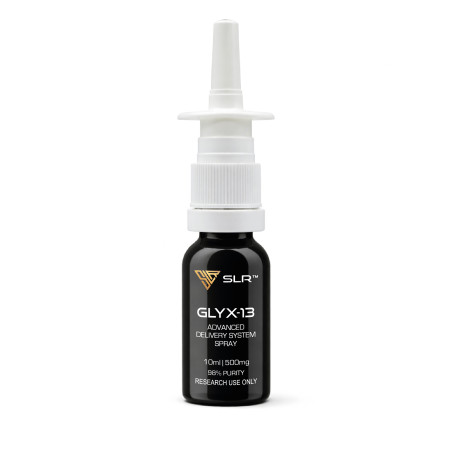
GLYX-13 - 10 ml/500mg - Spray
Glyx-13 has been investigated in preclinical, experimental, and clinical research for its role in NMDA receptor modulation, synaptic plasticity, cognitive processing, and rapid antidepressant-associated neuroadaptive signaling. In particular, research has explored its relevance in:
Rapid antidepressant response and reduction of depressive symptoms
Treatment-resistant depression research contexts
Synaptic plasticity and long-term potentiation (LTP)
NMDA receptor modulation and glutamatergic signaling
mTORC1-associated synaptic remodeling
Dendritic spine formation and synaptic protein expression
Cognitive function, attention, and memory-related processes
Prefrontal cortical signaling and adaptive neuronal responsiveness
Stress-related neural dysfunction
Neurobiological mechanisms distinct from ketamine, including the absence of psychotomimetic and dissociative effects in research settings
FRESHLY PREPARED SOLUTION
Description
ADVANCED DELIVERY SYSTEM - CELL PENETRATING PEPTIDE TECHNOLOGY
This product utilizes advanced delivery technology incorporating calibrated cell-penetrating peptide (CPP) systems. The formulation is engineered to support efficient and targeted intracellular delivery of active ingredients, contributing to enhanced transport performance and bioavailability.
SPECIFICATIONS
Product Code: G13500S
Sequence: Thr-Pro-Pro-Thr-NH2
Molecular Formula: C18H31N5O6
Molecular Weight: 413.47 g/mol
CAS: 117928-94-6
Purity: Technical / Research Grade ≥98%
Other details: No TFA Salt
Form: Liquid Solution
Color: Clear / Slightly opalescent
Total Content: 10 mL / 500 mg
Concentration: 50 mg/mL
Approximate Sprays per Bottle: ~82
Approximate Peptide per Spray: ~6.1 mg
Vehicle / Carrier System: Proprietary carrier system
Storage Temperature: 4°C (Do not freeze)
Source: Synthetic
Safety classification: Standard handling
DESCRIPTION
Glyx-13 is a short synthetic tetrapeptide that has been widely investigated in neuroscience research for its interaction with NMDA receptor–mediated signaling, a central system involved in synaptic plasticity, learning processes, adaptive neuronal communication, and mood-related neurobiology.
Unlike classical NMDA antagonists, Glyx-13 has been characterized as a functional modulator with partial agonist properties at the glycine site of the NMDA receptor. This mechanism allows it to influence receptor activity in a more regulatory and activity-dependent manner, rather than inducing broad, non-selective receptor blockade. As a result, it has attracted particular interest in experimental settings focused on synaptic plasticity, cognitive signaling, and rapid antidepressant-associated neuroadaptation.
NMDA receptors play a key role in:
- long-term potentiation (LTP)
- synaptic plasticity
- memory encoding
- adaptive neuronal signaling
- cortical network responsiveness
Balanced NMDA receptor activity is essential for normal neuronal function. Excessive activation may contribute to excitotoxic stress, while insufficient activity may impair plasticity and network efficiency. Glyx-13 has been investigated for its ability to support physiological NMDA receptor responsiveness under controlled conditions, enhancing activity-dependent signaling without causing indiscriminate overstimulation.
In experimental systems, Glyx-13 has been associated with:
- enhancement of long-term potentiation (LTP)
- improved synaptic signaling efficiency
- increased dendritic spine density
- modulation of AMPA receptor-related synaptic mechanisms
- support of adaptive neuronal remodeling
These effects are consistent with its proposed role as a synaptic plasticity modulator rather than a conventional stimulant or broad excitatory agent.
A major focus of Glyx-13 research has been its relevance to rapid antidepressant-associated mechanisms. Experimental findings indicate that a single dose of Glyx-13 rapidly activates the mTORC1 signaling pathway in the medial prefrontal cortex, a pathway strongly associated with synaptic protein synthesis, structural plasticity, and adaptive neuronal responses. Studies also show that its behavioral antidepressant-like effects are blocked when mTORC1 signaling is inhibited, supporting the importance of this pathway in the compound’s activity.
In parallel, Glyx-13 has been shown to rapidly increase the number and function of spine synapses in layer V pyramidal neurons of the medial prefrontal cortex. It has also been associated with increased levels of synaptic proteins such as GluR1 and synapsin I, both of which are relevant to synaptic strengthening and functional connectivity. These findings suggest that the observed effects are not limited to transient receptor modulation, but involve structural and functional synaptic adaptation that may persist beyond the period of acute exposure.
Particular interest has also emerged from human clinical research, where Glyx-13 has been investigated for rapid effects on depressive symptoms. In a Phase 2 clinical study, a single administration of GLYX-13 produced statistically significant reductions in depression scores in patients who had not responded adequately to conventional antidepressant treatments. These improvements were reported to become evident within 24 hours of administration and persisted for an average of approximately 7 days following a single dose. Preliminary observations have also indicated that improvements in depressive symptoms may begin within hours, highlighting the compound’s relevance in research on rapid-acting antidepressant mechanisms.
An especially notable feature of Glyx-13 is that these rapid antidepressant-associated effects were investigated in the absence of the psychotomimetic, dissociative, and abuse-related liabilities commonly associated with ketamine. Comparative studies reported that, while both ketamine and Glyx-13 enhance attention-related performance and activate synaptic plasticity pathways, Glyx-13 does not appear to produce the same serotonergic behavioral changes linked to psychotomimetic responses. This distinction has been considered highly relevant in research aimed at separating rapid antidepressant activity from dissociative side effects.
Additional experimental studies suggest that Glyx-13 may preferentially enhance hypocretin-sensitive thalamocortical signaling, while exerting less influence on 5-HT2A receptor–associated cortical circuitry compared with ketamine. This distinction may help explain why Glyx-13 has been associated with beneficial synaptic and behavioral effects without the hallucinogenic-like or impulsivity-related responses observed with certain NMDA antagonists.
From a cognitive and neurobiological perspective, Glyx-13 has been explored in relation to:
- learning and memory-associated signaling
- attention and adaptive behavioral processing
- prefrontal cortical synaptic remodeling
- hippocampal LTP-related processes
- glutamatergic and AMPA-dependent signaling
- stress-related neural dysfunction
- synaptic deficits associated with depressive states
Its activity-dependent profile is particularly important. Glyx-13 does not appear to simply increase baseline neuronal firing in a non-specific way; rather, it supports relevant synaptic strengthening in actively engaged circuits, a feature that may underlie both its cognitive and antidepressant research profile.
Overall, Glyx-13 is best understood as a rapid-acting NMDA receptor modulator with strong relevance to synaptic plasticity, prefrontal cortical signaling, and antidepressant-associated neuroadaptation. In research settings, it has been associated with enhanced LTP, increased spine synapse formation, activation of mTORC1-related pathways, improved attention-related performance, and rapid reductions in depressive symptom scores following single-dose administration in treatment-resistant human subjects. Its distinct profile relative to ketamine has made it a significant compound of interest in the study of how rapid antidepressant effects may be achieved without psychotomimetic burden.
REFERENCES
All information presented above is derived from in vitro experiments, animal studies, and other preclinical research models. These data are intended solely for basic scientific investigation of biological mechanisms and do not imply any therapeutic, diagnostic, preventive, or clinical use in humans or animals.
Rong-Jian Liu et al., "GLYX-13 Produces Rapid Antidepressant Responses with Key Synaptic and Behavioral Effects Distinct from Ketamine" [PubMed]
J. Burgdorf et al., "The long-lasting antidepressant effects of rapastinel (GLYX-13) are associated with a metaplasticity process in the medial prefrontal cortex and hippocampus" [PubMed]
J.R. Moskal et al., "GLYX-13, an NMDA receptor glycine site functional partial agonist enhances cognition and produces antidepressant effects without the psychotomimetic side effects of NMDA receptor antagonists" [PubMed]
J.R. Moskal et al., "The Development of Rapastinel (Formerly GLYX-13); A Rapid Acting and Long Lasting Antidepressant" [PubMed]
Po-Sheng Yang et al., "NMDA receptor partial agonist GLYX-13 alleviates chronic stress-induced depression-like behavior through enhancement of AMPA receptor function in the periaqueductal gray" [PubMed]
J. Burgdorf et al., "Rapastinel (GLYX-13) has therapeutic potential for the treatment of post-traumatic stress disorder: Characterization of a NMDA receptor-mediated metaplasticity process in the medial prefrontal cortex of rats" [PubMed]
J. Burgdorf et al., "The N-methyl-D-aspartate receptor modulator GLYX-13 enhances learning and memory, in young adult and learning impaired aging rats" [PubMed]
DISCLAIMER
This product is intendend for lab research and development use only. These studies are performed outside of the body. This product is not medicines or drugs and has not been approved by the FDA or EMA to prevent, treat or cure any medical condition, ailment or disease. Bodily introduction of any kind into humans or animals is strictly forbidden by law. This product should only be handled by licensed, qualified professionals.
All product information provided on this website is for informational and educational purposes only.
Data sheet
| Image | Ref. | Unit price | Weight | Avail. | Buy |
|---|---|---|---|---|---|
 | G13500S | €389.00 Discount by quantity 10+ €311.20 –20% 20+ €272.30 –30% 50+ €241.18 –38% 100+ €217.84 –44% 200+ €194.50 –50% | 0.000000 kg |  | |
| Total: 0,0 All prices with tax included. | |||||
Product is available Product is no longer in stock
 Product is no in stock, but is allowed to be back-ordered