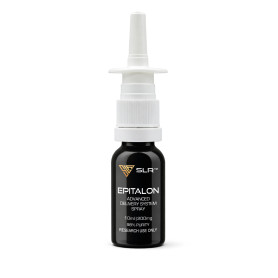
EPITALON - 10ml/200mg - Spray
€268.00



B7-33 has been investigated in preclinical research models related to:
Fibrotic tissue remodeling models
Vascular protection and endothelial signaling models
Cardiac injury and post-ischemic remodeling models
Pulmonary inflammation and fibrosis-related models
FRESHLY PREPARED SOLUTION
ADVANCED DELIVERY SYSTEM - CELL PENETRATING PEPTIDE TECHNOLOGY
This product utilizes advanced delivery technology incorporating calibrated cell-penetrating peptide (CPP) systems. The formulation is engineered to support efficient and targeted intracellular delivery of active ingredients, contributing to enhanced transport performance and bioavailability.
SPECIFICATIONS
Product Code: B73010S
Sequence: VIKLSGRELVRAQIAISGMSTWSKRSL-NH2
Molecular Formula: C131H229N41O36S
Molecular Weight: 2986.58 g/mol
CAS: 1818415-56-3
Purity: Technical / Research Grade ≥97%
Other details: No TFA Salt
Form: Liquid Solution
Color: Clear / Slightly opalescent
Total Content: 10 mL / 20 mg
Concentration: 2 mg/mL
Approximate Sprays per Bottle: ~82
Approximate Peptide per Spray: ~244 mcg
Vehicle / Carrier System: Proprietary carrier system
Storage Temperature: 4°C (Do not freeze)
Source: Synthetic
Safety classification: Standard handling
DESCRIPTION
B7-33 is a synthetic, single-chain peptide derived from human H2-relaxin, a naturally occurring member of the relaxin peptide family. It has been developed as a soluble research analog designed to retain specific anti-fibrotic and tissue-remodeling signaling properties of relaxin while exhibiting selective pathway activation under experimental conditions.
Relaxin-derived peptide biology (preclinical)
The relaxin peptide family includes several structurally related proteins—such as relaxin, insulin-like peptide 3, relaxin-3, and insulin-like peptide 5—which are evolutionarily related to insulin and have been shown in experimental studies to exert pleiotropic biological effects across multiple tissue systems. These effects have been explored in preclinical models involving musculoskeletal, cardiovascular, vascular, and reproductive biology.
B7-33 represents one of several synthetic peptides generated from H2-relaxin to investigate structure–function relationships within relaxin-mediated signaling.
Receptor signaling and pathway selectivity (preclinical)
Members of the relaxin peptide family signal through relaxin family peptide receptors (RXFPs), which are grouped into two main receptor pairs: RXFP1/2 and RXFP3/4. Experimental studies have associated these receptors with diverse biological roles, including vascular signaling, reproductive tissue regulation, neurobiological pathways, and metabolic signaling, depending on receptor subtype and tissue context.
In cell-based and animal models, B7-33 has been shown to bind preferentially to RXFP1, where it exhibits biased signaling, favoring activation of the ERK1/2 (pERK) pathway over the cAMP pathway. This signaling selectivity has been exploited in laboratory research to investigate downstream processes related to cell-cycle regulation, extracellular matrix turnover, and tissue remodeling.
Extracellular matrix remodeling and fibrosis-related research (preclinical)
In experimental systems, activation of ERK1/2 signaling by relaxin-derived peptides has been associated with increased expression of matrix metalloproteinases, including MMP-2, which play a role in collagen degradation and extracellular matrix remodeling. B7-33 has been used in preclinical models of fibrotic tissue remodeling to study how selective relaxin signaling influences collagen organization and scar formation at the molecular level.
Fibrosis—characterized by excessive or disorganized extracellular matrix deposition—has been extensively modeled in laboratory settings as a contributor to progressive tissue dysfunction in various organs. B7-33 has been applied in such models to explore mechanisms of abnormal wound healing and tissue repair, without implying therapeutic outcomes.
Cardiovascular and vascular biology research (preclinical)
Relaxin and relaxin-derived peptides have long been investigated in preclinical cardiovascular models for their involvement in vasodilation, vascular remodeling, and endothelial signaling. In animal studies, B7-33 has been used to examine vasoprotective mechanisms, including interactions with endothelial function and modulation of vascular tone through endothelium-dependent pathways.
Experimental comparisons between full-length H2-relaxin and B7-33 have focused on pathway-specific effects, particularly the dissociation of ERK-mediated tissue remodeling from cAMP-associated systemic effects, enabling researchers to study vascular signaling with reduced off-target pathway activation in laboratory models.
Cancer and proliferative signaling research (preclinical)
Because relaxin signaling has been implicated in cell proliferation and tissue growth, B7-33 has been examined in preclinical oncology-related models to investigate how selective pathway activation influences fibrosis-associated tumor microenvironments and stromal remodeling. In these models, B7-33 has been used to study extracellular matrix dynamics without promoting cAMP-driven proliferative signaling observed with full-length relaxin proteins.
Reproductive and placental biology research (preclinical)
In experimental reproductive biology models, relaxin signaling has been studied for its role in placental vascular development and endothelial function. B7-33 has been explored in in vitro and animal systems to investigate RXFP1-mediated signaling in trophoblast-related cells and its relationship to angiogenic factor expression, including pathways associated with vascular endothelial growth factor (VEGF).
These investigations aim to characterize maternal–fetal vascular signaling mechanisms under controlled laboratory conditions.
Comparative relaxin analog research (preclinical)
The development of B7-33 has been driven in part by the limitations observed with full-length relaxin proteins in experimental use, including manufacturing complexity, delivery constraints, and broad pathway activation. As a result, B7-33 has been employed as a research-selective analog to dissect the contributions of ERK-biased signaling to tissue protection, fibrosis modulation, and vascular remodeling in non-clinical models.
REFERENCES
All information presented above is derived from in vitro experiments, animal studies, and other preclinical research models. These data are intended solely for basic scientific investigation of biological mechanisms and do not imply any therapeutic, diagnostic, preventive, or clinical use in humans or animals.
M.A. Hossain et al., "A single-chain derivative of the relaxin hormone is a functionally selective agonist of the G protein-coupled receptor, RXFP1" [PubMed]
S.A. Marshall et al., "B7-33 replicates the vasoprotective functions of human relaxin-2 (serelaxin)" [PubMed]
R.J. Summers "Recent progress in the understanding of relaxin family peptides and their receptors" [NCBI]
DISCLAIMER
This product is intendend for lab research and development use only. These studies are performed outside of the body. This product is not medicines or drugs and has not been approved by the FDA or EMA to prevent, treat or cure any medical condition, ailment or disease. Bodily introduction of any kind into humans or animals is strictly forbidden by law. This product should only be handled by licensed, qualified professionals.
All product information provided on this website is for informational and educational purposes only.
| Image | Ref. | Unit price | Weight | Avail. | Buy |
|---|---|---|---|---|---|
| B73010S | €238.00 Discount by quantity 10+ €195.16 –18% 20+ €171.36 –28% 50+ €147.56 –38% 100+ €130.90 –45% 200+ €119.00 –50% | 0.100000 kg |  | |
| Total: 0,0 All prices with tax included. | |||||
Product is available Product is no longer in stock
 Product is no in stock, but is allowed to be back-ordered