
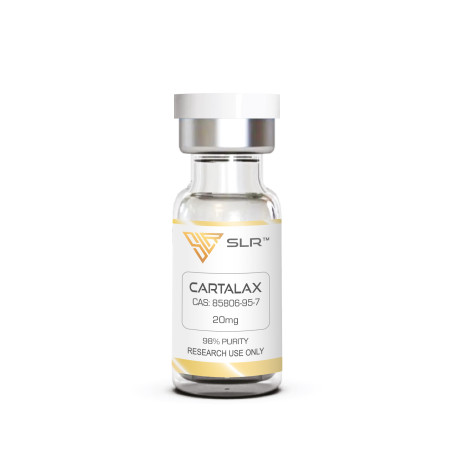
CARTALAX - 20mg
Cartalax is a synthetic short bioregulatory tripeptide composed of Alanine, Glutamic Acid, and Aspartic Acid (Ala-Glu-Asp). It has been investigated in preclinical research for its potential role in regulating chondrocyte activity, maintaining extracellular matrix homeostasis, and supporting cartilage biology. Experimental studies suggest that Cartalax may influence gene expression and protein synthesis involved in connective tissue maintenance rather than acting as a structural replacement for cartilage components. Ongoing research explores its relevance in models of cartilage aging, extracellular matrix remodeling, and musculoskeletal tissue regulation. All available data are derived from laboratory and preclinical investigations, and further independent studies are required to fully characterize its biological mechanisms and potential applications.
Description
SPECIFICATIONS
Product Code: CRT020D
Sequence: Ala-Glu-Asp
Molecular Formula: C12H19N3O8
Molecular Weight: 333.29 g/mol
CAS: 85806-95-7
Purity: Technical / Research Grade 98%
Other details: No TFA Salt
Form: Lyophilized powder
Color: White
Storage temperature: -20°C
Source: Synthetic
Safety classification: Standard handling
DESCRIPTION
Cartalax is a short synthetic bioregulatory peptide composed of three amino acids—Alanine, Glutamic Acid, and Aspartic Acid—arranged in the primary sequence Ala-Glu-Asp. Originally developed within the bioregulatory peptide research program conducted by the St. Petersburg Institute of Bioregulation and Gerontology, Cartalax has been investigated as a regulatory peptide with potential relevance to cartilage biology, connective tissue homeostasis, and musculoskeletal function. Due to its small molecular size, the peptide has attracted interest as a model compound for studying peptide-mediated regulation of cellular activity and tissue maintenance rather than as a structural component of the extracellular matrix itself.
Experimental research has primarily focused on Cartalax because cartilage possesses a very limited intrinsic regenerative capacity. Articular cartilage is an avascular tissue composed mainly of extracellular matrix synthesized and maintained by highly specialized cells known as chondrocytes. These cells are responsible for producing structural macromolecules such as type II collagen, aggrecan, and other proteoglycans that provide cartilage with its characteristic elasticity, compressive resistance, and mechanical stability. During aging, chronic mechanical stress, inflammation, or degenerative processes, chondrocyte activity may decline, leading to progressive deterioration of extracellular matrix composition and reduced tissue integrity. For this reason, short regulatory peptides capable of influencing chondrocyte function have become subjects of increasing interest in experimental cartilage biology.
According to the proposed mechanism described in preclinical studies, Cartalax has been designed to interact with regulatory processes occurring within chondrocytes and connective tissue cells. Rather than acting as a replacement for structural proteins, the peptide has been investigated for its potential ability to influence gene expression and cellular protein synthesis through epigenetic or transcriptional regulatory mechanisms. Research suggests that short bioregulatory peptides may bind specific regions of DNA or chromatin-associated proteins, thereby contributing to the normalization of gene expression patterns involved in cellular maintenance and tissue homeostasis. Although the precise molecular mechanism remains under investigation, this hypothesis forms the basis for ongoing research into Cartalax and related bioregulatory peptides.
Within experimental models, the intended biological objective of Cartalax is to support the normal physiological activity of chondrocytes by promoting balanced synthesis of extracellular matrix components while helping preserve normal cellular metabolism under conditions associated with aging or prolonged mechanical stress. By maintaining appropriate cellular activity rather than directly stimulating uncontrolled proliferation, Cartalax is being investigated as a research tool for understanding the molecular regulation of cartilage maintenance, connective tissue remodeling, and musculoskeletal aging.
Because cartilage degeneration represents a central feature of numerous musculoskeletal disorders, Cartalax has also been explored in preclinical research involving age-related changes in cartilage physiology, experimental models of connective tissue degeneration, and studies investigating the regulation of extracellular matrix turnover. Current evidence remains limited and is largely derived from experimental laboratory investigations. Additional independent research is required to further clarify its molecular targets, biological mechanisms, and potential role in cartilage biology and connective tissue regulation.
DISCLAIMER
This product is intended for laboratory research and development use only. These studies are performed outside of the body. This product is not a medicine or drug and has not been approved by the FDA or EMA to prevent, treat, or cure any medical condition, ailment, or disease. Bodily introduction of any kind into humans or animals is strictly forbidden by law. This product should only be handled by licensed, qualified professionals.
All product information provided on this website is for informational and educational purposes only.
Data sheet
Customers who bought this product also bought:
| Image | Ref. | Unit price | Weight | Avail. | Buy |
|---|---|---|---|---|---|
 | CRT020D | €72.00 Discount by quantity 10+ €61.20 –15% 20+ €51.84 –28% 50+ €43.20 –40% 100+ €37.44 –48% 200+ €32.40 –55% | 0.000000 kg |  | |
| Total: 0,0 All prices with tax included. | |||||
Product is available Product is no longer in stock
 Product is no in stock, but is allowed to be back-ordered