BACTERIOSTATIC WATER - 30ml
€19.50

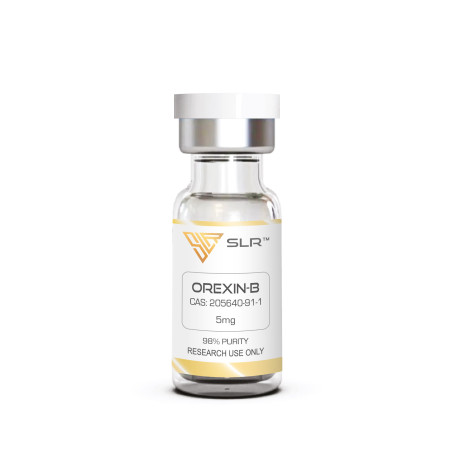

Research indicates that Orexin-B is a neuropeptide involved in the regulation of wakefulness and arousal. It has been studied for its role in appetite-related signaling, locomotor activity, and modulation of sympathetic nervous system tone. Through its interactions with orexin receptors, Orexin-B contributes to neural pathways associated with vigilance, energy balance, and autonomic regulation.
SPECIFICATIONS
Product Code: ORB005
Sequence: RSGPPGLQGRLQRLLQASGNHAAGILTM-NH₂
Modification: Met-28 C-terminal amide
Molecular Formula: C123H212N44O35S
Molecular Weight: 2899.36 g/mol
CAS: 205640-91-1
Purity: Technical / Research Grade 98%
Other details: No TFA Salt
Form: Lyophilized powder
Color: White
Storage temperature: -20°C
Source: Synthetic
Safety classification: Standard handling
DESCRIPTION
Orexin neuropeptides were identified in 1998 by two independent research groups. Sakurai and Yanagisawa named them orexin-A and orexin-B due to their initially proposed involvement in appetite regulation (orexis = appetite), while de Lecea and Sutcliffe referred to them as hypocretin-1 and hypocretin-2, reflecting their hypothalamic origin.
Subsequent research demonstrated that orexin peptides exert limited effects on feeding but play a fundamental role in arousal and sleep regulation. Narcolepsy has been strongly associated with the loss of orexin-producing neurons, leading to significant interest in orexin receptor modulation in sleep research.
Orexin-A and orexin-B are released by neurons in the lateral hypothalamus and regulate wakefulness by stimulating brain regions including the raphe nuclei, ventral tegmental area, tuberomammillary nucleus, and locus coeruleus. Through activation of these structures, orexins modulate dopamine, norepinephrine, serotonin, and histamine signaling, stabilizing transitions between wakefulness and REM/non-REM sleep.
Approximately 90% of individuals with narcolepsy and cataplexy exhibit low or undetectable orexin levels in cerebrospinal fluid, reflecting reduced hypothalamic orexinergic neurons.
Orexin peptides and their receptors—orexin receptor 1 (OXR1) and orexin receptor 2 (OXR2)—are central to sleep–wake homeostasis. Dysregulation of this system is implicated in narcolepsy and disorders characterized by altered vigilance states.
Animal studies confirm that activation of orexin pathways increases arousal, whereas inhibition promotes sleep. Orexinergic neurons interact dynamically with inhibitory GABAergic neurons from the ventrolateral preoptic nucleus (VLPO), maintaining balance between arousal-promoting and sleep-promoting systems.
Beyond sleep regulation, orexin peptides contribute to thermoregulation. Animal models lacking orexin neurons exhibit altered responses to cold exposure, suggesting involvement in thermogenic homeostasis.
Hypocretin-1 levels in cerebrospinal fluid have been examined in chronic migraine and medication-overuse headache, where altered concentrations have been reported. Migraine prevalence is increased among narcoleptic individuals, suggesting potential involvement of hypocretin signaling in headache-related mechanisms.
Orexin-A and orexin-B influence central and peripheral nervous system processes including metabolism, neuroendocrine signaling, autonomic regulation, and immune-related pathways. Orexin receptors are G protein-coupled receptors (GPCRs), with OXR1 and OXR2 as the primary subtypes. Orexin-A binds both receptors with similar affinity, while orexin-B preferentially binds OXR2.
Experimental findings indicate that orexin-A can cross the blood–brain barrier via passive diffusion, whereas orexin-B does not appear to share this property to the same extent. Receptor distribution varies by region, with OXR1 prevalent in dorsal raphe and hippocampal regions, and OXR2 predominantly expressed in basal ganglia structures.
Research suggests that orexin signaling may influence inflammatory and neuronal responses in models of cerebral ischemia. Orexin peptides also modulate autonomic activity, sympathetic tone, cardiovascular parameters, energy expenditure, and locomotor activity.
Animal models deficient in orexin signaling demonstrate reduced metabolic rate and altered energy balance. Similarly, individuals with narcolepsy often exhibit differences in body weight and metabolic regulation, reflecting the broader physiological role of orexin pathways.
REFERENCES
All observations described above originate from in vitro systems, animal studies, or other preclinical experimental models. They are intended solely to support basic research into molecular, cellular, and physiological mechanisms and do not imply therapeutic, diagnostic, or preventive applications in humans or animals.
C.B. Calva et al., “Effects of Intranasal Orexin-A (Hypocretin-1) Administration on Neuronal Activation, Neurochemistry, and Attention in Aged Rats” [Frontiers in Aging Neuroscience]
Tao Li et al., “Orexin A alleviates neuroinflammation via OXR2/CaMKKβ/AMPK signaling pathway after ICH in mice” [BMC]
T.E. Scammell et al., “Orexin Receptors: Pharmacology and Therapeutic Opportunities” [PMC]
M. Lang et al., “Structure–Activity Studies of Orexin A and Orexin B at Human Orexin Receptors” [Journal of Medicinal Chemistry]
A. Yamanaka et al., “Orexin Directly Excites Orexin Neurons through Orexin 2 Receptor” [The Journal of Neuroscience]
J.P. Nixon et al., “Distribution of immunoreactive orexin A and B in nocturnal and diurnal rodents” [BMC]
S. Goodrick, “Orexin or hypocretin?” [The Lancet]
M. Mieda et al., “Orexin peptides prevent cataplexy and improve wakefulness in narcolepsy models” [PNAS]
K. Bieganska et al., “Orexin A Suppresses the Growth of Rat C6 Glioma Cells” [Journal of Molecular Neuroscience]
J.E. Digby et al., “Orexin receptor expression in human adipose tissue” [Journal of Endocrinology]
K. Hirota et al., “Orexin A and B evoke noradrenaline release” [British Journal of Pharmacology]
DISCLAIMER
This product is intended for laboratory research and development use only. These studies are performed outside of the body. This product is not a medicine or drug and has not been approved by the FDA or EMA to prevent, treat, or cure any medical condition, ailment, or disease. Bodily introduction of any kind into humans or animals is strictly forbidden by law. This product should only be handled by licensed, qualified professionals.
All product information provided on this website is for informational and educational purposes only.
| Image | Ref. | Unit price | Weight | Avail. | Buy |
|---|---|---|---|---|---|
| ORB005 | €120.00 Discount by quantity 10+ €102.00 –15% 20+ €86.40 –28% 50+ €72.00 –40% 100+ €62.40 –48% 200+ €54.00 –55% | 0.000000 kg |  | |
| Total: 0,0 All prices with tax included. | |||||
Product is available Product is no longer in stock
 Product is no in stock, but is allowed to be back-ordered