
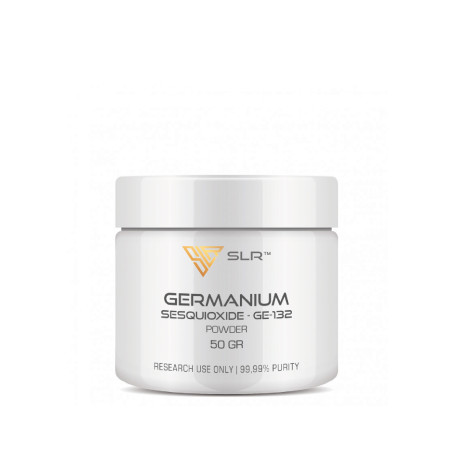
GERMANIUM SESQUIOXIDE GE-132 - 99,99% - 50g
Organic Germanium GE-132 (carboxyethylgermanium sesquioxide) is a water-soluble organogermanium compound investigated for its effects on immune signaling, chemokine regulation, and oxidative stress pathways.
Research consistently highlights modulation of the CCL2–CCR2 chemokine axis, which influences monocyte recruitment and macrophage trafficking, as well as induction of interferon-associated pathways with activation of NK cells and macrophages in experimental models. GE-132 has also been shown to suppress NF-κB and MAPK signaling and reduce inflammatory mediators under controlled conditions.
Another key feature is redox modulation. Several studies report protection against hydrogen peroxide–induced oxidative stress, increased intracellular glutathione, reduced LDL oxidation, elevated α-tocopherol levels, and improved antioxidant enzyme activity. In vitro data also indicate increased cellular ATP levels and potential support of mitochondrial bioenergetics.
Preclinical oncology research describes effects on tumor microenvironment regulation, macrophage M1 gene polarization, inhibition of the CCL2 pathway, and reduction of tumor progression. Additional experimental contexts include vascular inflammation, myocardial remodeling, neuroinflammatory paradigms, hepatic oxidative injury, antiviral immune signaling, and wound healing biology.
Description
SPECIFICATIONS
Product Code: GES050P
Synonyms: Organic Germanium (GE-132); Carboxyethylgermanium Sesquioxide
Molecular Formula: C6H10Ge2O7
Molecular Weight: 339.42 g/mol
CAS: 12758-40-6
Purity: Technical / Research Grade 99.99% (lot-specific; verify on COA)
Form: Solid (powder / crystalline powder)
Color: White to off-white
Storage Temperature: Store in a cool, dry place; keep container tightly closed
Source: Synthetic (organogermanium compound)
Safety Classification: Standard laboratory handling
DESCRIPTION
Germanium Sesquioxide – Organic Germanium GE-132 (carboxyethylgermanium sesquioxide) is an organogermanium compound extensively investigated in experimental biology for its interaction with immune signaling networks, chemokine-mediated inflammatory pathways, oxidative stress systems, and cellular metabolic regulation.
Organic, water-soluble derivatives such as GE-132 were originally synthesized to improve biocompatibility compared to inorganic germanium compounds. In aqueous solution, GE-132 undergoes hydrolysis to form 3-(trihydroxygermyl)propanoic acid (THGP), a biologically active monomer evaluated in multiple mechanistic research models.
Research literature has primarily focused on:
- Immune pathway modulation
- Chemokine signaling regulation (CCR2 / CCL2 axis)
- Macrophage trafficking dynamics
- Redox balance and oxidative stress modulation
- Mitochondrial bioenergetics
- Tumor-microenvironment immune signaling
CCR2 / CCL2 Axis Modulation
One of the most documented mechanistic pathways associated with GE-132 is modulation of the CCR2 chemokine receptor axis, a regulator of monocyte recruitment and macrophage trafficking. Experimental studies indicate interference with CCR2-dependent signaling, resulting in reduced monocyte/macrophage infiltration in inflammatory and cardiovascular research models.
In tumor-related experimental systems, modulation of the CCL2–CCR2 pathway has been associated with:
- Reduced tumor burden in animal models
- Decreased tumor-associated macrophage infiltration
- Altered metastatic niche formation
These findings position GE-132 as a modulator of immune cell trafficking rather than a direct cytotoxic compound.
Interferon Induction and Innate Immune Signaling
Early experimental investigations demonstrated induction of interferon-related signaling following GE-132 exposure in murine models.
Reported biological observations include:
- Activation of NK cell pathways
- Enhanced macrophage functional activity
- Modulation of IFN-γ signaling
- Altered T-cell response patterns
Redox and Oxidative Stress Modulation
GE-132 exhibits redox-related biological activity in laboratory models. In vitro studies have reported:
- Protection against hydrogen peroxide-induced oxidative stress
- Increased intracellular glutathione levels
- Reduction in reactive oxygen species (ROS)
- Preservation of antioxidant enzyme activity
In vivo research models have described modulation of lipid oxidation and antioxidant biomarkers, supporting its relevance in oxidative stress research.
Mitochondrial Bioenergetics
Cellular studies suggest that GE-132 may influence ATP production and oxidative phosphorylation-related pathways under experimental conditions. These findings connect the compound to research in cellular energy metabolism and mitochondrial function.
Musculoskeletal and Regenerative Research
CCR2-mediated monocyte recruitment plays a role in inflammatory tissue injury models. Experimental observations indicate that GE-132 influences macrophage infiltration and cytokine signaling in musculoskeletal and joint-related research contexts.
Cardiovascular Research
Preclinical studies have explored the role of organogermanium compounds in vascular inflammation, atherosclerosis models, and post-injury cardiac remodeling. Reported outcomes include altered macrophage activation and modulation of inflammatory cell recruitment.
Neuroimmune and Neuroinflammatory Research
Because chemokine signaling and oxidative stress contribute to neuroinflammatory models, GE-132 has been referenced in research investigating immune–neural pathway interactions.
Summary of Mechanistic Themes
Across the literature, the most consistent biological themes associated with GE-132 include:
- CCR2 chemokine receptor modulation
- Interferon-related signaling
- NK and macrophage pathway activation
- NF-κB pathway modulation
- Redox and ROS regulation
- ATP and mitochondrial function research
All observations described above originate from in vitro systems, animal studies, or other preclinical experimental contexts and are intended exclusively for scientific investigation.
REFERENCES
X. Luo et al., "The role of germanium in diseases: exploring its important biological effects" [PubMed]
B.J. Kaplan et al., "Germane facts about germanium sesquioxide: I. Chemistry and anticancer properties" [PubMed]
T. Takeda et al., "Organogermanium suppresses cell death due to oxidative stress in normal human dermal fibroblasts" [PMC]
A. Fujii et al., "Effect of organic germanium compound (Ge-132) on experimental osteoporosis in rats" [PubMed]
M.K. Yang et al., "Protective role of germanium-132 against paraquat-induced oxidative stress in the livers of senescence-accelerated mice" [PubMed]
K. Aizawa et al., "Organogermanium: Potential beneficial effects on the cardiovascular system" [PMC]
DISCLAIMER
This product is intended strictly for laboratory research and development use only. This material is not a medicine or drug and has not been evaluated or approved by the FDA, EMA, or any regulatory authority for the prevention, treatment, or cure of any disease. Any form of administration to humans or animals is strictly prohibited. Handling is restricted to qualified laboratory professionals.
All product information provided on this website is for informational and educational purposes only.
Data sheet
Customers who bought this product also bought:
TALTIRELIN - 10mg, 100mg
MOTS-c - 40mg
PINEALON - 100mg
α-Klotho - 25mcg
REJUV RESEARCH 1
TESTAGEN - 40mg
TISSUE REPAIR - 30ml
BACTERIOSTATIC WATER - 30ml
| Image | Ref. | Unit price | Weight | Avail. | Buy |
|---|---|---|---|---|---|
 | GES050P | €189.00 Discount by quantity 10+ €154.98 –18% 20+ €136.08 –28% 50+ €117.18 –38% 100+ €105.84 –44% 200+ €94.50 –50% | 0.100000 kg |  | |
| Total: 0,0 All prices with tax included. | |||||
Product is available Product is no longer in stock
 Product is no in stock, but is allowed to be back-ordered