
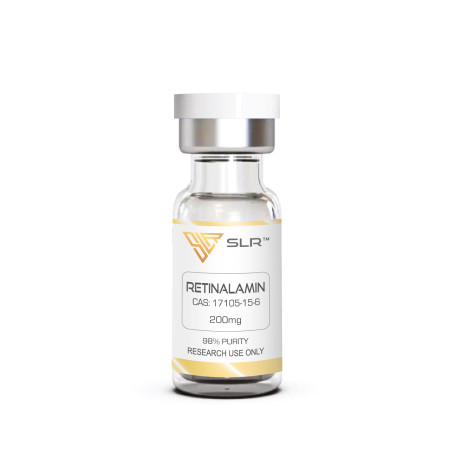
RETINALAMIN - 200 mg
Research suggests that Retinalamin is of interest in ophthalmology and retinal-support research due to its potential role in supporting retinal tissue function, microcirculation, and recovery mechanisms under conditions of degeneration or vascular stress. Studies indicate that it may be relevant in a range of retinal and vision-related disorders, including diabetic retinopathy, myopic disease, retinitis pigmentosa, age-related macular degeneration (AMD), chorioretinitis, primary open-angle glaucoma, and other eye diseases associated with impaired retinal performance and progressive vision decline.
Description
SPECIFICATIONS
Product Code: RET200
Sequence: H-Glu(H-Lys-OH)-OH
Molecular Formula: C11H21N3O5
Molecular Weight: 275.30 g/mol
CAS: 17105-15-6
Purity: Technical / Research Grade ≥98%
Other details: No TFA Salt
Form: Lyophilized powder
Color: White
Storage temperature: -20°C
Source: Synthetic
Safety classification: Standard handling
DESCRIPTION
The retina, the neural layer of the eyeball, is one of the thinnest and most specialized tissues in the human body. It is responsible for light perception, color recognition, and image processing, converting visual stimuli into neural signals transmitted to the brain. Due to its anatomical position and vascular characteristics, the retina is particularly vulnerable to oxidative stress, radiation, metabolic imbalance, and systemic diseases.
Retinal impairment may occur in conditions such as hypertension, diabetes mellitus, renal insufficiency, vascular disorders, and metabolic syndromes. Smoking and excessive alcohol consumption may further contribute to retinal damage. Severe retinal degeneration can lead to significant visual impairment and, in advanced cases, blindness.
Among the most common retinal diseases are age-related macular degeneration, hereditary retinal degenerations (including retinitis pigmentosa), complicated myopia, and diabetic retinopathy. Conventional pharmacological approaches do not always provide sustained improvement, and disease progression may continue despite treatment.
In the mid-1980s, research conducted at the S.M. Kirov Military Medical Academy in Saint Petersburg under the direction of V.Kh. Khavinson contributed to the development of peptide-based regulatory approaches in biological systems. According to this concept, short peptides may influence protein synthesis and cellular repair processes through regulatory mechanisms.
One of the early peptide preparations developed in this context was Retinalamin, a peptide complex derived from animal retinal tissue. Clinical observations suggested supportive effects on retinal function in conditions such as retinal vein thrombosis, glaucoma-related changes, hemorrhagic retinopathies, photic injury, laser-induced damage, and other retinal pathologies.
Subsequent research explored short synthetic peptide analogues designed to replicate or refine the regulatory activity of complex tissue-derived preparations. These peptides (typically 2–4 amino acids in length) were associated with retina, pineal gland, cortex, thymus, vascular tissue, and other organs.
Diabetic Retinopathy
Diabetic retinopathy is a progressive complication of diabetes mellitus characterized by microvascular damage. Oxidative stress plays a central role in its pathogenesis. Peptide bioregulators have been described as potentially influencing antioxidant defense mechanisms and supporting vascular wall integrity. Observational reports suggest possible reduction of edema, hemorrhage, and vascular permeability through modulation of intracellular regulatory processes.
Retinitis Pigmentosa
Retinitis pigmentosa is a hereditary degenerative retinal disorder. Observational data from peptide bioregulator courses have reported widening of visual fields and improved electrophysiological indices (ERG). Improvements in visual acuity and scotopic vision have been described following structured treatment cycles.
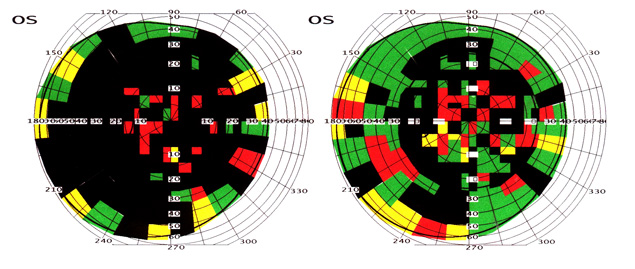
Clinical observations indicated that effects may become apparent approximately one month after treatment and may remain stable for several months.
Age-Related Macular Degeneration
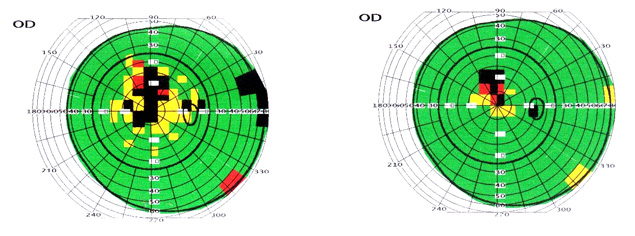
Supportive use of peptide bioregulators has been described in both wet and dry forms of macular degeneration. Reported findings included widening of visual fields and improved ERG indices following treatment cycles.
Other Retinal Conditions
Encouraging observations have been reported in cases of high myopia, retinal degenerations, and macular retinopathies of various etiologies (including inflammatory, photic, and laser-induced injuries). Electrophysiological studies suggested improved retinal functional activity, particularly in central retinal regions.
Primary Open-Angle Glaucoma
Clinical reports describe stabilization of visual field parameters, increased visual acuity, and preservation of retinal nerve fiber layer thickness following peptide-based retinoprotective approaches. In comparative groups without such intervention, disease progression was more frequently observed.
REFERENCES
All information presented above is derived from in vitro experiments, animal studies, or clinical observations intended to explore biological mechanisms. These data do not imply therapeutic, diagnostic, or preventive claims.
J. Ambati et al., "Age-related eye disease study caveats" [PubMed]
N.V. Makashova et al., "Application of Retinalamin for glaucomatous optic neuropathy" [PubMed]
A.A. Suetov et al., "Retinoprotective effects of Retinalamin in photochemical damage model" [PubMed]
V.Kh. Khavinson et al., "Effects of peptides on proliferative activity of retinal cells" [PubMed]
D.A. Dorofeev et al., "Effect of retinal protective therapy on OCT angiography" [PubMed]
DISCLAIMER
This product is intended for laboratory research and development use only. It is not a medicine or drug and has not been approved by the FDA or EMA to prevent, treat, or cure any medical condition.
Bodily introduction into humans or animals is strictly prohibited. This product should be handled only by qualified professionals.
All product information is provided for informational and educational purposes only.
Data sheet
Customers who bought this product also bought:
L-GLUTATHIONE - 500mg
HUMANIN G - 10mg
FOX04 - DRI - 30mg
CORTAGEN -100mg
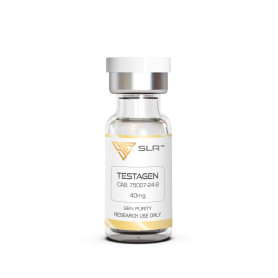
TESTAGEN - 40mg
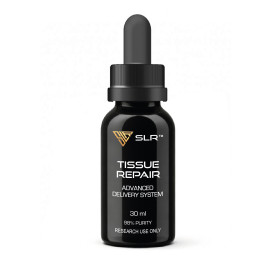
TISSUE REPAIR - 30ml
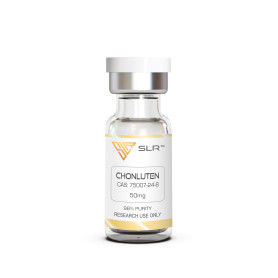
CHONLUTEN - 50mg
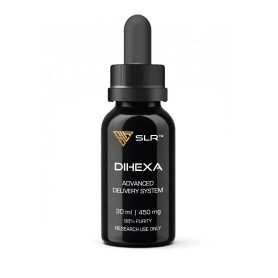
DIHEXA - 30ml/450mg
AOD9604 - 5mg
| Image | Ref. | Unit price | Weight | Avail. | Buy |
|---|---|---|---|---|---|
 | RET200 | €259.00 Discount by quantity 10+ €212.38 –18% 20+ €186.48 –28% 50+ €160.58 –38% 100+ €145.04 –44% 200+ €129.50 –50% | 0.000000 kg |  | |
| Total: 0,0 All prices with tax included. | |||||
Product is available Product is no longer in stock
 Product is no in stock, but is allowed to be back-ordered