GHK-CU - 30ml/600mg
€152.00

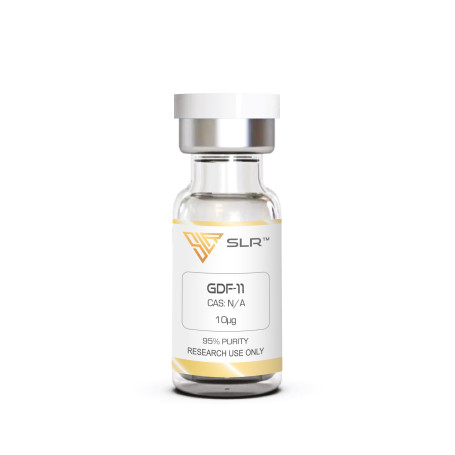

GDF11 has been shown to improve the outcomes of neurodegenerative and neurovascular diseases, increase the amount of skeletal muscle and boost muscular strength. It also has the power to reverse age-related degenerative alterations, as well as govern organ and skin regeneration following damage. These are all examples of its biological effects, which include reversing senescence.
SPECIFICATIONS
Product Code: GD1010
Product Name: GDF11 Protein (Human Growth Differentiation Factor 11), also known as BMP-11
Structure: Recombinant human GDF-11 disulfide-linked homodimer containing two 109-amino-acid polypeptide chains
Sequence: NLGLDCDEHS SESRCCRYPL TVDFEAFGWD WIIAPKRYKA NYCSGQCEYM FMQKYPHTHL VQQANPRGSA GPCCTPTKMS PINMLYFNDK QQIIYGKIPG MVVDRCGCS
Molecular Weight: 25 kDa
Purity: Technical / Research Grade ≥95%
Salt Form: No TFA Salt
Form: Lyophilized powder
Color: White
Storage Temperature: -20°C
Source: Recombinant
Safety Classification: Standard laboratory handling
DESCRIPTION
Growth Differentiation Factor 11 (GDF11), also known as Bone Morphogenetic Protein 11 (BMP-11), is a member of the transforming growth factor-β (TGF-β) superfamily of signaling proteins. In humans, GDF11 is encoded by the GDF11 gene and is expressed in multiple tissues, including skeletal muscle, pancreas, kidney, nervous system, retina, and cardiovascular tissue.
As both a circulating and locally acting signaling molecule, GDF11 is involved in the regulation of cellular differentiation, tissue development, and regenerative processes under physiological and experimental conditions.
GDF11 has attracted scientific interest due to its reported involvement in age-associated biological pathways and tissue homeostasis. Experimental studies indicate that circulating and tissue levels of GDF11 may vary with age and may influence regenerative capacity across different organ systems in preclinical models.
Cardiac tissue represents one of the most extensively investigated systems in GDF11 research. In experimental settings, reduced GDF11 expression has been observed in aged myocardium and following ischemic damage, while elevation of GDF11 expression has been associated with improvements in structural and functional cardiac parameters in animal models.
Within the nervous system, GDF11 has been explored in relation to neurogenesis, vascular support, and maintenance of neural tissue integrity in laboratory and animal studies.
GDF11 has also been studied for its influence on progenitor and stem cell populations in various tissues. Experimental data suggest that GDF11 can modulate proliferation and differentiation of progenitor cells through canonical TGF-β/Smad signaling pathways.
In dermatological research models, GDF11 has been examined in relation to keratinocyte differentiation and dermal fibroblast function. In vitro exposure to recombinant GDF11 has been associated with modulation of extracellular matrix components, including collagen types I and III and fibronectin.
Mesenchymal stem cells (MSCs) have been identified as a source of GDF11 secretion. Research suggests that MSC-derived GDF11 may contribute to paracrine signaling mechanisms involved in tissue remodeling under experimental conditions.
At the molecular level, GDF11 activates Smad2/3 phosphorylation, consistent with its classification within the TGF-β superfamily. This signaling activity has been linked to regulation of cellular growth, differentiation, and extracellular matrix production in laboratory models.
All observations described above originate from in vitro systems, animal studies, or other preclinical research contexts and are intended exclusively for scientific investigation.
REFERENCES
C. Zhang et al., "Growth differentiation factor 11 promotes differentiation of MSCs into endothelial-like cells for angiogenesis" [PubMed]
Guo-Qing Du et al., "Targeted myocardial delivery of GDF11 gene rejuvenates the aged mouse heart and enhances myocardial regeneration after ischemia-reperfusion injury" [PubMed]
Y. Ma et al., "Growth differentiation factor 11: a 'rejuvenation factor' involved in regulation of age-related diseases?" [PubMed]
Y. Zhao et al., "GDF11 enhances therapeutic efficacy of mesenchymal stem cells for myocardial infarction via YME1L-mediated OPA1 processing" [PubMed]
L. Rochette et al., "Neuroprotective Potential of GDF11: Myth or Reality?" [PubMed]
L. Zhao et al., "TERT assists GDF11 to rejuvenate senescent VEGFR2+/CD133+ cells in elderly patients with myocardial infarction" [PubMed]
C. Zhang et al., "GDF11 enhances therapeutic functions of mesenchymal stem cells for angiogenesis" [PubMed]
DISCLAIMER
This product is intended strictly for laboratory research and development use only. It is not a medicine or drug and has not been approved by the FDA, EMA, or any regulatory authority for the prevention, diagnosis, treatment, or cure of any disease or medical condition.
Bodily introduction into humans or animals is strictly prohibited. This material must be handled exclusively by qualified laboratory professionals.
All product information provided on this website is for informational and educational purposes only.
| Image | Ref. | Unit price | Weight | Avail. | Buy |
|---|---|---|---|---|---|
| GD1010 | €119.00 Discount by quantity 10+ €101.15 –15% 20+ €85.68 –28% 50+ €71.40 –40% 100+ €61.88 –48% 200+ €53.55 –55% | 0.050000 kg |  | |
| Total: 0,0 All prices with tax included. | |||||
 Product is available
 Product is no longer in stock Product is no in stock, but is allowed to be back-ordered