GDF-8 – 1mg
€90.00

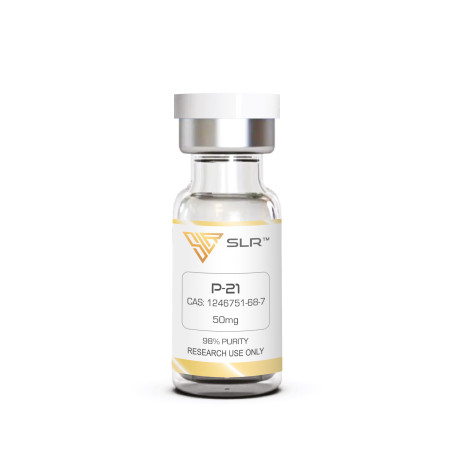


Research indicates that P21 is associated with increased levels of brain-derived neurotrophic factor (BDNF), a key molecule involved in neuronal development and synaptic plasticity. BDNF is linked to enhanced neurogenesis and has been shown in experimental models to modulate biological pathways related to amyloid plaque and tau protein formation, both of which are characteristic features of Alzheimer’s disease pathology.
In addition, multiple studies suggest that P21 supports learning processes and cognitive performance by promoting neuroplastic mechanisms and maintaining synaptic function in the central nervous system.
SPECIFICATIONS
Product Code: P21050
Sequence: Ac-DGGL-adamantane-G-NH₂
Molecular Formula: C30H54N6O5
Molecular Weight: 578.3 g/mol
CAS: 1246751-68-7
Purity: Technical / Research Grade ≥98%
Other Details: No TFA Salt
Form: Lyophilized powder
Color: White
Storage Temperature: -20°C
Source: Synthetic
Safety Classification: Standard handling
Note: P-21 comprises an adamantyl group at the C- and/or N-terminal end. The compound was developed from the neurogenic undecamer Ac-VGDGGLFEKKL-NH₂ (Peptide 6). A truncated tetramer Ac-DGGL-NH₂ (Peptide 6c) retained neurogenic properties. Addition of an adamantane-based unnatural amino acid to the C-terminus via solid-phase peptide synthesis generated Ac-DGGLAG-NH₂ (P21).
DESCRIPTION
P21 is a short synthetic peptide derived from ciliary neurotrophic factor (CNTF), a human protein involved in neuronal development and survival. Native CNTF plays a role in neuronal maturation and maintenance but presents limitations due to unfavorable pharmacokinetics, limited plasma stability, inability to efficiently cross the blood–brain barrier, and potential immunogenicity.
P21 was identified using epitope-mapping techniques designed to isolate biologically active CNTF receptor–associated domains. Short synthetic fragments were evaluated for their ability to mimic CNTF-related interactions. P21 was selected as a peptide capable of modulating CNTF-related pathways while crossing the blood–brain barrier. The addition of adamantylated glycine enhances stability, resistance to exopeptidase degradation, and central nervous system permeability.
In contrast to native CNTF, P21 demonstrates high stability under physiological conditions. Studies indicate over 95% stability in simulated gastric fluid for more than 30 minutes, near-complete stability in intestinal conditions for up to two hours, and plasma stability for approximately three hours.
P21 promotes neurogenesis and neuronal maturation, particularly within the dentate gyrus of the hippocampus. The dentate gyrus is critically involved in episodic memory formation, spatial learning, and environmental adaptation.
Although often described as a CNTF mimetic, experimental data suggest that P21 does not directly bind to the CNTF receptor. Instead, it appears to prevent CNTF neutralization, potentially by interacting with inhibitory antibodies or modulatory molecules that reduce endogenous CNTF activity.
P21 has also been associated with inhibition of leukemia inhibitory factor (LIF)–STAT signaling. LIF maintains cells in an undifferentiated state during development. By suppressing LIF activity, P21 may shift the neural environment toward enhanced neuronal differentiation and neurogenesis.
In experimental models of neurodegeneration, including Alzheimer’s disease models, P21 administration has been associated with increased dentate gyrus activity, enhanced neurogenesis, and improved cognitive performance. Preclinical findings suggest potential value in early-stage intervention strategies.
P21 has been shown to increase brain-derived neurotrophic factor (BDNF) and neurotrophin-4 levels while reducing fibroblast growth factor-2–associated mitogenic signaling. Increased BDNF activity is associated with reduced glycogen synthase kinase-3 beta (GSK-3β) signaling, a pathway implicated in tau phosphorylation and amyloid-beta production.
Importantly, P21 supports maintenance of microtubule-associated protein 2 (MAP2) and restores synaptic proteins including synapsin I, GluR1 (AMPA receptor subunit), and NR1 (NMDA receptor subunit), all of which are critical for synaptic plasticity and memory consolidation.
Experimental studies suggest that P21 enhances synaptic integrity and neuroplasticity in both diseased and healthy neural tissue, with timing of administration being a critical factor in neuroregenerative contexts.
P21 is distinct from Cerebrolysin. Whereas Cerebrolysin is a complex peptide mixture derived from porcine brain tissue, P21 is a fully synthetic peptide consisting of four CNTF-derived amino acids combined with an adamantane moiety. Comparative studies suggest differential neurogenic activity profiles between the two compounds.
REFERENCES
All observations described above originate from in vitro systems, animal studies, or other preclinical experimental models. They are intended solely to support basic research into molecular, cellular, and physiological mechanisms and do not imply therapeutic, diagnostic, or preventive applications in humans or animals.
N. Baazaoui et al., “Prevention of dendritic and synaptic deficits and cognitive impairment with a neurotrophic compound” [BMC]
Bin Li et al., “Neurotrophic peptides incorporating adamantane improve learning and memory, promote neurogenesis and synaptic plasticity in mice” [PubMed]
S.F. Kazim et al., “Disease modifying effect of chronic oral treatment with a neurotrophic peptidergic compound in a triple transgenic mouse model of Alzheimer's disease” [PubMed]
S.F. Kazim et al., “Neurotrophic factor small-molecule mimetics mediated neuroregeneration and synaptic repair” [BMC]
J.J. Luykx et al., “The involvement of GSK3β in bipolar disorder” [ScienceDirect]
M.K. Mohammad et al., “Olanzapine inhibits glycogen synthase kinase-3beta” [PubMed]
K. Iqbal et al., “Shifting balance from neurodegeneration to regeneration of the brain” [PMC]
E. Rockenstein et al., “Effects of Cerebrolysin on neurogenesis” [PubMed]
H. Chen et al., “Trophic factors counteract elevated FGF-2-induced inhibition of adult neurogenesis” [PubMed]
DISCLAIMER
This product is intended for laboratory research and development use only. This product is not a medicine or drug and has not been approved by the FDA or EMA to prevent, treat, or cure any medical condition, ailment, or disease. Bodily introduction into humans or animals is strictly forbidden by law. This product should only be handled by licensed, qualified professionals.
All product information provided on this website is for informational and educational purposes only.
| Image | Ref. | Unit price | Weight | Avail. | Buy |
|---|---|---|---|---|---|
| P21050 | €249.00 Discount by quantity 10+ €199.20 –20% 20+ €174.30 –30% 50+ €154.38 –38% 100+ €139.44 –44% 200+ €124.50 –50% | 0.000000 kg |  | |
| Total: 0,0 All prices with tax included. | |||||
Product is available Product is no longer in stock
 Product is no in stock, but is allowed to be back-ordered