MOTS-c - 40mg
€139.00

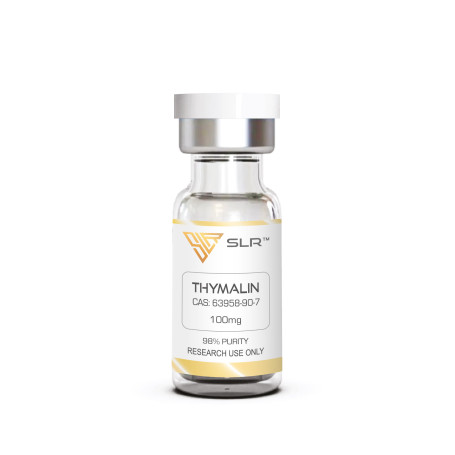

Thymalin is a synthetic peptide bioregulator related to thymic factors such as thymulin, which are involved in immune signaling and the regulation of inflammatory pathways. Research has investigated Thymalin for its potential role in supporting immune function, modulating systemic homeostasis, and influencing age-associated immune decline.
Studies suggest that Thymalin may contribute to improved immune resilience, cardiovascular function, and regulation of neuroendocrine processes linked to circadian rhythm and the sleep–wake cycle. It has also attracted significant interest in longevity research, as experimental findings have associated thymic peptide bioregulators with reduced mortality and lifespan extension in animal models.
SPECIFICATIONS
Product Code: THY100
Sequence: Pyr-Ala-Lys-Ser-Gln-Gly-Gly-Ser-Asn
Molecular Formula: C33H54N12O15
Molecular Weight: 858.864 g/mol
CAS: 63958-90-7
Purity: Technical / Research Grade 98%
Other details: No TFA Salt
Form: Lyophilized powder
Color: White
Storage temperature: -20°C
Source: Synthetic
Safety classification: Standard handling
DESCRIPTION
Studies have shown that this immunomodulatory molecule occurs naturally in the thymus. The thymus is a specialized bilobed primary lymphoid organ that plays a critical role in the development of functionally active and self-tolerant T-cells, which are a fundamental component of the adaptive immune system. Studies suggest that many of the thymus’ physiological functions are mediated through thymic immunomodulators, which help regulate immune maturation and immune signaling pathways.
The mature T-cells produced by the thymus are essential for adaptive immunity, including immune memory, immune surveillance, and the ability to respond effectively to pathogens. Loss (or congenital absence) of the thymus before critical immune development thresholds are reached can result in DiGeorge Syndrome, a condition characterized by severe immunodeficiency. Although thymic activity declines with age, studies indicate that there is still residual T-cell lymphopoiesis throughout adult life, even in later decades.
Nonetheless, research has shown that progressive thymic involution during aging is associated with increased susceptibility to severe infections and a higher risk of cancer development. This phenomenon has been attributed to reduced immune competence, impaired immune response to infections, and weakened immune surveillance mechanisms that normally help recognize and eliminate abnormal or malignant cells. In this context, thymic immunomodulators have attracted research interest due to their potential ability to support thymic signaling and restore certain aspects of immune homeostasis.
Additional diseases associated with thymic dysfunction include allergic hypersensitivity, Severe Combined Immunodeficiency Syndrome (SCID), lymphomas, Myasthenia Gravis, thymomas, and the rare disorder APECED (Autoimmune Polyendocrinopathy-Candidiasis-Ectodermal Dystrophy). Research suggests that thymic immunomodulators may help restore thymic regulatory activity in dysfunctional or compromised thymic tissue, potentially reducing the severity of immune deficiency or supporting immune balance in vulnerable individuals. For this reason, thymus-derived peptides have been studied not only for immune support, but also for broader systemic regulation, including inflammatory balance and age-associated immune decline.
Because thymulin is naturally linked to thymic signaling, research has explored its possible role in immune modulation, immune stimulation, and immune system normalization. In experimental and clinical research settings, thymulin has been investigated for its potential to support T-cell maturation pathways, immune response coordination, and immunological resilience. Some studies also suggest that thymic peptides may influence neuroendocrine-immune cross-talk, which is a regulatory network connecting immune function with endocrine signaling and nervous system activity.
Researchers at the St. Petersburg Institute of Bioregulation and Gerontology (North-Western Branch of the Russian Academy of Medical Sciences) and the Institute of Gerontology of the Ukrainian Academy of Medical Sciences (Kiev) clinically assessed the geroprotective effects of thymic peptide bioregulators (Thymalin) and the pineal peptide bioregulator Epithalamin (Epitalon) in 266 elderly and older individuals over a period of 6–8 years. In this long-term observational research, both peptides were administered at 10 mg daily for ten consecutive days, once every 6 months. The bioregulators were applied during the first 2–3 years of the observation period.
The obtained results suggested that these peptide bioregulators may support normalization of fundamental physiological functions, including measurable parameters of cardiovascular, endocrine, immune, and nervous system activity, as well as metabolic regulation and general homeostasis. In the peptide-treated groups, reported outcomes included a 2.0–2.4-fold decrease in acute respiratory disease incidence, along with reduced incidence of clinical manifestations of ischemic heart disease, hypertension, deforming osteoarthrosis, and osteoporosis compared to control groups. These changes were also associated with a reduction in mortality during the observation period: 2.0–2.1-fold in the Thymalin-treated group; 1.6–1.8-fold in the Epithalamin-treated group; and approximately 2.5-fold in individuals treated with Thymalin plus Epithalamin compared to control.
A separate patient group received Thymalin in combination with Epithalamin annually for 6 years, and their mortality rate was reported to decrease by 4.1 times compared to the control group. These findings have contributed to ongoing scientific interest in thymic and pineal peptide bioregulators as potential research tools for studying immune aging, systemic homeostasis, and age-associated decline in immune surveillance and metabolic regulation.
REFERENCES
All information presented above is derived from in vitro experiments, animal studies, and other preclinical research models. These data are intended solely for basic scientific investigation of biological mechanisms and do not imply any therapeutic, diagnostic, preventive, or clinical use in humans or animals.
V.KH. Khavinson et al., "Thymalin: Activation of Differentiation of Human Hematopoietic Stem Cells" [PubMed]
V.Kh. Khavinson et al., "Geroprotective effect of thymalin and epithalamin" [PubMed]
T.F. Babenko et al., "Thymalin in the combined treatment of patients with chronic lympholeukemia" [PubMed]
G.S. Sukhodoeva et al., "The effect of thymalin on the development of sensitization with a soluble microbial antigen and on the phenotypic composition of lymphocyte subpopulations in the organs of immunity" [PubMed]
K.I. Gurevich et al., "Use of thymalin in trauma patients" [PubMed]
L.S. Kogosova et al., "Effectiveness of administration of thymalin in the complex treatment of pulmonary tuberculosis" [PubMed]
V.Kh. Khavinson et al., "Thymalin: Activation of Differentiation of Human Hematopoietic Stem Cells" [PubMed]
M.L. Chukhlovina et al., "The immunomodulating and metabolic actions of thymalin in an experimental herpetic infection" [PubMed]
B.I. Kuznik et al. "Thymalin as a modulator of immunogenesis and hemostasis" [PubMed]
M.M. Solo'ev et al., "Clinical use of thymalin in the prophylaxis and treatment of infectious-inflammatory diseases of the maxillofacial region" [PubMed]
C.V. Zhukova et al., "Effect of Thymalin on the Tumor and Thymus under Conditions of Activation Therapy In Vivo" [PubMed]
K.G. Mskalik "Effect of thymalin and epithalamin on the metastasis of experimental tumors irradiated with pulsed laser radiation" [PubMed]
V.Kh. Khavinson et al., "The Use of Thymalin for Immunocorrection and Molecular Aspects of Biological Activity" [PMC]
M.P. Isaeva et al., "The effect of thymalin on indices of immunity and hemostasis in patients with disseminated forms of psoriasis" [PubMed]
V.E. Ryzhenkov et al., "Effect of thymalin on the development of experimental hyperlipidemia and atherosclerosis" [PubMed]
V.Kh. Khavinson et al., "The effect of thymalin on biochemical and immunological indices of lymphocyte differentiation and functional activity" [PubMed]
M.U. Musaev "Comparative study of the effects of thymalin and vitamin E on certain indices for local pulmonary protection in rheumatoid arthritis" [PubMed]
N.V. Govorin et al., "Use of thymic peptide thymalin in the complex treatment of therapy-resistant schizophrenia" [PubMed]
N.A. Trekova "Effect of thymalin on protein synthesis in the brain and conditioned-reflex activity of the progeny of neurosensitized female rats" [PubMed]
B.I. Kuznik et al., "Effect of thymalin on blood coagulation and fibrinolysis" [PubMed]
V.A. Koslov et al., "Efficacy of thymalin in the treatment of patients with traumatic osteomyelitis of the lower jaw" [PubMed]
T.G. Kurbanov et al., "The efficacy of using thymalin in diabetes mellitus in children" [PubMed]
B. Nasseri et al., "Thymulin treatment attenuates inflammatory pain by modulating spinal cellular and molecular signaling pathways" [PubMed]
V.G. Morozov et al., "Natural and synthetic thymic peptides as therapeutics for immune dysfunction" [PubMed]
S.M. Lunin et al., "Thymulin, a thymic peptide, prevents the overproduction of pro-inflammatory cytokines and heat shock protein Hsp70 in inflammation-bearing mice" [PubMed]
B. Kuznik et al., "Peptide Drug Thymalin Regulates Immune Status in Severe COVID-19 Older Patients" [PMC]
V.Kh. Khavinson et al., "Peptides of pineal gland and thymus prolong human life" [PubMed]
DISCLAIMER
This product is intendend for lab research and development use only. These studies are performed outside of the body. This product is not medicines or drugs and has not been approved by the FDA or EMA to prevent, treat or cure any medical condition, ailment or disease. Bodily introduction of any kind into humans or animals is strictly forbidden by law. This product should only be handled by licensed, qualified professionals.
All product information provided on this website is for informational and educational purposes only.
| Image | Ref. | Unit price | Weight | Avail. | Buy |
|---|---|---|---|---|---|
| THY100 | €159.00 Discount by quantity 10+ €127.20 –20% 20+ €111.30 –30% 50+ €98.58 –38% 100+ €89.04 –44% 200+ €79.50 –50% | 0.000000 kg |  | |
| Total: 0,0 All prices with tax included. | |||||
Product is available Product is no longer in stock
 Product is no in stock, but is allowed to be back-ordered