THYMOSIN ALPHA-1 - 10 mg
€89.00

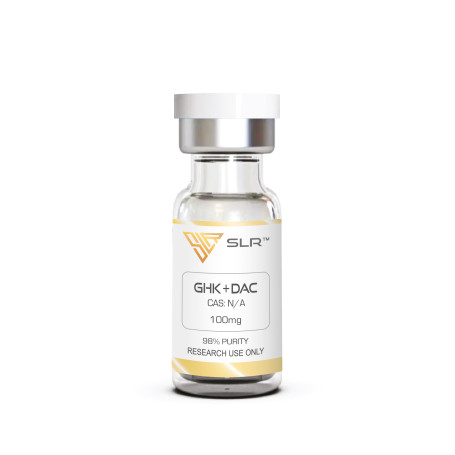

GHK with DAC is a modified form of the naturally occurring tripeptide GHK that has been engineered to enhance stability and prolong its persistence in experimental systems. Like native GHK, it has been widely investigated in laboratory and preclinical research for its involvement in multiple biological processes. Scientific studies suggest that GHK is associated with the following research-observed activities:
Support of tissue repair processes
Modulation of fibrinogen-related pathways
Activation of DNA repair–related gene networks
Engagement of the ubiquitin/proteasome system
Influence on insulin and insulin-like signaling pathways.
The addition of DAC (Drug Affinity Complex or stabilizing moiety) is designed to enhance resistance to enzymatic degradation and extend the duration of peptide activity in experimental conditions. This modification may allow for more sustained interaction with biological systems, supporting improved observation of time-dependent and cumulative effects in research models.
Collectively, these properties make GHK with DAC a molecule of interest in research areas such as tissue regeneration, aging mechanisms, metabolic regulation, and cellular homeostasis, particularly in experimental settings where prolonged peptide exposure is required.
SPECIFICATIONS
Product Code: GHD100D
Sequence: Gly-His-Lys (GHK)
Modification: DAC-conjugated (Maleimide-β-Ala linker)
Molecular Formula: C14H24N6O4 + (DAC linker moiety) (exact formula depends on conjugation state)
Molecular Weight: ~340.38 Da (GHK base) + linker (final MW typically ~550–700 Da depending on DAC structure)
CAS: N/A
Purity: Technical / Research Grade ≥98%
Other Details: No TFA Salt
Form: Lyophilized powder
Color: White
Storage Temperature: -20°C
Source: Synthetic
Safety Classification: Standard laboratory handling
DESCRIPTION
GHK with DAC is a modified form of the naturally occurring tripeptide glycyl-L-histidyl-L-lysine, engineered through the addition of a DAC (Drug Affinity Complex or stabilizing moiety) designed to influence its stability and persistence in experimental systems.
Native GHK is a naturally occurring peptide found in human plasma, saliva, and urine, where it has been identified as a signaling molecule involved in multiple biological processes related to tissue maintenance, cellular communication, and homeostatic regulation. Since its discovery, GHK has been extensively investigated in laboratory and preclinical research for its broad modulatory activity at the molecular level.
The introduction of DAC represents a structural modification intended to alter the pharmacokinetic profile of the peptide in experimental settings. Native GHK is characterized by a relatively short half-life due to rapid enzymatic degradation. DAC conjugation is designed to enhance resistance to proteolytic breakdown, prolong peptide availability, and extend interaction time with biological systems under controlled research conditions.
From a molecular perspective, DAC attachment may influence parameters such as peptide stability, distribution behavior, and persistence within extracellular and intracellular environments. These modifications are commonly explored in peptide engineering to improve experimental reproducibility and allow for more sustained observation of biological effects.
Experimental investigations have associated GHK with a wide range of biological activities in laboratory settings, particularly in areas related to tissue repair, cellular signaling, inflammation modulation, and gene expression regulation. The DAC modification does not alter the core amino acid sequence of GHK but is intended to extend the duration over which these activities can be observed.
Effects on Tissue Repair
In experimental models, GHK has been studied for its role in tissue repair processes involving skin, hair follicles, gastrointestinal lining, and bone tissue. Laboratory findings suggest that GHK may influence the synthesis of collagen, glycosaminoglycans, and other extracellular matrix components essential for maintaining tissue structure. Cell-based studies have demonstrated that GHK can support fibroblast and keratinocyte migration and proliferation, which are key processes in tissue remodeling. The presence of DAC may allow for prolonged exposure of these cell types to the peptide, potentially enabling extended observation of regenerative processes in controlled environments.
Effects on Inflammatory Signaling and Fibrinogen Regulation
Research indicates that GHK may interact with inflammatory signaling pathways, including those involving interleukin-6 (IL-6), a cytokine linked to fibrinogen synthesis. Experimental observations suggest that GHK may influence these pathways under laboratory conditions. The DAC modification may support sustained modulation of inflammatory signaling by maintaining more stable peptide levels over time, which can be relevant in studies investigating chronic or time-dependent inflammatory responses.
Effects on DNA Repair-Related Gene Expression
Accumulation of DNA damage is associated with cellular dysfunction and aging. Gene expression analyses have shown that GHK may modulate pathways involved in DNA repair and genomic stability in experimental models. Extended peptide availability through DAC conjugation may allow researchers to study these regulatory effects over longer durations, potentially improving the ability to observe time-dependent responses related to cellular stress and repair mechanisms.
Effects on the Ubiquitin-Proteasome System
The ubiquitin-proteasome system (UPS) plays a critical role in intracellular protein turnover and quality control. Experimental data suggest that GHK may influence aspects of proteasome-related activity in cellular models. DAC-modified GHK may provide prolonged interaction with intracellular systems, allowing for more consistent evaluation of protein degradation pathways and cellular homeostasis over extended experimental timelines.
Effects on Insulin and IGF-1 Signaling Pathways
GHK has been investigated for potential interactions with insulin and insulin-like growth factor (IGF-1) signaling pathways in gene expression studies. Laboratory findings suggest modulation of components within these metabolic pathways. The addition of DAC may allow for sustained exposure in experimental systems designed to evaluate metabolic signaling over time, potentially enhancing the consistency of observed effects.
Pharmacokinetic and Stability Considerations of DAC
The primary purpose of DAC conjugation is to influence the pharmacokinetic behavior of peptide systems in experimental settings. DAC-modified GHK is typically evaluated for:
These characteristics are particularly relevant in research contexts where transient peptide activity may limit the ability to observe cumulative or long-term biological effects.
Conclusion
GHK with DAC represents a structurally modified version of a naturally occurring human tripeptide, designed to enhance stability and extend functional persistence in experimental systems. While the intrinsic biological properties of GHK remain central to its activity, the addition of DAC introduces improved temporal control over peptide exposure, supporting more detailed investigation of its role in tissue remodeling, inflammatory signaling, genomic maintenance, protein turnover, and metabolic regulation.
All observations described above originate from laboratory, cellular, or preclinical research contexts and are intended exclusively for scientific and educational purposes. Further investigation is required to fully characterize the mechanisms and potential applications of this modified peptide.
DISCLAIMER
This product is intended for laboratory research and development use only. It is not a medicine or drug and has not been approved by the FDA or EMA to prevent, treat, or cure any medical condition. Bodily introduction into humans or animals is strictly prohibited. This product must be handled by qualified professionals.
All information provided is for educational and informational purposes only.
| Image | Ref. | Unit price | Weight | Avail. | Buy |
|---|---|---|---|---|---|
| GHD100D | €265.00 Discount by quantity 10+ €212.00 –20% 20+ €193.45 –27% 50+ €172.25 –35% 100+ €153.70 –42% 200+ €137.80 –48% | 0.000000 kg |  | |
| Total: 0,0 All prices with tax included. | |||||
Product is available Product is no longer in stock
 Product is no in stock, but is allowed to be back-ordered