
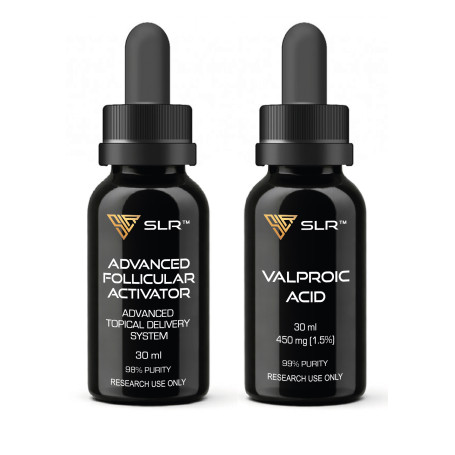
ADVANCED FOLLICULAR ACTIVATOR - 30ml + 30ml
Advanced Follicular Activator is a structured multi-domain research formulation designed to address the complex biological architecture underlying follicular cycling dynamics. Rather than functioning as a single-pathway stimulant, the system integrates extracellular matrix stabilization, microvascular support, cytoskeletal adaptability, immune equilibrium modulation, and controlled Wnt/β-catenin pathway permissiveness.
The primary formulation combines GHK-Cu, BPC-157 arginate, Thymosin Beta-4 fragment, Zinc–Thymulin, and PTD-DBM within a proprietary carrier system engineered for membrane interaction and controlled diffusion behavior.
A secondary amplification module containing 1.5% Valproic Acid provides optional pathway reinforcement through GSK3β modulation and β-catenin stabilization under structured research conditions.
This layered architecture is constructed to recalibrate the follicular microenvironment rather than impose isolated growth-factor mimicry or hormonal suppression. The formulation reflects a systems-based research model aligned with contemporary understanding of follicular signaling networks, structural integrity maintenance, and pathway permissiveness dynamics.
FRESHLY PREPARED SOLUTION
Description
ADVANCED TOPICAL DELIVERY SYSTEM - STRUCTURED CARRIER TECHNOLOGY
This product utilizes a structured topical delivery architecture integrating membrane-interactive carrier matrices with controlled CPP-assisted transport modulation. The formulation is engineered according to the physicochemical profile of the research compound to support membrane interaction, diffusion behavior, and preservation of molecular integrity.
SPECIFICATIONS
Product Code: AFA030T
GHK-Cu - 300 mg
Sequence: Gly-His-Lys (GHK)
Complex: Copper(II) Complex
Molecular Formula: C14H24N6O4Cu
Molecular Weight: ~403.9 g/mol
CAS: 49557-75-7
Purity: Technical / Research Grade ≥98%
BPC-157 ARGINATE FORM - 150 mg
Sequence: Gly-Glu-Pro-Pro-Pro-Gly- Lys-Pro-Ala-Asp-Asp-Ala-Gly-Leu-Val x 2 x L-Arg
Molecular Formula: C62H98N16O22
Molecular Weight (peptide): 1418.70 g/mol
CAS: 137525-51-0
Purity: Technical / Research Grade ≥98%
THYMOSIN B4 FRAGMENT - 75 mg
Sequence: Ac-Leu-Lys-Lys-Thr-Glu-Thr-Gln
Molecular Formula: C38H68N10O14
Molecular Weight: 889.018 g/mol
CAS number: 885340-08-9
Purity: Technical / Research Grade ≥98%
ZINC THYMULIN - 20 mg
Sequence: Glu-Ala-Lys-Ser-GIn-Gly-Gly-Ser-Asn
Molecular Formula: C33H54N12O15
Purity: Technical / Research Grade ≥98%
PTD-DBM - 10 mg
Sequence: RRRRRRRRGGGGRKTGHQICKFRKC
Molecular Formula: C134H244N60O32S2
Molecular Weight: 3082.65 g/mol
CAS: N/A
Purity: Technical / Research Grade ≥98%
General Porpeties
Other details: No TFA Salt
Form: Liquid Solution
Color: Slightly blue
Total Content: 555 mg in 30 mL (18.50 mg/mL total peptide concentration)
Concentration per mL: GHK-Cu: 10 mg; BPC-157 Arginate: 5 mg; Thymosin B4 Frag: 2.5 mg; Zinc Thymulin: 0.667 mg; PTD-DBM: 0.333 mg
Vehicle / Carrier System: Proprietary carrier system
Storage Temperature: 4°C (Do not freeze)
Source: Synthetic
Safety classification: Standard laboratory handling
VALPROIC ACID - 450 mg (1.5%)
Molecular Formula: C8H16O2
Molecular Weight: 144.21 g/mol
CAS: 99-66-1
Purity: Technical / Research Grade ≥99%
Form: Liquid Solution
Appearance: Colorless to slightly yellow
Storage Temperature: 4°C (Do not freeze)
Source: Synthetic
Safety Classification: Standard laboratory handling
DESCRIPTION
Hair growth is not a single-pathway phenomenon. It is the visible outcome of a highly coordinated biological architecture involving structural integrity, intracellular signaling permissiveness, vascular sufficiency, immune regulation, and micronutrient availability. The hair follicle functions as a dynamic mini-organ that cycles through:
• Anagen (active growth phase)
• Catagen (regression phase)
• Telogen (resting phase)
Maintenance of prolonged anagen duration is critical for visible density and shaft thickness. Shortened anagen and premature catagen entry contribute to progressive miniaturization. Emerging research indicates that follicular decline is rarely caused by absence of a single growth factor. Rather, it reflects cumulative destabilization of the follicular microenvironment. This destabilization may include:
• Extracellular matrix fragmentation
• Reduced dermal papilla metabolic competence
• Low-grade perifollicular inflammation
• Oxidative stress accumulation
• Stem cell niche quiescence
• Excess inhibitory signaling within Wnt/β-catenin pathways
Advanced Follicular Activator has been designed as a multi-domain modulation system addressing these interconnected layers simultaneously. It is not structured as a direct stimulant. It is constructed as a follicular architecture recalibration platform. The system consists of:
Primary formulation (30 mL):
• GHK-Cu – 300 mg
• BPC-157 – 150 mg
• Thymosin Beta-4 Fragment – 75 mg
• Zinc–Thymulin – 20 mg
• PTD-DBM – 10 mg
Secondary amplification module (30 mL):
• Valproic Acid 1.5%
The separation of amplification from baseline modulation reflects an intentional architectural design.
Extracellular matrix stabilization and follicular anchora (GHK-Cu)
The extracellular matrix surrounding the follicle is not passive support tissue. It is an active signaling interface that determines:
• Mechanical anchorage
• Integrin-mediated communication
• Growth factor diffusion gradients
• Cellular adhesion stability
• Dermal papilla positioning
Matrix degradation contributes to follicular instability and altered cycling. GHK-Cu has been extensively studied for its influence on:
• Collagen type I and III expression
• Elastin-associated gene regulation
• Glycosaminoglycan production
• Matrix metalloproteinase modulation
Balanced collagen turnover is critical. Excess degradation weakens anchorage. Excess deposition induces rigidity. Experimental transcriptomic analyses demonstrate that GHK-Cu influences broad gene networks associated with tissue remodeling rather than a single isolated pathway. Within follicular systems, this may translate to:
• Improved dermal papilla support
• Enhanced structural coherence
• Increased shaft thickness parameters
• Stabilized follicular embedding within the dermis
Copper bioavailability is also relevant. Copper-dependent enzymes such as lysyl oxidase facilitate collagen and elastin cross-linking, reinforcing tensile strength. This structural layer establishes the biomechanical foundation required for sustainable growth-phase support. Without matrix integrity, signaling interventions are limited.
Microvascular competence and metabolic viability (BPC-157)
The anagen phase is metabolically demanding. Rapid matrix cell proliferation requires:
• Oxygen sufficiency
• Nutrient delivery
• Waste removal
• Stable endothelial signaling
Microvascular compromise may contribute to shortened growth phases. BPC-157 has been investigated in preclinical angiogenesis and endothelial signaling models for:
• Modulation of nitric oxide pathways
• Influence on vascular endothelial growth factor–associated cascades
• Collateral vessel formation in ischemia models
• Cytoprotective signaling under stress conditions
In follicular research contexts, these mechanisms may support:
• Enhanced dermal papilla metabolic competence
• Improved perifollicular perfusion
• Reduced ischemia-associated stress
• Stabilization during active growth phases
Oxidative stress is another factor influencing follicular aging.
Preclinical data suggest BPC-157 interacts with oxidative markers and redox-regulatory systems. By supporting vascular and cytoprotective dynamics, this layer enhances environmental viability rather than directly inducing proliferation.
Cytoskeletal dynamics and regenerative reorganization (Thymosin Beta-4 Fragment)
Follicular remodeling during anagen requires coordinated cytoskeletal adaptation. Thymosin Beta-4 interacts with G-actin, influencing actin polymerization and cellular motility. In regenerative research systems, Tβ4 has been associated with:
• Endothelial migration
• Keratinocyte motility
• Fibroblast recruitment
• Angiogenesis-associated signaling
Within follicular models, cytoskeletal adaptability supports:
• Dermal papilla–epithelial communication
• Matrix cell repositioning
• Structural reorganization during growth-phase transitions
Cell migration is fundamental to tissue remodeling.
Without cytoskeletal plasticity, regeneration is incomplete. This component enhances dynamic adaptability within the follicular microenvironment.
Immune equilibrium and micronutrient support (Zinc–Thymulin)
The hair follicle operates within a delicate immune balance. Chronic low-grade perifollicular inflammation has been observed in several thinning contexts and may contribute to:
• Premature anagen termination
• Stem cell niche destabilization
• Increased matrix degradation
Zinc–thymulin integrates two biological domains:
- Immune signaling modulation (thymulin)
- Essential micronutrient enzymatic support (zinc)
Zinc participates in:
• DNA synthesis
• Keratinocyte proliferation
• Antioxidant enzyme systems (e.g., superoxide dismutase)
• Collagen cross-linking
• Immune homeostasis
Thymulin has been studied for its influence on cytokine signaling balance. In vitro follicular research suggests thymulin may contribute to maintenance of anagen duration under controlled conditions. By stabilizing immune signaling and ensuring zinc-dependent enzymatic support, this component reduces inflammatory noise and enhances follicular resilience.
Reduction of Wnt Negative Feedback Signaling (PTD-DBM)
The Wnt/β-catenin pathway is central to follicular activation. CXXC5 functions as a negative feedback regulator within this pathway by binding to Dishevelled (Dvl), attenuating downstream signaling. PTD-DBM is engineered as a competitive inhibitor of the CXXC5–Dvl interaction. Mechanistically, this allows:
• Reduced inhibitory binding
• Increased β-catenin stabilization
• Restoration of pathway permissiveness
Importantly, PTD-DBM does not artificially activate Wnt signaling. It reduces suppression. Preclinical observations in CXXC5-deficient models have demonstrated:
• Enhanced telogen-to-anagen transition
• Increased alkaline phosphatase expression
• Elevated PCNA levels
• Improved dermal papilla activity
This layer removes inhibitory constraints, enabling physiological signaling to proceed.
Controlled wnt amplification (Valproic Acid)
Valproic acid has been studied for:
• GSK3β inhibition
• β-catenin stabilization
• Histone deacetylase modulation
Through GSK3β inhibition, degradation of β-catenin is reduced. Preclinical combination studies show synergistic effects between PTD-DBM and VPA:
• Increased dermal papilla cell activity
• Elevated follicular activation markers
• Enhanced anagen transition in murine models
Separation of this module allows controlled intensity. Continuous amplification may not be desirable for long-term modulation models.
Cyclical reinforcement supports strategic pathway enhancement.
Advanced Follicular Activator is designed as a comprehensive follicular microenvironment recalibration system.
- It does not rely on hormonal suppression.
- It does not rely on vasodilator stimulation.
- It does not depend on single growth-factor mimicry.
Instead, it addresses structural, metabolic, immune, and signaling architecture simultaneously. This integrated design reflects a systems-based research approach aligned with modern follicular biology understanding
REFERENCES
D. Filippo et al., "Thymosin beta4 increases hair growth by activation of hair follicle stem cells" [PubMed]
B. Dai et al., "Multiple potential roles of thymosin β4 in the growth and development of hair follicles" [PubMed]
Xiao-Yu Gao et al., "Role of thymosin beta 4 in hair growth" [PubMed]
Xiao-Yu Gao et al., "Thymosin Beta-4 Induces Mouse Hair Growth" [PubMed]
Soung-Hoon Lee et al., "Targeting of CXXC5 by a Competing Peptide Stimulates Hair Regrowth and Wound-Induced Hair Neogenesis" [PubMed]
A. Premanand et al ., "Androgen modulation of Wnt/β-catenin signaling in androgenetic alopecia" [PubMed]
G. Severei et al., "Androgenetic alopecia in men aged 40–69 years: prevalence and risk factors" [BJD]
Vickers ER "An Analysis of the Safety and Efficacy of Topical Zinc-Thymulin to treat Androgenetic Alopecia" [Hair : Therapy & Transplantation]
M. Dardenne et al., "Interactions Between Zinc and Thymulin" [Hindawi]
A.S. Prasad et al., "Serum thymulin in human zinc deficiency" [JCJ]
M. Dardenne et al., "Zinc and Thymulin" [Springer]
Soung-Hoon Lee et al., "The Dishevelled-binding protein CXXC5 negatively regulates cutaneous wound healing" [JEM]
Soung-Hoon Lee et al., "Targeting of CXXC5 by a Competing Peptide Stimulates Hair Regrowth and Wound-Induced Hair Neogenesis" [ScienceDirect]
Y.C. Ryu et al., "CXXC5 Mediates DHT-Induced Androgenetic Alopecia via PGD2" [MDPI]
S.J. Jo et al., "Topical valproic acid increases the hair count in male patients with androgenetic alopecia: a randomized, comparative, clinical feasibility study using phototrichogram analysis" [PubMed]
S. Lee "Molecular Signaling Pathways in Wound-Induced Hair-Follicle Neogenesis" [PMC]
Y.C. Ryu et al., "KY19382, a novel activator of Wnt/β‐catenin signalling, promotes hair regrowth and hair follicle neogenesis" [PMC]
M. Bejaoui et al., "β-catenin-mediated hair growth induction effect of 3,4,5-tri-O-caffeoylquinic acid" [PMC]
S.J. Jo et al., "Valproic acid promotes human hair growth in in vitro culture model" [PubMed]
A. Mehta et al., "Revolutionary Approaches to Hair Regrowth: Follicle Neogenesis, Wnt/ß-Catenin Signaling, and Emerging Therapies" [PMC]
G. Severei et al., "Androgenetic alopecia in men aged 40–69 years: prevalence and risk factors" [BJD]
Vickers ER "An Analysis of the Safety and Efficacy of Topical Zinc-Thymulin to treat Androgenetic Alopecia" [Hair : Therapy & Transplantation]
M. Dardenne et al., "Interactions Between Zinc and Thymulin" [Hindawi]
A.S. Prasad et al., "Serum thymulin in human zinc deficiency" [JCJ]
M. Dardenne et al., "Zinc and Thymulin" [Springer]
L. Pickart et al., "GHK-Cu may Prevent Oxidative Stress in Skin by Regulating Copper and Modifying Expression of Numerous Antioxidant Genes" [MDPI]
M. Kukowska et al., "In vitro studies of antimicrobial activity of Gly-His-Lys conjugates" [PubMed]
L. Pickart et al., "Regenerative and Protective Actions of the GHK-Cu Peptide" [PubMed]
L. Pickart et al., "GHK Peptide as a Natural Modulator of Multiple Cellular Pathways" [BioMed Research International]
S.O. Canapp Jr et al., "Topical tripeptide-copper complex on healing of ischemic wounds" [PubMed]
DISCLAIMER
This product is intendend for lab research and development use only. These studies are performed outside of the body. This product is not medicines or drugs and has not been approved by the FDA or EMA to prevent, treat or cure any medical condition, ailment or disease. Bodily introduction of any kind into humans or animals is strictly forbidden by law. This product should only be handled by licensed, qualified professionals.
All product information provided on this website is for informational and educational purposes only.
Data sheet
Customers who bought this product also bought:
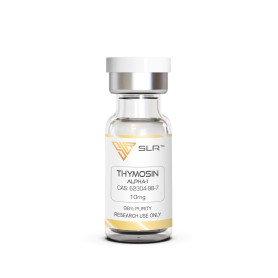
THYMOSIN ALPHA-1 - 10 mg
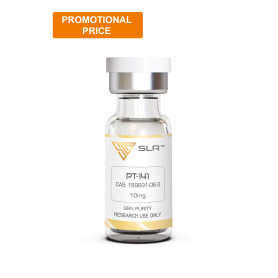
PT-141 - 10mg
MELANOTAN 1 - 10mg
IPAMORELIN - 5mg
BPC-157 - 5mg, 10mg
CORTAGEN - 10ml/100mg - Spray
PEG MGF - 5mg
| Image | Ref. | Unit price | Weight | Avail. | Buy |
|---|---|---|---|---|---|
 | AFA030T | €329.00 Discount by quantity 10+ €263.20 –20% 20+ €230.30 –30% 50+ €203.98 –38% 100+ €184.24 –44% 200+ €164.50 –50% | 0.100000 kg |  | |
| Total: 0,0 All prices with tax included. | |||||
Product is available Product is no longer in stock
 Product is no in stock, but is allowed to be back-ordered