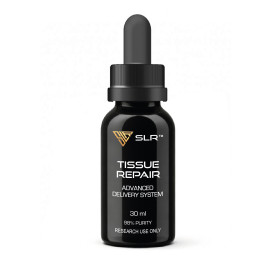
TISSUE REPAIR - 30ml
€329.00



Our Commitment to Analytical Transparency
Whenever available, our third-party Certificates of Analysis (COAs) include:
- HPLC purity testing
- Mass Spectrometry (MS) identity confirmation
- Net Peptide Content (NPC) analysis
We believe that Net Peptide Content analysis is particularly important for evaluating the actual amount of peptide present, taking into account residual moisture, counterions, and other non-peptide components.
The following is a list of some of the advantages of GHK-Cu:
- Improve skin density and firmness
- Reduce fine lines and deep wrinkles
- Reduce photodamage
- Hair growth benefit
- Dna repair
FRESHLY PREPARED SOLUTION
ADVANCED DELIVERY SYSTEM - STRUCTURED CARRIER TECHNOLOGY
This product utilizes a structured topical delivery architecture integrating membrane-interactive carrier matrices with controlled CPP-assisted transport modulation. The formulation is engineered according to the physicochemical profile of the research compound to support membrane interaction, diffusion behavior, and preservation of molecular integrity.
SPECIFICATIONS
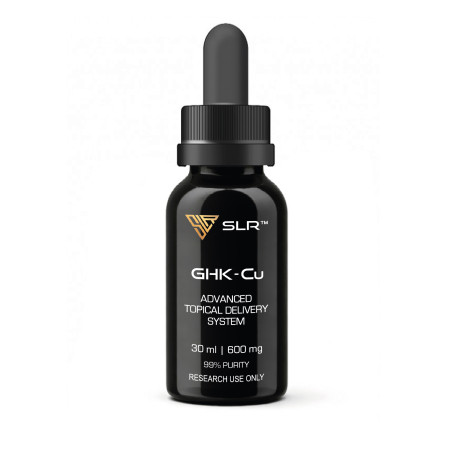
Product Code: GHK600T
Sequence: Gly-His-Lys (GHK)
Complex: Copper(II) Complex
Molecular Formula: C14H24N6O4Cu
Molecular Weight: ~403.9 g/mol
CAS: 49557-75-7
Purity: Technical / Research Grade ≥99%
Form: Liquid Solution
Color: Blue
Total Content: 30 mL / 600 mg
Concentration: 20 mg/mL
Vehicle / Carrier System: Proprietary carrier system
Storage Temperature: 4°C (Do not freeze)
Source: Synthetic
Safety Classification: Standard laboratory handling
DESCRIPTION
GHK-Cu (Gly-His-Lys copper complex) is a naturally occurring copper-binding tripeptide extensively studied for its role in cutaneous biology, dermal remodeling processes, and follicular microenvironment regulation. In the context of topical and dermal research, GHK-Cu is recognized for its interaction with structural skin cells, extracellular matrix components, and growth factor–associated signaling pathways. Within the skin, structural integrity depends on a finely coordinated interaction between fibroblasts, keratinocytes, endothelial cells, and extracellular matrix proteins such as collagen, elastin, and glycosaminoglycans. GHK-Cu has been investigated for its capacity to influence several of these interconnected domains simultaneously, supporting research into skin density, elasticity, and regenerative dynamics.
Dermal Fibroblast Activity
Fibroblasts represent the primary structural cells of the dermis. They are responsible for synthesizing collagen types I and III, elastin fibers, proteoglycans, and glycosaminoglycans that collectively determine mechanical strength and resilience. Research indicates that GHK-Cu can influence fibroblast activity, including stimulation of collagen synthesis and modulation of extracellular matrix protein production. By supporting fibroblast function, GHK-Cu has been associated with improved dermal matrix organization and enhanced structural coherence within the skin architecture. Balanced collagen deposition contributes to improved tensile properties and reduced structural fragmentation commonly observed in aged skin.
Collagen and Extracellular Matrix Remodeling
Collagen degradation and disorganization are central features of intrinsic aging and photo-induced skin damage. GHK-Cu has been studied for its influence on collagen gene expression and matrix metalloproteinase regulation. Experimental observations suggest that it may help balance collagen synthesis and degradation, contributing to more organized fiber alignment and dermal density. Glycosaminoglycan synthesis is another critical component of dermal hydration and volume. GHK-Cu has been associated with stimulation of glycosaminoglycan production, supporting water-binding capacity within the dermal matrix. This hydration support plays a role in skin firmness and surface smoothness.
Elastic Fiber Support
Elastic fibers provide recoil and flexibility. With age and oxidative stress, elastin fibers become fragmented and less functional. Research has explored GHK-Cu’s role in supporting elastin-associated gene expression and promoting structural maintenance of elastic networks, contributing to improved mechanical elasticity.
Keratinocyte Proliferation and Epidermal Renewal
The epidermis undergoes continuous renewal through keratinocyte proliferation and differentiation. GHK-Cu has been examined for its capacity to stimulate keratinocyte activity and enhance epidermal turnover. Increased keratinocyte proliferation contributes to improved barrier integrity and surface texture. Studies have reported increased expression of integrins and markers associated with epidermal renewal following GHK-Cu exposure. These processes are relevant to skin clarity, uniformity, and structural resilience.
Angiogenesis and Microcirculation
Adequate dermal microcirculation is essential for oxygen and nutrient delivery. GHK-Cu has been investigated for its influence on angiogenic signaling pathways and capillary formation in dermal models. Improved microvascular support contributes to enhanced tissue vitality and regenerative capacity.
Antioxidant and Redox Regulation
Oxidative stress contributes significantly to photoaging and dermal degradation. GHK-Cu has demonstrated antioxidant activity through modulation of reactive oxygen species and copper-dependent enzymatic pathways. By supporting redox balance, it may help protect structural proteins from oxidative fragmentation.
Regulation of Inflammatory Signaling
Excessive inflammatory signaling accelerates collagen breakdown and barrier disruption. GHK-Cu has been shown to modulate pro-inflammatory cytokine expression in dermal fibroblasts, including attenuation of TNF-α–induced IL-6 secretion. Balanced inflammatory signaling supports orderly tissue remodeling and reduces structural disruption.
Gene Expression Modulation
Transcriptomic studies have demonstrated that GHK-Cu influences expression of numerous genes associated with tissue remodeling, antioxidant defense, and structural repair pathways. Rather than acting on a single pathway, it appears to support coordinated regulation of multiple regenerative networks within the dermal environment.
Stem Cell–Associated Markers
Research has indicated that GHK-Cu can increase expression of p63 and integrin markers in epidermal progenitor cells. These findings suggest potential influence on proliferative capacity and renewal dynamics within the epidermal compartment.
Hair Follicle Biology
Hair growth depends on a cyclical process involving anagen (growth phase), catagen (regression phase), and telogen (resting phase). The follicular microenvironment requires balanced signaling between dermal papilla cells, keratinocytes, vascular supply, and extracellular matrix components. GHK-Cu and related analogues have been investigated for their capacity to stimulate hair follicle activity and prolong the growth phase in experimental systems. Increased expression of growth factors and integrin signaling within follicular structures has been observed in research models. Copper is an essential trace element involved in cross-linking of collagen and elastin, as well as in angiogenic and antioxidant enzyme systems. The GHK-Cu complex facilitates bioavailable copper delivery within the cutaneous environment, potentially supporting follicular structural integrity. Experimental models have reported increased hair shaft thickness, improved follicular anchoring, and enhanced microvascular support following GHK-Cu exposure. Some comparative systems have shown activity profiles approaching those observed with 5% minoxidil under controlled conditions.
Scalp Microenvironment Support
Healthy scalp tissue requires controlled inflammation, adequate vascularization, and balanced extracellular matrix turnover. GHK-Cu’s modulatory effects on cytokine signaling and oxidative balance may contribute to improved scalp condition and follicular resilience.
Barrier Function and Surface Integrity
The skin barrier depends on coordinated lipid synthesis, keratinocyte cohesion, and tight junction integrity. By supporting keratinocyte proliferation and reducing inflammatory disruption, GHK-Cu may contribute to improved barrier stability and reduced transepidermal water loss.
Photoaging and Environmental Stress
Ultraviolet exposure induces matrix degradation, oxidative stress, and inflammatory cascades. GHK-Cu has been investigated for protective effects against photo-induced damage, including modulation of collagen fragmentation and oxidative burden.
Dermal Thickness and Density
Controlled human studies have reported increased dermal thickness and density following topical application of copper peptide formulations. Histological analyses have shown increased collagen content and improved dermal organization.
Elasticity and Surface Appearance
Improvements in skin laxity, fine lines, and overall firmness have been documented in placebo-controlled cosmetic trials involving GHK-Cu creams. These changes are consistent with underlying matrix remodeling and epidermal renewal support.
Long-Term Structural Maintenance
Aging is associated with progressive decline in endogenous GHK levels. Reduced peptide availability correlates with diminished regenerative signaling and structural degradation. Topical supplementation in research contexts has been explored as a means to restore physiological peptide levels within aging skin.
Safety Profile in Dermal Research
Extensive cosmetic and dermal research has reported favorable safety observations for GHK-Cu when applied topically. No significant adverse effects have been documented in controlled skin application studies under standard conditions.
Integrated Skin & Hair Research Perspective
GHK-Cu functions within a network of interconnected processes:
• Fibroblast activation
• Collagen synthesis
• Elastin support
• Glycosaminoglycan production
• Keratinocyte proliferation
• Angiogenesis
• Redox balance
• Cytokine modulation
• Follicular microenvironment regulation
Rather than targeting a single pathway, it appears to support coordinated structural and regenerative dynamics across dermal and follicular systems.
In the context of Skin and Hair research, GHK-Cu represents a multifunctional copper-binding peptide complex studied for its influence on dermal matrix organization, epidermal renewal, scalp biology, and follicular structural integrity.
REFERENCES
L. Pickart et al., "GHK-Cu may Prevent Oxidative Stress in Skin by Regulating Copper and Modifying Expression of Numerous Antioxidant Genes" [MDPI]
M. Kukowska et al., "In vitro studies of antimicrobial activity of Gly-His-Lys conjugates" [PubMed]
L. Pickart et al., "Regenerative and Protective Actions of the GHK-Cu Peptide" [PubMed]
L. Pickart et al., "GHK Peptide as a Natural Modulator of Multiple Cellular Pathways" [BioMed Research International]
S.O. Canapp Jr et al., "Topical tripeptide-copper complex on healing of ischemic wounds" [PubMed]
DISCLAIMER
This product is intended for laboratory research and development use only. It is not a medicine or drug and has not been approved by the FDA or EMA to prevent, treat, or cure any medical condition. Bodily introduction into humans or animals is strictly prohibited. This product must be handled by qualified professionals.
All information provided is for educational and informational purposes only.
| Image | Ref. | Unit price | Weight | Avail. | Buy |
|---|---|---|---|---|---|
| GHK600T | €152.00 Discount by quantity 10+ €121.60 –20% 20+ €106.40 –30% 50+ €94.24 –38% 100+ €85.12 –44% 200+ €76.00 –50% | 0.100000 kg |  | |
| Total: 0,0 All prices with tax included. | |||||
Product is available Product is no longer in stock
 Product is no in stock, but is allowed to be back-ordered