
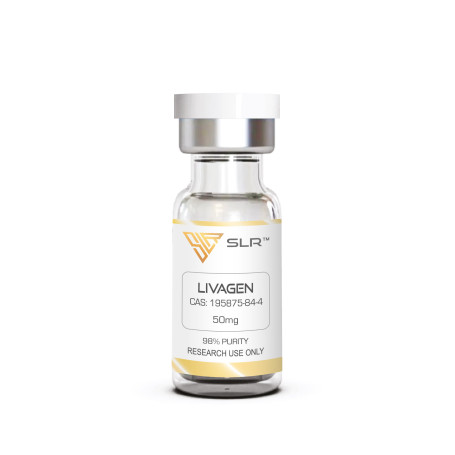
LIVAGEN - 50mg
Livagen is a short bioregulatory peptide that has been investigated in experimental research for its influence on DNA organization and gene expression. It is primarily recognized for its association with chromatin decondensation, a process that increases DNA accessibility and has been linked to cellular profiles typically observed in younger cells. Scientific research has focused predominantly on immune system lymphocytes, where Livagen has been shown to modulate gene activity and cellular function. Through these mechanisms, Livagen has been studied for its involvement in biological processes related to immune regulation and signaling pathways associated with cardiovascular, gastrointestinal, neurological, and immune system function. Experimental findings have also explored Livagen’s role in nociception and pain-related signaling. Ongoing research continues to examine Livagen’s broader relevance in studies of aging, cellular senescence, and long-term biological regulation.
Description
SPECIFICATIONS
Product Code: LIV050
Sequence: Lys-Glu-Asp-Ala
Molecular Formula: C18H31N5O9
Molecular Weight: 461.5 g/mol
CAS: 195875-84-4
Purity: Technical / Research Grade 98%
Other details: No TFA Salt
Form: Lyophilized powder
Color: White
Storage temperature: -20°C
Source: Synthetic
Safety classification: Standard handling
DESCRIPTION
Livagen is a short regulatory peptide structurally and functionally associated with Epitalon (also known as Epithalon). It has been widely investigated in experimental and preclinical research for its involvement in biological processes related to the liver, gastrointestinal tract, and immune system. Livagen is classified as a peptide bioregulator and has been studied for its ability to influence DNA organization and gene expression patterns. In research contexts, its age-associated effects have been linked to its capacity to modulate genes involved in immune and gastrointestinal function that tend to become less active over time due to progressive chromatin condensation.
Experimental studies involving lymphocytes from older individuals indicate that Livagen can stimulate the expression of multiple genes by promoting chromatin decondensation, a process that increases DNA accessibility. This effect has been associated with the reactivation of genes that are typically transcriptionally silent in older cells, including ribosomal genes. The activation of these genes has been linked, in experimental systems, to enhanced protein synthesis and increased cellular activity.
These findings suggest that Livagen exerts a direct influence on lymphocyte DNA organization. Lymphocytes are key cellular components of the immune system, and alterations in their gene expression profiles have been extensively studied in relation to aging-associated functional decline.
Research examining the biological endpoints of Livagen, Epitalon, and Vilon administration in older subjects has shown that Livagen is associated with activation of synthetic processes through ribosomal gene reactivation, chromatin unpacking, altered gene expression, and chromatin decondensation in lymphocytes. These molecular effects are consistent with a broader pattern of transcriptional reactivation observed in experimental aging models.
As a consequence of these combined actions, chromatin regions that become transcriptionally silenced with age appear to regain activity in experimental settings. Researchers have proposed that this shift may restore certain lymphocyte characteristics toward a more youthful functional profile, although long-term outcomes of such changes have not yet been fully characterized.
It is well established that age-related changes in gene accessibility, gene expression patterns, and DNA structural organization contribute significantly to biological aging. Professor Teimuraz Lezhava, a leading researcher in age-related chromatin modifications, has documented progressive increases in chromosomal abnormalities with advancing age. One of the most prominent of these changes is progressive chromatin condensation.
There is substantial experimental evidence suggesting that limiting or reversing chromatin condensation may be associated with extended cellular functionality. If age-related gene silencing contributes to functional decline, then reactivation of these genes may slow certain aging-associated processes. Research conducted by Dr. Lezhava and others has demonstrated that Livagen, Epitalon, and several related bioregulatory peptides influence chromatin structure by promoting DNA decondensation. These findings support the hypothesis that such peptides may help counteract some forms of age-associated dysfunction, particularly those involving immune regulation and reduced protein synthesis.
Lymphocytes also play an active role in cardiovascular health. Research involving individuals with hypertrophic cardiomyopathy (HCM) and atherosclerosis has suggested that dysregulation of lymphocyte chromatin structure may contribute to disease pathogenesis.
Lymphocytes include B cells and T cells, two major classes of immune cells. B cells are responsible for antibody production, while T cells target infected or abnormal cells and produce cytokines that regulate immune and inflammatory responses. Because of their central role in immune surveillance, reduced lymphocyte activity with age has been proposed as one factor contributing to increased susceptibility to infection and disease. Restoring lymphocyte gene activity toward a more youthful state has therefore been explored as a potential avenue in experimental immunology research.
Multiple studies suggest that gene reactivation in lymphocytes through chromatin decondensation may help mitigate long-term effects associated with certain cardiovascular conditions. In research involving HCM, changes in lymphocyte gene expression have been associated with reduced inflammatory signaling and fibrosis. Given that Livagen induces similar chromatin-related effects, it has been extensively investigated in this research context. These findings have led to interest in Livagen as a molecular tool for studying preventive strategies related to cardiovascular aging and immune-mediated pathology.
Recent research has also examined the role of Livagen in gastrointestinal physiology. Activation of μ and δ receptors has been shown to contribute to protection of the gastrointestinal mucosal barrier. In experimental models, Livagen has been associated with altered mucosal nitric oxide and prostaglandin levels, as well as increased vagal nerve signaling to the gastrointestinal tract. Collectively, these effects have been linked to enhanced gastroprotective responses in laboratory settings, including models relevant to inflammatory bowel conditions and viral-induced gastrointestinal disturbances. Given its ability to influence enkephalin availability and receptor activation, Livagen has been widely studied in gastrointestinal research.
Livagen has additionally been shown in experimental studies to increase circulating levels of endogenous enkephalins by reducing the activity of enzymes responsible for their degradation. Enkephalins are short peptides involved in pain signaling and modulation. Through this mechanism, Livagen has been investigated for its influence on pain-related signaling pathways in experimental models.
REFERENCES
All observations described above originate from in vitro systems, animal studies, or other preclinical experimental models. They are intended solely to support basic research into molecular, cellular, and physiological mechanisms and do not imply therapeutic, diagnostic, or preventive applications in humans or animals.
T. Lezhava et al., “Anti-aging peptide bioregulators induce reactivation of chromatin” [PubMed]
N. V. Kost et al., “Effect of new peptide bioregulators livagen and epitalon on enkephalin-degrading enzymes in human serum” [PubMed]
Georgian Med News, “Effect of peptide bioregulator and cobalt ions on the activity of NORs and associations of acrocentric chromosomes in lymphocytes of patients with hypertrophic cardiomyopathy and their relatives” [PubMed]
T. Lezhava et al., “Activation of pericentromeric and telomeric heterochromatin in cultured lymphocytes from old individuals” [Europe PMC]
V. Kh. Khavinson et al., “Effects of Livagen peptide on chromatin activation in lymphocytes from old people” [PubMed]
T. Lezhava, “Human chromosome functional characteristics and aging” [PubMed]
N. M. Timofeeva et al., “Effect of peptide Livagen on activity of digestive enzymes in gastrointestinal tract and non-digestive organs in rats of different ages” [PubMed]
V. K. Khavinson, “Tissue-specific effects of peptides” [PubMed]
I. Riadnova et al., “Functional morphology of an organotypic liver culture exposed to the peptide livagen” [PubMed]
T. Jokhadze et al., “Evaluation of genomic parameters in ductal breast cancer patients and the ability of it's correction” [PubMed]
V. Khavinson et al., “Effects of short peptides on lymphocyte chromatin in senile subjects” [PubMed]
V. Brodskii et al., “Rhythm of protein synthesis in cultures of hepatocytes from rats of different ages. Norm and effect of the peptide livagen” [PubMed]
B. I. Kuznik et al., “The influence of polypeptide liver complex and tetrapeptide KEDA on organism physiological function in norm and age-related pathology” [PubMed]
V. K. Khavinson et al., “Tissue-specific action of peptides in tissue culture of rats of various ages” [PubMed]
DISCLAIMER
This product is intended for laboratory research and development use only. These studies are performed outside of the body. This product is not a medicine or drug and has not been approved by the FDA or EMA to prevent, treat, or cure any medical condition, ailment, or disease. Bodily introduction of any kind into humans or animals is strictly forbidden by law. This product should only be handled by licensed, qualified professionals.
All product information provided on this website is for informational and educational purposes only.
Data sheet
Customers who bought this product also bought:
VILON - 50 mg
PEG MGF - 5mg
OXYTOCIN - 10mg
NAD+ - 1000mg
AOD9604 - 5mg
THYMOSIN ALPHA-1 - 10 mg
| Image | Ref. | Unit price | Weight | Avail. | Buy |
|---|---|---|---|---|---|
 | LIV050 | €129.00 Discount by quantity 10+ €103.20 –20% 20+ €90.30 –30% 50+ €79.98 –38% 100+ €72.24 –44% 200+ €64.50 –50% | 0.000000 kg |  | |
| Total: 0,0 All prices with tax included. | |||||
Product is available Product is no longer in stock
 Product is no in stock, but is allowed to be back-ordered