
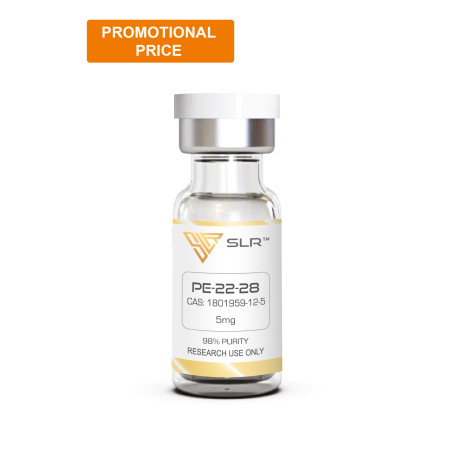
PE-22-28 - 5mg
PE-22-28 is a synthetic derivative of the naturally occurring peptide spadin that targets the TREK-1 channel. Since TREK-1 is found in brain regions that govern mood, memory, and learning, PE-22-28 was designed with the goal of being a potential treatment candidate for depression and a powerful stimulator of neurogenesis and synaptogenesis in the hippocampus. PE-22-28 is currently being researched for several applications, including:
Antidepressant activity
Enhancement of memory and learning
Support for stroke recovery
Potential roles in addressing neurodegenerative diseases such as Alzheimer’s
Promotion of neurogenesis
Description
SPECIFICATIONS
Product Code: PE2205
Sequence: Gly–Val–Ser–Trp–Gly–Leu–Arg
Molecular Formula: C35H55N11O9
Molecular Weight: 773.89 g/mol
CAS: 1801959-12-5
Purity: Technical / Research Grade ≥98%
Other Details: No TFA Salt
Form: Lyophilized powder
Color: White
Storage Temperature: -20°C
Source: Synthetic
Safety Classification: Standard handling
DESCRIPTION
PE-22-28 is a synthetic peptide derived from the naturally occurring peptide spadin. Spadin functions as an antagonist of the TREK-1 (TWIK-related potassium channel-1) receptor, a two-pore domain potassium channel implicated in mood regulation, neurogenesis, and neuronal excitability.
TREK-1 is expressed in brain regions involved in emotion, learning, and memory, including the prefrontal cortex, amygdala, and hippocampus. Activation of TREK-1 reduces neuronal excitability, whereas inhibition increases excitability and promotes depolarization. TREK-1 activity has been associated with regulation of excitotoxicity, anesthesia response, neuroprotection, and pain perception.
PE-22-28 represents a shortened and optimized analog of spadin. Compared to naturally occurring spadin, PE-22-28 demonstrates enhanced stability, improved in vivo persistence, and increased neurogenic activity in experimental models.
Neurogenesis is recognized as a long-term outcome associated with conventional antidepressant treatments such as selective serotonin reuptake inhibitors (SSRIs). PE-22-28 has been shown in preclinical models to stimulate neurogenesis within four days, a substantially faster timeframe than traditional antidepressant compounds.
Experimental evidence indicates that PE-22-28 enhances synaptogenesis and neuronal proliferation within the hippocampus, particularly in the dentate gyrus. The hippocampus plays a central role in learning, spatial navigation, and memory formation and is structurally reduced in various affective disorders.
PE-22-28 has been associated with increased CREB (cAMP response element-binding protein) expression, a transcription factor involved in neuronal plasticity, synaptic formation, and memory consolidation. CREB downregulation has been observed in neurodegenerative conditions, and modulation of CREB signaling is considered relevant in cognitive research.
Studies suggest that PE-22-28 promotes synaptic protein expression and supports restoration of hippocampal volume in experimental models. By enhancing neurogenesis and synaptogenesis, the peptide may shift the balance from neurodegeneration toward regeneration in preclinical systems.
Because TREK-1 receptors are also expressed in peripheral tissues such as the heart, smooth muscle, lung, prostate, and pancreas, early research evaluated potential off-target effects. Preclinical studies indicate that PE-22-28 does not significantly interfere with TREK-2, TRAAK, TASK, or TRESK channels and demonstrates a favorable safety profile in animal models.
Beyond mood-related research, TREK-1 antagonism has been investigated in models of seizure activity, ischemia, and pain modulation. The rapid neurogenic and synaptogenic effects observed with PE-22-28 have also generated interest in cognitive performance and neurodegenerative research contexts.
REFERENCES
All information presented above is derived from in vitro experiments, animal studies, and other preclinical research models. These data are intended solely for basic scientific investigation of biological mechanisms and do not imply any therapeutic, diagnostic, preventive, or clinical use in humans or animals.
J. Mazella et al., “Spadin, a sortilin-derived peptide, targeting rodent TREK-1 channels: a new concept in antidepressant drug design” [PubMed]
A. Djillani et al., “Shortened Spadin Analogs Display Better TREK-1 Inhibition, In Vivo Stability and Antidepressant Activity” [PMC]
A. Djillani et al., “Role of TREK-1 in Health and Disease, Focus on the Central Nervous System” [PubMed]
R.S. Duman et al., “Regulation of adult neurogenesis by antidepressant treatment” [PubMed]
J.E. Malberg et al., “Increasing hippocampal neurogenesis: a novel mechanism for antidepressant drugs” [PubMed]
N. Katalanic et al., “Ketamine as a new treatment for depression: a review of its efficacy and adverse effects” [PubMed]
H.M. Ou Maati et al., “Spadin as a new antidepressant: absence of TREK-1-related side effects” [PubMed]
C. Devader et al., “In vitro and in vivo regulation of synaptogenesis by the novel antidepressant spadin” [PubMed]
A.J. Silva et al., “CREB and memory” [PubMed]
Qi Lei et al., “Response of the human detrusor to stretch is regulated by TREK-1” [PMC]
DISCLAIMER
This product is intended for laboratory research and development use only. This product is not a medicine or drug and has not been approved by the FDA or EMA to prevent, treat, or cure any medical condition, ailment, or disease. Bodily introduction into humans or animals is strictly forbidden by law. This product should only be handled by licensed, qualified professionals.
All product information provided on this website is for informational and educational purposes only.
Data sheet
Customers who bought this product also bought:
DNSP-11 - 5mg
KPV - 100mg
PNC-27 - 5mg
HUMANIN G - 10mg
MOTS-c - 40mg
THYMALIN - 100mg
TESTAGEN - 40mg
| Image | Ref. | Unit price | Weight | Avail. | Buy |
|---|---|---|---|---|---|
 | PE2205 | €29.00 Discount by quantity 10+ €24.65 –15% 20+ €20.88 –28% 50+ €17.40 –40% 100+ €15.08 –48% 200+ €13.05 –55% | 0.000000 kg |  | |
| Total: 0,0 All prices with tax included. | |||||
Product is available Product is no longer in stock
 Product is no in stock, but is allowed to be back-ordered