PEG MGF - 5mg
€68.00

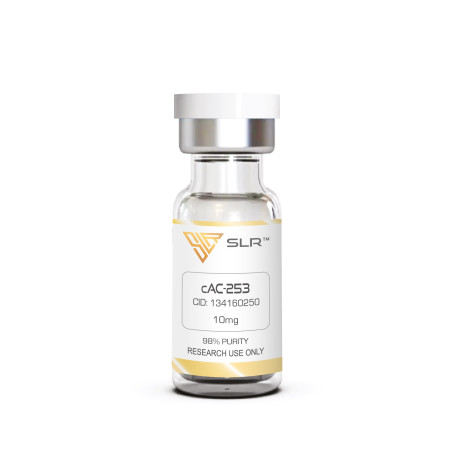

cAC-253 is a disulfide-cyclized research peptide used in preclinical experimental models to investigate amylin receptor–mediated signaling under conditions of amyloid-associated cellular stress. In in vitro systems and animal studies, cAC-253 has been explored for its effects on synaptic function, learning- and memory-related signaling pathways, amyloid-associated biochemical markers, and neuroinflammatory responses, providing a tool for mechanistic research into receptor-specific pathways involved in synaptic integrity.
SPECIFICATIONS
Product Code: CA2010
Sequence: CLGRLSQELHRLQTYPRTNTGSNTYC (Modifications: Cys-26 = C-terminal amide, Disulfide bridge between 1 - 26)
Molecular Formula: C126H202N42O40S2
Molecular Weight: 3009.36 g / mol
PubChem ID: 134160250
Purity: Technical / Research Grade 98%
Other details: No TFA Salt
Form: Lyophilized powder
Color: White
Storage temperature: -20°C
Source: Synthetic
Safety classification: Standard handling
DESCRIPTION
The amylin receptor has been identified in experimental neuroscience research as a mediator of cellular responses associated with amyloid-related stress and synaptic dysfunction. In preclinical models, signaling through this receptor has been shown to contribute to alterations in neuronal communication under conditions of amyloid exposure.
cAC-253 is a synthetic, disulfide-cyclized peptide designed as an amylin receptor antagonist and is used exclusively in preclinical research models to investigate amyloid-associated signaling, synaptic integrity, and neurodegeneration-related mechanisms.
Amyloid and synaptic signaling research (preclinical)
In in vitro systems, antagonism of the amylin receptor by cAC-253 has been shown to attenuate amyloid-induced neurotoxicity and to counteract experimental suppression of hippocampal long-term potentiation (LTP), a cellular model commonly used to study synaptic plasticity.
Transgenic animal models and cognitive signaling (preclinical)
cAC-253 has been investigated in transgenic animal models overexpressing amyloid precursor protein (APP) to explore its effects on learning-, memory-, and synapse-associated signaling pathways. In these models, experimental administration of cAC-253 has been associated with:
These studies are used to characterize mechanistic links between amylin receptor signaling and synaptic integrity under amyloid stress conditions.
Structural optimization and pharmacokinetic research (preclinical)
cAC-253 incorporates a head-to-tail disulfide cyclization, introduced to improve proteolytic stability and structural constraint relative to linear peptide formats. In laboratory evaluations, cyclization has been associated with:
Central nervous system distribution studies (preclinical)
Using fluorescently labeled peptide constructs, cAC-253 has been studied in animal models to investigate blood–brain barrier transit and regional brain distribution. Experimental imaging analyses have demonstrated preferential localization to hippocampal regions, consistent with known patterns of amylin receptor expression. These observations support the use of cAC-253 as a research probe for receptor-specific central signaling, rather than as a therapeutic agent.
Proteolytic stability and clearance research (preclinical)
Comparative laboratory studies have shown that cyclization of cAC-253 confers markedly increased stability in biological matrices, extending experimental half-life relative to non-cyclized formats. These properties are leveraged in research settings to ensure sustained receptor engagement during mechanistic studies.
Amyloid burden and neuroinflammation models (preclinical)
In long-term experimental paradigms, cAC-253 has been examined for its effects on amyloid accumulation, synaptic marker expression, and neuroinflammatory signaling in animal models. Observed changes in amyloid-positive profiles and synaptic-associated proteins are interpreted strictly as experimental indicators of pathway modulation, not as disease outcomes.
REFERENCES
All information presented above is derived from in vitro experiments, animal studies, and other preclinical research models. These data are intended solely for basic scientific investigation of biological mechanisms and do not imply any therapeutic, diagnostic, preventive, or clinical use in humans or animals.
W. Fu et al., "Role of microglial amylin receptors in mediating beta amyloid (Aβ)-induced inflammation" [PubMed]
R. Soudy et al., "Cyclic AC253, a novel amylin receptor antagonist, improves cognitive deficits in a mouse model of Alzheimer's disease" [PubMed]
R. Soudy et al., "Short amylin receptor antagonist peptides improve memory deficits in Alzheimer’s disease mouse model" [Scientific Reports]
DISCLAIMER
This product is intendend for lab research and development use only. These studies are performed outside of the body. This product is not medicines or drugs and has not been approved by the FDA or EMA to prevent, treat or cure any medical condition, ailment or disease. Bodily introduction of any kind into humans or animals is strictly forbidden by law. This product should only be handled by licensed, qualified professionals.
All product information provided on this website is for informational and educational purposes only.

| Image | Ref. | Unit price | Weight | Avail. | Buy |
|---|---|---|---|---|---|
| CA2010 | €376.00 Discount by quantity 10+ €300.80 –20% 20+ €263.20 –30% 50+ €233.12 –38% 100+ €210.56 –44% 200+ €188.00 –50% | 0.100000 kg |  | |
| Total: 0,0 All prices with tax included. | |||||
Product is available Product is no longer in stock
 Product is no in stock, but is allowed to be back-ordered