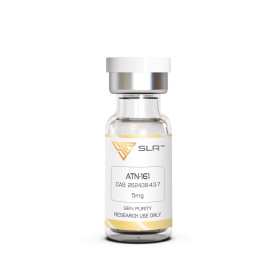
ATN-161- 5mg, 60mg
€56.00

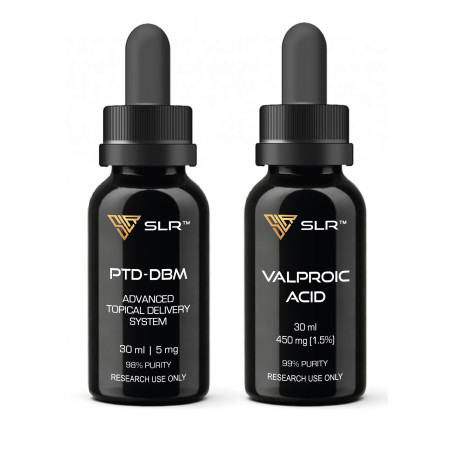

PTD-DBM + Valproic Acid is a research-oriented topical formulation designed to modulate intracellular signaling mechanisms associated with hair follicle biology. PTD-DBM (Protein Transduction Domain – Dishevelled Binding Motif) is a synthetic chimeric peptide developed to interfere with the inhibitory interaction between CXXC5 and Dishevelled (Dvl), a regulatory checkpoint within the Wnt/β-catenin signaling pathway. By reducing this inhibitory binding, PTD-DBM supports restoration of physiological Wnt pathway dynamics under experimental conditions.
Valproic Acid (1.5%) acts as a complementary signaling modulator. Through inhibition of GSK3β and associated intracellular pathways, it contributes to β-catenin stabilization and supports downstream signaling activity.
The combined formulation is structured to provide multi-layer modulation of follicular signaling networks, addressing both inhibitory feedback control (CXXC5–Dvl interaction) and β-catenin stabilization mechanisms. In preclinical research models, co-modulation of these pathways has been associated with:
Enhanced dermal papilla signaling activity
Promotion of anagen-associated markers
Increased β-catenin pathway activity
Support of follicular regenerative signaling dynamics
FRESHLY PREPARED SOLUTION
ADVANCED DELIVERY SYSTEM - STRUCTURED CARRIER TECHNOLOGY
This product utilizes a structured topical delivery architecture integrating membrane-interactive carrier matrices with controlled CPP-assisted transport modulation. The formulation is engineered according to the physicochemical profile of the research compound to support membrane interaction, diffusion behavior, and preservation of molecular integrity.
SPECIFICATIONS
Product Code: PDV005T
PTD-DBM - 5 mg
Sequence: RRRRRRRRGGGGRKTGHQICKFRKC
Molecular Formula: C134H244N60O32S2
Molecular Weight: 3082.65 g/mol
CAS: N/A
Purity: Technical / Research Grade ≥98%
Form: Liquid Solution
Appearance: Clear to slightly opalescent
Total Content: 30 mL / 5 mg
Concentration: 0.167 mg/mL
Vehicle / Carrier System: Proprietary carrier system
Storage Temperature: 4°C (Do not freeze)
Source: Synthetic
Safety Classification: Standard laboratory handling
VALPROIC ACID - 450 mg (1.5%)
Molecular Formula: C8H16O2
Molecular Weight: 144.21 g/mol
CAS: 99-66-1
Purity: Technical / Research Grade ≥99%
Form: Liquid Solution
Appearance: Colorless to slightly yellow
Storage Temperature: 15–25°C
Source: Synthetic
Safety Classification: Standard laboratory handling
DESCRIPTION
PTD-DBM is an acronym for Protein Transduction Domain – Dishevelled Binding Motif. It is a synthetic chimeric peptide engineered to interact with intracellular signaling pathways associated with hair follicle biology. This peptide combines two functional components:
• A protein transduction domain (PTD), typically composed of a poly-arginine sequence that facilitates cellular uptake.
• A Dvl-binding motif (DBM), designed to interfere with the interaction between specific regulatory proteins involved in Wnt signaling.
PTD-DBM is investigated in experimental models as a biochemical modulator of hair follicle signaling pathways.
Rather, it functions as a signaling interaction modulator.
Biological Background: Hair Follicle Signaling
Hair follicle development, cycling, and regeneration are strongly influenced by the Wnt/β-catenin signaling pathway. The Wnt pathway regulates:
• Stem cell activation
• Transition from telogen (resting phase) to anagen (growth phase)
• Dermal papilla cell activity
• Follicular morphogenesis
• Tissue regeneration
Wnt signaling involves coordinated communication between membrane receptors, cytoplasmic proteins, and transcription factors. One of the critical regulatory checkpoints within this pathway involves the interaction between:
• CXXC-type zinc finger protein 5 (CXXC5)
• Dishevelled protein (Dvl)
The Role of CXXC5 in Follicular Regulation
CXXC5 has been identified in experimental literature as a negative regulator of Wnt/β-catenin signaling. When CXXC5 binds to Dishevelled (Dvl), it:
• Inhibits downstream Wnt activation
• Reduces β-catenin stabilization
• Suppresses transcription of Wnt target genes
• Limits follicular activation
This regulatory mechanism appears to function as a negative feedback loop within the follicle. In androgenetic alopecia models, increased CXXC5 activity has been associated with reduced follicular regenerative signaling.
Mechanism of PTD-DBM
PTD-DBM is designed as a competitive inhibitor of the CXXC5–Dvl interaction. After cellular internalization via its protein transduction domain, the DBM portion of the peptide:
• Binds to Dishevelled
• Prevents CXXC5 from interacting with Dvl
• Reduces inhibitory signaling
• Supports restoration of Wnt pathway activity
By disrupting this inhibitory complex, PTD-DBM allows β-catenin signaling to proceed more effectively in experimental systems. Importantly, PTD-DBM does not artificially activate Wnt signaling. Instead, it reduces suppression. This distinction is critical for safety and regulatory context.
Experimental Observations in Preclinical Models
In CXXC5-deficient murine models:
• Enhanced transition from telogen to anagen was observed
• Increased β-catenin levels were detected
• Elevated alkaline phosphatase expression was noted
• Proliferating cell nuclear antigen (PCNA) levels increased
These markers are commonly associated with follicular activation and regenerative signaling. Loss of CXXC5 function appeared to support hair cycling progression.
Valproic Acid (VPA) as a Synergistic Signaling Modulator
Valproic acid is a branched-chain fatty acid investigated in dermatological research for its ability to influence signaling pathways associated with hair biology. In cellular systems, VPA has demonstrated:
• Inhibition of GSK3β activity
• Partial Wnt pathway agonist behavior
• Modulation of histone deacetylase (HDAC) activity
• Increased β-catenin stabilization
Through GSK3β inhibition, VPA reduces β-catenin degradation, thereby supporting Wnt pathway activation. In experimental hair models, VPA has been associated with increased dermal papilla activity and follicular signaling.
Synergistic Interaction Between PTD-DBM and VPA
Preclinical experiments demonstrated that:
• PTD-DBM interferes with inhibitory binding (CXXC5–Dvl)
• VPA enhances β-catenin stabilization via GSK3β antagonism
When combined:
• Increased dermal papilla cell activity was observed
• Enhanced β-catenin signaling was detected
• Greater expression of alkaline phosphatase and PCNA was reported
• Synergistic hair regrowth effects were noted in murine models
Importantly, Wnt3a stimulation alone induced CXXC5 expression, suggesting a built-in negative feedback mechanism.
Together, they support a regulatory shift toward follicular activation under experimental conditions.
Implications for Hair Follicle Biology
In laboratory systems, modulation of the CXXC5–Dvl interaction has been associated with:
• Promotion of anagen transition
• Increased dermal papilla signaling
• Enhanced expression of FGF9
• Elevated keratin 17 expression
• Augmented wound-induced hair neogenesis
These effects are consistent with restoration of Wnt signaling dynamics.
Conceptual Framework of the Combination
PTD-DBM acts at the level of protein-protein interaction. Valproic acid modulates intracellular kinase and epigenetic regulation. Their combined action addresses:
This multi-layer modulation may provide a mechanistically coherent approach to follicular signaling research.
Follicular Microenvironment Considerations
Hair follicle cycling depends on:
• Stem cell niche integrity
• Dermal papilla communication
• Extracellular matrix balance
• Local inflammatory tone
By influencing Wnt pathway dynamics, PTD-DBM + VPA may contribute to:
• Support of follicular signaling networks
• Maintenance of regenerative signaling conditions
• Modulation of inhibitory feedback loops
Summary of Mechanistic Action
PTD-DBM:
• Blocks CXXC5–Dvl binding
• Reduces inhibitory Wnt feedback
• Supports β-catenin signaling restoration
Valproic Acid:
• Inhibits GSK3β
• Stabilizes β-catenin
• Modulates epigenetic transcription
Together:
• Enhance Wnt pathway signaling dynamics
• Support follicular activation markers in experimental models
• Demonstrate synergistic effects in preclinical hair regeneration studies.
REFERENCES
Soung-Hoon Lee et al., "The Dishevelled-binding protein CXXC5 negatively regulates cutaneous wound healing" [JEM]
Soung-Hoon Lee et al., "Targeting of CXXC5 by a Competing Peptide Stimulates Hair Regrowth and Wound-Induced Hair Neogenesis" [ScienceDirect]
Y.C. Ryu et al., "CXXC5 Mediates DHT-Induced Androgenetic Alopecia via PGD2" [MDPI]
S.J. Jo et al., "Topical valproic acid increases the hair count in male patients with androgenetic alopecia: a randomized, comparative, clinical feasibility study using phototrichogram analysis" [PubMed]
S. Lee "Molecular Signaling Pathways in Wound-Induced Hair-Follicle Neogenesis" [PMC]
Y.C. Ryu et al., "KY19382, a novel activator of Wnt/β‐catenin signalling, promotes hair regrowth and hair follicle neogenesis" [PMC]
M. Bejaoui et al., "β-catenin-mediated hair growth induction effect of 3,4,5-tri-O-caffeoylquinic acid" [PMC]
S.J. Jo et al., "Valproic acid promotes human hair growth in in vitro culture model" [PubMed]
A. Mehta et al., "Revolutionary Approaches to Hair Regrowth: Follicle Neogenesis, Wnt/ß-Catenin Signaling, and Emerging Therapies" [PMC]
DISCLAIMER
This product is intendend for lab research and development use only. These studies are performed outside of the body. This product is not medicines or drugs and has not been approved by the FDA or EMA to prevent, treat or cure any medical condition, ailment or disease. Bodily introduction of any kind into humans or animals is strictly forbidden by law. This product should only be handled by licensed, qualified professionals.
All product information provided on this website is for informational and educational purposes only.
...
| Image | Ref. | Unit price | Weight | Avail. | Buy |
|---|---|---|---|---|---|
| PDV005T | €120.00 Discount by quantity 10+ €96.00 –20% 20+ €84.00 –30% 50+ €74.40 –38% 100+ €67.20 –44% 200+ €60.00 –50% | 0.000000 kg |  | |
| Total: 0,0 All prices with tax included. | |||||
Product is available Product is no longer in stock
 Product is no in stock, but is allowed to be back-ordered