IPAMORELIN - 5mg
€22.00


Research on Dihexa suggests it has been explored for its potential role in:
Supporting neuronal repair mechanisms in experimental models
Promoting synaptic connectivity and signaling pathways involved in neural plasticity
Enhancing neurotrophic activity associated with growth-factor mediated communication
Investigating protective effects in preclinical models of neurodegeneration, including Alzheimer’s- and Parkinson’s-related pathways
Supporting cognitive performance parameters such as learning, memory formation, and recall in animal studies
Improving motivation- and mood-related behavioral markers in exploratory research models
Enhancing mental endurance and sustained attention in cognitive testing paradigms
Supporting executive functions such as problem-solving and information processing speed in experimental settings
Exploring effects on social recognition and interaction-related behavioral markers in preclinical studies
FRESHLY PREPARED SOLUTION
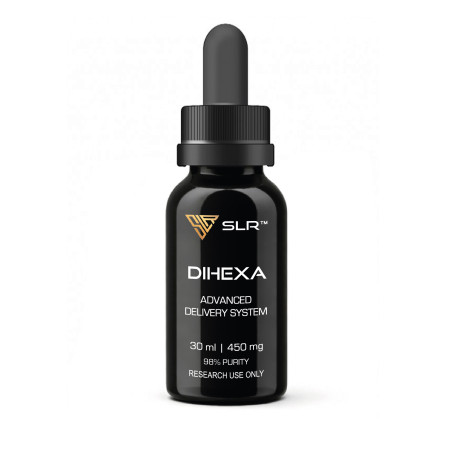
ADVANCED DELIVERY SYSTEM - CELL PENETRATING PEPTIDE TECHNOLOGY
This product utilizes advanced delivery technology incorporating calibrated cell-penetrating peptide (CPP) systems. The formulation is engineered to support efficient and targeted intracellular delivery of active ingredients, contributing to enhanced transport performance and bioavailability.
SPECIFICATIONS
Product Code: DHX450L
Sequence: Hexanoyl-Tyr-Ile-Ahx-NH2
Molecular Formula: C27H44N4O5
Molecular Weight: 504.28 g/mol
CAS: 1401708-83-5
Purity: Technical / Research Grade ≥98%
Other details: No TFA Salt
Form: Liquid Solution
Color: Clear / Slightly opalescent
Total Content: 30 mL / 450 mg
Concentration: 15 mg/mL
Vehicle / Carrier System: Proprietary carrier system
Storage Temperature: 4°C (Do not freeze)
Source: Synthetic
Safety classification: Standard handling
DESCRIPTION
Dihexa is an N-hexanoyl-Tyr-Ile-(6) aminohexanoic amide peptide. This compound was originally derived from Angiotensin IV, and is therefore frequently described in the research literature as an Angiotensin IV–derived oligopeptide. Dihexa is a small peptide investigated primarily in preclinical experimental research, and it was originally developed and characterized by researchers at Washington State University. Since its early development, Dihexa has attracted attention due to its reported high binding affinity for hepatocyte growth factor (HGF) and its receptor system, c-Met, a signaling axis strongly associated with cellular growth, regeneration, tissue repair, and neurotrophic activity.
Research interest in Dihexa has focused on its potential role in synaptogenesis, neuronal survival signaling, and synaptic remodeling under conditions of neurodegenerative stress. The HGF/c-Met pathway is widely studied in neuroscience because it is involved in neuronal differentiation, dendritic outgrowth, axonal guidance, synaptic stabilization, and regulation of inflammatory responses in neural tissue. Within this mechanistic framework, Dihexa has been explored as a candidate compound that may amplify or mimic certain beneficial signaling effects of HGF while maintaining a smaller and potentially more stable peptide structure.
According to published experimental observations, the half-life of Dihexa has been described as approximately one week, which is notably longer than the half-lives reported for many neurotrophic signaling molecules. This relatively long persistence has been considered one of the reasons why Dihexa has generated interest as a potential research tool, particularly in contexts where sustained synaptic repair signaling may be beneficial. A recurring finding described in several experimental studies is that synaptogenesis appears to be one of the most prominent biological outcomes associated with Dihexa exposure. Synaptogenesis refers to the formation of new synaptic connections between neurons, a process essential for learning, memory consolidation, adaptive behavior, and recovery after neural injury.
In models of cognitive impairment and neuronal damage, Dihexa has been explored for its association with improvements in synaptic density and synaptic communication. Unlike many research approaches aimed at slowing degeneration, Dihexa has been discussed in scientific literature as a compound potentially linked to active synaptic restoration, meaning that its effects may involve supporting the rebuilding of damaged neural networks rather than solely delaying neuronal loss. This distinction is important because synaptic loss is considered a major contributor to cognitive decline across multiple neurological disorders, including Alzheimer’s disease and other forms of dementia.
In certain experimental impairment models, Dihexa has been associated with the restoration of tyrosine hydroxylase synthesis in the substantia nigra, a brain region critically involved in motor coordination and dopamine regulation. Tyrosine hydroxylase is the enzyme responsible for the rate-limiting step in catecholamine synthesis, including the production of dopamine and noradrenaline. Because dopaminergic degeneration in the substantia nigra is a hallmark of Parkinsonian pathology, this observation has fueled additional research interest into Dihexa’s possible relevance to experimental Parkinson’s disease models.
In addition to dopaminergic systems, Dihexa has also been explored in relation to signaling pathways associated with executive function and cognition, including pathways linked to the anterior cingulate cortex, a region studied for its involvement in attention regulation, decision-making, emotional processing, and adaptive learning. This has led to discussions of Dihexa in broader neuropsychiatric research frameworks, including experimental models involving motivational dysfunction, stress-related cognitive decline, and altered neural connectivity.
Some research literature has described Dihexa as significantly more potent than BDNF (brain-derived neurotrophic factor) in specific synaptogenic assays. BDNF is widely regarded as one of the most important neurotrophic factors involved in synaptic growth and neuronal survival. Although these potency comparisons are typically limited to controlled experimental assays and cannot be directly extrapolated to human physiology, they have contributed to Dihexa’s reputation as a strong synaptogenesis-associated candidate in research settings. This type of activity has made Dihexa a compound of interest for studying synaptic repair mechanisms, particularly in models where BDNF signaling is impaired.
Dihexa has also been explored as an orally administered compound in certain experimental contexts and has been described as capable of penetrating the blood-brain barrier. Blood-brain barrier permeability is considered a major limitation for many neurotrophic proteins, since large growth factors typically do not cross efficiently. The ability of a small peptide to access central nervous system tissue is therefore considered a valuable property in experimental research, especially when investigating pathways that require direct engagement with brain structures.
Mechanistically, research discussions suggest that Dihexa may influence processes such as receptor sensitivity, intracellular kinase signaling, synaptic protein expression, and neurotrophic gene transcription. These mechanisms may collectively contribute to synaptic remodeling and neuronal resilience under stress conditions. In experimental frameworks, Dihexa has been associated with pathways that may support synaptic stabilization and functional recovery, particularly when neuronal networks are disrupted by toxic protein aggregates, ischemic stress, inflammatory mediators, or mechanical injury.
Because of these properties, Dihexa has been studied in experimental contexts relevant to neurodegenerative disorders such as Alzheimer’s disease and Parkinson’s disease, as well as in research models related to traumatic brain injury (TBI). In some early studies, Dihexa was explored as a potential modulator of functional recovery following experimental trauma affecting the brain and nervous system, including models relevant to head and neck injury. The hypothesis in such models is that enhanced synaptogenesis and neurotrophic signaling could support reorganization of damaged circuits, allowing partial restoration of function.
Alzheimer’s Disease and Neurodegenerative Decline
Alzheimer’s disease is a progressive degenerative brain condition and one of the leading causes of dementia and cognitive decline. It accounts for approximately 60–80% of dementia cases, making it the most common form of dementia worldwide. Alzheimer’s pathology is strongly associated with two well-characterized hallmarks: amyloid-beta plaque accumulation and neurofibrillary tangles formed by hyperphosphorylated tau protein. These aggregates are associated with synaptic disruption, chronic neuroinflammation, oxidative stress, and progressive neuronal loss, ultimately leading to memory impairment and cognitive decline.
In experimental models of Alzheimer’s-related neurodegeneration, synaptic loss is often considered one of the earliest and most functionally relevant events. As a result, compounds that may promote synaptogenesis or restore synaptic density have become an important research focus. Dihexa has been investigated in this context due to its association with enhanced synaptic formation and neural connectivity. Research literature has suggested that Dihexa exposure may reduce amyloid plaque burden and tau-associated pathological markers in certain laboratory models. These findings remain part of preclinical exploration, but they have contributed to the broader interest in Dihexa as a candidate compound in cognitive impairment research.
In addition, experimental observations have suggested that Dihexa may be associated with increased expression of neurotrophic factors such as BDNF and NGF (nerve growth factor). Both BDNF and NGF are essential for neuronal survival, synaptic plasticity, long-term potentiation, and memory formation. The possible involvement of these factors provides a plausible mechanistic framework for Dihexa’s reported cognitive-related effects in animal studies. In the context of Alzheimer’s research, boosting neurotrophic signaling is considered relevant because Alzheimer’s disease is often associated with reduced BDNF levels and impaired neurotrophic support.
Another key aspect of Alzheimer’s progression involves neuroinflammation and microglial activation. Although Dihexa is not primarily described as an anti-inflammatory peptide, the HGF/c-Met signaling axis has been studied for its immunomodulatory properties, including potential roles in reducing excessive inflammatory responses and supporting tissue repair. Therefore, researchers have proposed that Dihexa may influence Alzheimer’s pathology through multiple converging pathways: synaptic repair, neurotrophic support, and modulation of degenerative stress signaling.
It is also important to note that Alzheimer’s disease involves not only cortical degeneration but also hippocampal damage. The hippocampus is a brain structure central to learning and memory consolidation. Synaptic remodeling within the hippocampus is essential for spatial learning, long-term memory storage, and recall. In experimental research, Dihexa has been discussed as a compound potentially capable of enhancing hippocampal synaptic plasticity, which may be relevant for memory impairment models.
Overall, the interest in Dihexa in Alzheimer’s-related research stems from its potential association with improved synaptic density, increased neurotrophic signaling, and enhanced functional connectivity in experimental systems.
Parkinson’s Disease and Dopaminergic Systems
Parkinson’s disease is a progressive neurodegenerative disorder characterized primarily by degeneration of dopaminergic neurons in the substantia nigra and disruption of dopamine signaling in the striatum. Clinically, Parkinson’s disease is associated with symptoms such as tremor, rigidity, bradykinesia, postural instability, and motor coordination impairment. Beyond motor symptoms, Parkinson’s disease is also associated with non-motor complications such as cognitive decline, mood disturbances, sleep disruption, and autonomic dysfunction.
Because dopaminergic neuron loss is central to Parkinsonian pathology, research efforts have focused on identifying compounds capable of protecting dopamine neurons, promoting regeneration, or supporting synaptic function in dopaminergic circuits. HGF has been studied for its neuroprotective properties and its role in supporting neuronal survival, axonal outgrowth, and synaptic connectivity. For this reason, small-molecule or peptide activators of HGF signaling have been considered promising experimental candidates.
Dihexa has been investigated in preclinical Parkinson’s disease models as a potential HGF mimetic or amplifier. In these models, Dihexa administration has been associated with improvements in motor function. In certain experimental designs, researchers have reported restoration of tyrosine hydroxylase staining, which is commonly used as a marker of dopaminergic neuron integrity. Since tyrosine hydroxylase is essential for dopamine synthesis, its restoration may reflect a partial recovery of dopaminergic signaling capacity.
Another relevant component of Parkinson’s pathology is mitochondrial dysfunction and oxidative stress. Dopamine neurons are particularly vulnerable to oxidative damage due to dopamine metabolism and high energy demand. While Dihexa is not classically categorized as a mitochondrial peptide, enhanced trophic signaling through c-Met may indirectly support cellular resilience, antioxidant response pathways, and neuronal survival signaling.
Furthermore, Parkinson’s disease is associated with altered connectivity between motor cortex, basal ganglia, and cerebellar pathways. Synaptic repair mechanisms are therefore relevant not only for neuron survival but also for functional reorganization of motor circuits. In this context, Dihexa’s association with synaptogenesis has been proposed as one possible mechanism underlying improved motor outcomes observed in animal studies.
Cognitive Function, Memory Consolidation, and Executive Processing
A major theme in Dihexa research is its potential association with cognitive enhancement in experimental models. Memory formation depends on synaptic strengthening, synaptic remodeling, and long-term potentiation within brain structures such as the hippocampus and prefrontal cortex. Disruptions in synaptic signaling are strongly linked to learning impairment, dementia progression, and reduced cognitive flexibility.
Dihexa has been discussed as a compound potentially involved in memory consolidation and retrieval processes. Experimental models have investigated its effects on learning performance, recall, and behavioral markers of cognitive resilience. These investigations often focus on how synaptic density and receptor signaling changes may translate into improved cognitive output.
The anterior cingulate cortex and related prefrontal structures are involved in executive control, emotional regulation, and attention. Dysregulation in these networks has been implicated in depression, anxiety, cognitive fatigue syndromes, and neurodevelopmental disorders. Because Dihexa has been studied for its association with synaptic repair and enhanced signaling, it has also generated interest in research related to cognitive endurance, attention regulation, and behavioral flexibility.
Some research discussions have proposed that Dihexa may influence gene expression patterns related to synaptic proteins, receptor trafficking, and intracellular signaling cascades. These mechanisms could potentially support improved cognitive performance in animal models, though it is important to emphasize that such findings remain primarily within experimental and preclinical settings.
Traumatic Brain Injury and Neural Repair Research
Traumatic brain injury (TBI) is associated with acute neuronal damage, inflammation, blood-brain barrier disruption, and secondary degeneration. Even mild or moderate TBI can lead to long-term cognitive deficits, memory problems, mood disorders, and executive dysfunction. A key feature of TBI is the loss of synaptic integrity and disruption of neural networks.
Because synaptic restoration is central to recovery, compounds capable of promoting synaptogenesis and neurotrophic signaling have been explored as potential post-injury interventions in experimental models. Dihexa has been discussed as a compound that may support recovery processes through trophic signaling pathways. Early research has investigated its potential association with functional improvement after neural injury, including models relevant to head trauma and neural degeneration.
The potential for Dihexa to support synaptic remodeling has led to hypotheses that it could play a role in the reorganization of neural circuits following injury. This is relevant because functional recovery after TBI often depends on neuroplasticity, where remaining circuits compensate for damaged pathways.
REFERENCES
J.B. Weiss et al., "Stem cell, Granulocyte-Colony Stimulating Factor and/or Dihexa to promote limb function recovery in a rat sciatic nerve damage-repair model: Experimental animal studies" [ScienceDirect]
J.W. Harding "Development of Small Molecule Hepatocyte Growth Factor Mimetics for the Treatment of Parkinson’s Disease" [The M.J. Fox Foundation]
C. Benoist et al., "The procognitive and synaptogenic effects of angiotensin IV-derived peptides are dependent on activation of the hepatocyte growth factor/c-met system" [PubMed]
J.W. Wright et al., "The development of small molecule angiotensin IV analogs to treat Alzheimer's and Parkinson's diseases" [PubMed]
X. Sun et al., "AngIV-Analog Dihexa Rescues Cognitive Impairment and Recovers Memory in the APP/PS1 Mouse via the PI3K/AKT Signaling Pathway" [PubMed]
J.W. Wright et al., "The Brain Hepatocyte Growth Factor/c-Met Receptor System: A New Target for the Treatment of Alzheimer's Disease" [PubMed]
S. Mathapati et al., "Small-Molecule-Directed Hepatocyte-Like Cell Differentiation of Human Pluripotent Stem Cells" [PubMed]
J.K. Ho, D.A. Nation "Cognitive benefits of angiotensin IV and angiotensin-(1-7): A systematic review of experimental studies" [PubMed]
A.T. McCoy et al., "Evaluation of metabolically stabilized angiotensin IV analogs as procognitive/antidementia agents" [PubMed]
R. Siller et al., "Small-molecule-driven hepatocyte differentiation of human pluripotent stem cells" [PubMed]
DISCLAIMER
This product is intended for laboratory research and development use only. These studies are performed outside of the body. This product is not a medicine or drug and has not been approved by the FDA or EMA to prevent, treat, or cure any medical condition, ailment, or disease. Bodily introduction of any kind into humans or animals is strictly forbidden by law. This product should only be handled by licensed, qualified professionals.
All product information provided on this website is for informational and educational purposes only.


| Image | Ref. | Unit price | Weight | Avail. | Buy |
|---|---|---|---|---|---|
| DHX450L | €165.00 Discount by quantity 10+ €132.00 –20% 20+ €115.50 –30% 50+ €102.30 –38% 100+ €92.40 –44% 200+ €82.50 –50% | 0.100000 kg |  | |
| Total: 0,0 All prices with tax included. | |||||
Product is available Product is no longer in stock
 Product is no in stock, but is allowed to be back-ordered