PE-22-28 - 5mg
€29.00

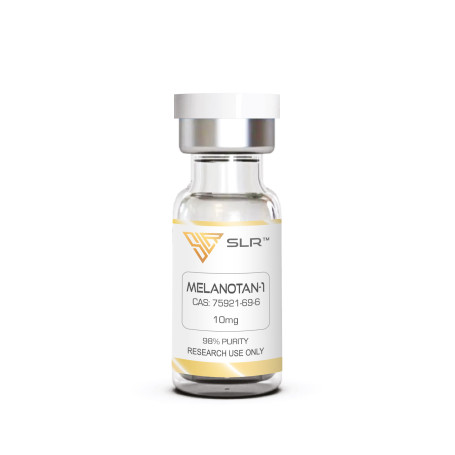

Melanotan 1 is a synthetic peptide originally developed as an analog of alpha-melanocyte-stimulating hormone (α-MSH) to study sunless pigmentation mechanisms. Subsequent experimental and preclinical research has shown that Melanotan 1 interacts with multiple melanocortin pathways, resulting in a range of physiological effects beyond skin pigmentation. These include modulation of signaling pathways involved in cardiovascular regulation, appetite and energy balance, and central nervous system function. Ongoing research continues to explore the broader biological roles of Melanotan 1 across multiple physiological systems.
SPECIFICATIONS
Product Code: ML1010
Sequence: Ser-Tyr-Ser-Nle-Glu-His-D-Phe-Arg-Trp-Gly-Lys-Pro-Val
Molecular Formula: C78H111N21O19
Molecular Weight: 1646.874 g/mol
CAS Number: 75921-69-6
Purity: Technical / Research Grade 98%
Other details: No TFA Salt
Form: Lyophilized powder
Color: White
Storage temperature: -20°C
Source: Synthetic
Safety classification: Standard handling
DESCRIPTION
Melanotan 1 (MT-1) is a synthetic peptide analog structurally derived from the naturally occurring alpha-melanocyte-stimulating hormone (α-MSH), a key component of the melanocortin system. MT-1 was initially developed and studied for its ability to stimulate melanogenesis, leading to increased skin pigmentation without direct ultraviolet exposure. Over time, experimental and preclinical research has revealed that MT-1 interacts with multiple melanocortin receptors distributed throughout the body, resulting in a broad range of biological effects extending beyond pigmentation alone.
Due to its interaction with central and peripheral melanocortin pathways, MT-1 has been investigated in research contexts related to neuroendocrine regulation, immune modulation, metabolic signaling, and cellular protection. These findings have positioned MT-1 as a multifunctional peptide of interest across dermatological, neurological, metabolic, and immunological research domains.
Melanotan 1 and Skin Pigmentation
Beyond Skin Pigmentation: Additional Biological Effects
Research Applications
Neuroprotective and Neurological Research
Mechanisms of Action
Conclusion
Melanotan 1 is a multifunctional synthetic peptide that extends well beyond its original role in pigmentation research. Through its interaction with the melanocortin system, MT-1 has been shown to influence a wide array of biological processes, including skin biology, neuroendocrine signaling, immune modulation, metabolism, and cellular protection. While initially developed as a sunless tanning agent, its diverse physiological interactions continue to make MT-1 a subject of active experimental and preclinical investigation across multiple scientific disciplines.
REFERENCES
All observations described above originate from in vitro systems, animal studies, or other preclinical experimental models. They are intended solely to support basic research into molecular, cellular, and physiological mechanisms and do not imply therapeutic, diagnostic, or preventive applications in humans or animals.
R.T. Dorr et al., "Effects of a superpotent melanotropic peptide in combination with solar UV radiation on tanning of the skin in human volunteers" [PubMed]
S.O. Ugwu et al., "Skin pigmentation and pharmacokinetics of melanotan-I in humans" [PubMed]
N. Surendran et al., "High-performance liquid chromatographic assay for Melanotan-1 ([Nle4-DPhe7]alpha-melanocyte-stimulating hormone) in biological matrices" [PubMed]
L.M. Fitzgerald et al., "Effect of MELANOTAN, [Nle(4), D-Phe(7)]-alpha-MSH, on melanin synthesis in humans with MC1R variant alleles" [PubMed]
M.E. Hadley et al., "Discovery and development of novel melanogenic drugs. Melanotan-I and -II" [PubMed]
R.T. Dorr, "Increased eumelanin expression and tanning is induced by a superpotent melanotropin [Nle4-D-Phe7]-alpha-MSH in humans" [PubMed]
DISCLAIMER
This product is intendend for lab research and development use only. These studies are performed outside of the body. This product is not medicines or drugs and has not been approved by the FDA or EMA to prevent, treat or cure any medical condition, ailment or disease. Bodily introduction of any kind into humans or animals is strictly forbidden by law. This product should only be handled by licensed, qualified professionals.
All product information provided on this website is for informational and educational purposes only.
| Image | Ref. | Unit price | Weight | Avail. | Buy |
|---|---|---|---|---|---|
| ML1010 | €31.00 Discount by quantity 10+ €26.35 –15% 20+ €22.32 –28% 50+ €18.60 –40% 100+ €16.12 –48% 200+ €13.95 –55% | 0.000000 kg |  | |
| Total: 0,0 All prices with tax included. | |||||
Product is available Product is no longer in stock
 Product is no in stock, but is allowed to be back-ordered