L-GLUTATHIONE - 500mg
€29.00

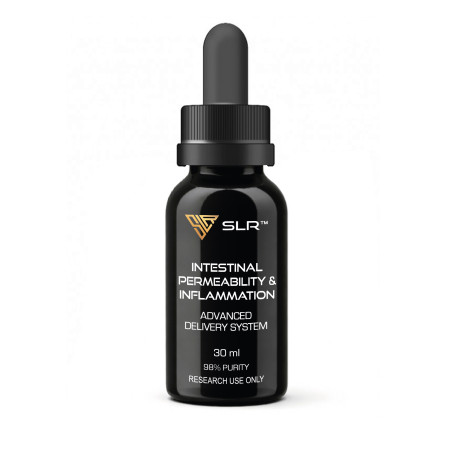

Intestinal Permeability & Inflammation integrates three experimentally investigated peptides—BPC-157 Arginate Form, Larazotide Acetate, and KPV—each studied in preclinical models for their interaction with epithelial barrier integrity, inflammatory signaling pathways, and mucosal microenvironment regulation.
BPC-157 Arginate has been explored for its involvement in nitric oxide–related signaling, cytoprotective cascades, angiogenic pathways, and tight junction recovery mechanisms, with the arginate form demonstrating enhanced physicochemical stability under simulated gastric conditions.
Larazotide Acetate has been investigated as a modulator of zonulin-associated tight junction dynamics, supporting research into paracellular permeability regulation and epithelial barrier stabilization in controlled laboratory systems.
KPV, a tripeptide fragment of α-MSH, has been examined for its interaction with NF-κB and MAPK-related inflammatory pathways, as well as for its transport via PepT1 under experimentally induced inflammatory conditions.
FRESHLY PREPARED SOLUTION
ADVANCED DELIVERY SYSTEM - CELL PENETRATING PEPTIDE TECHNOLOGY
This product utilizes advanced delivery technology incorporating calibrated cell-penetrating peptide (CPP) systems. The formulation is engineered to support efficient and targeted intracellular delivery of active ingredients, contributing to enhanced transport performance and bioavailability under controlled laboratory conditions.
SPECIFICATIONS
Product Code: IIPC30L
BPC-157 ARGINATE FORM – 60 mg
Sequence: Gly-Glu-Pro-Pro-Pro-Gly-Lys-Pro-Ala-Asp-Asp-Ala-Gly-Leu-Val × 2 × L-Arg
Molecular Formula: C62H98N16O22
Molecular Weight (peptide): 1418.70 g/mol
CAS: 137525-51-0
Purity: Technical / Research Grade ≥98%
LARAZOTIDE ACETATE – 60 mg
Sequence: GGVLVQPG
Molecular Formula: C32H55N9O10
Molecular Weight: 725.845 g/mol
CAS: 158818-34-7
Purity: Technical / Research Grade ≥98%
KPV – 100 mg
Sequence: Lys-Pro-Val
Molecular Formula: C16H30N4O4
Molecular Weight: 342.43 g/mol
CAS: 67727-97-3
Purity: Technical / Research Grade ≥98%
General Properties
Other details: No TFA Salt
Form: Liquid Solution
Color: Clear / Slightly opalescent
Total Content: 220 mg in 30 mL (7.33 mg/mL total peptide concentration)
Concentration per mL: BPC-157 Arginate: 2 mg; Larazotide Acetate: 2 mg; KPV: 3.33 mg
Vehicle / Carrier System: Proprietary carrier system
Storage Temperature: 4°C (Do not freeze)
Source: Synthetic
Safety classification: Standard laboratory handling
DESCRIPTION
Intestinal Permeability & Inflammation is a structured multi-peptide formulation developed to support research into the coordinated biological mechanisms that regulate intestinal barrier integrity, epithelial permeability control, and inflammatory balance within the gastrointestinal microenvironment. When the intestinal barrier is exposed to inflammatory stimuli, oxidative stress, microbial imbalance, or immune dysregulation, disruption does not occur through a single mechanism. A defined sequence of biological events typically unfolds:
Barrier dysfunction is not simply “inflammation.” It is the result of structural disorganization combined with immune signaling imbalance and permeability deregulation. The quality of intestinal recovery depends not only on reducing inflammatory signals, but on restoring structural coherence at the epithelial level while maintaining controlled immune activity. This formulation combines peptides that influence complementary domains of intestinal barrier regulation rather than targeting a single isolated pathway. The integrated structure focuses on:
Tight Junction Stabilization and Barrier Integrity
The intestinal epithelium functions as a selective barrier that allows nutrient absorption while preventing uncontrolled passage of luminal antigens and inflammatory triggers. Tight junction proteins — including occludin, claudins, and zonula occludens (ZO-1) — form the structural seal between epithelial cells. When inflammatory cytokines increase or zonulin signaling becomes amplified, these junctional complexes may disassemble, increasing paracellular permeability. Stabilizing tight junction architecture is central to restoring barrier integrity. This complex incorporates components investigated for their interaction with tight junction regulatory systems and zonulin-associated signaling cascades. Preserving junctional organization supports:
Barrier stability is foundational to intestinal homeostasis.
Regulation of Inflammatory Signaling
Intestinal inflammation involves activation of transcription factors such as NF-κB and downstream cytokines including TNF-α, IL-1β, and IL-6. Excessive activation can perpetuate epithelial damage and delay structural restoration. Balanced inflammatory modulation supports the transition from acute signaling toward resolution. Components within this formulation have been examined for their influence on:
Regulated inflammatory signaling allows epithelial repair processes to proceed without prolonged tissue destabilization.
Epithelial Restitution and Surface Continuity
Following injury, epithelial cells must migrate laterally to re-cover exposed areas. This process involves cytoskeletal reorganization, integrin signaling, and focal adhesion remodeling. Efficient restitution restores surface continuity before full structural regeneration occurs. Disruption of this process prolongs permeability defects. Peptides in this formulation have been studied for their influence on cytoskeletal dynamics and epithelial migration mechanisms. Supporting restitution dynamics enhances:
Microvascular Support and Mucosal Oxygenation
Intestinal mucosa relies on an intact microvascular network for oxygen delivery and nutrient exchange. Inflammation can impair microcirculation and endothelial responsiveness. Support of angiogenic signaling and nitric oxide–related pathways contributes to mucosal stabilization. Improved microvascular balance supports:
Microvascular integrity is a structural component of intestinal repair, not merely a secondary factor.
Oxidative Stress Regulation
Inflamed mucosal environments often exhibit increased reactive oxygen species (ROS). Excess oxidative burden damages proteins, lipids, and cellular membranes, further compromising barrier integrity. Redox balance supports:
Components in this complex have been examined for interaction with redox-sensitive transcription systems and ROS modulation. Reducing oxidative amplification contributes to a more stable epithelial environment.
Integrated Barrier Function Restoration
Intestinal barrier dysfunction is multi-factorial. It involves structural disassembly, inflammatory amplification, oxidative stress, and microvascular instability occurring simultaneously. Addressing only one domain often leaves others unregulated. This formulation reflects the biological reality that barrier restoration requires coordination between:
Rather than focusing on a single mechanism, the complex is structured to explore how these processes interact when addressed simultaneously.
Integrated Conclusion
Intestinal permeability and inflammatory dysregulation represent interconnected structural and signaling disturbances within the mucosal environment. Restoration of barrier integrity requires more than suppression of inflammation; it requires structural stabilization, controlled immune signaling, epithelial restitution, and vascular support working in concert. Intestinal Inflammation Permeability Complex is designed to support advanced research into these coordinated mechanisms governing mucosal resilience and epithelial structural regulation.
Individual Component Roles
REFERENCES
All observations described above originate from in vitro systems, animal studies, or other preclinical experimental models and do not imply therapeutic, diagnostic, or preventive applications.
G. Dalmasso et al., "PepT1-Mediated Tripeptide KPV Uptake Reduces Intestinal Inflammation" [Gastroenterology]
S.J. Getting et al., "Dissection of the Anti-Inflammatory Effect of the Core and C-Terminal (KPV) α-Melanocyte-Stimulating Hormone Peptides" [Journal of Pharmacology and Experimental Therapeutics]
S.C. Land "Inhibition of cellular and systemic inflammation cues in human bronchial epithelial cells by melanocortin-related peptides: mechanism of KPV action and a role for MC3R agonists" [PMC]
T.A. Luger et al., "α‐MSH related peptides: a new class of anti‐inflammatory and immunomodulating drugs" [PMC]
M. Bohm et al., "Are melanocortin peptides future therapeutics for cutaneous wound healing?" [Wiley Online Library]
E. Viennois et al., "Critical Role of PepT1 in Promoting Colitis-Associated Cancer and Therapeutic Benefits of the Anti-inflammatory PepT1-Mediated Tripeptide KPV in a Murine Model" [PMC]
S. Khaleghi et al., "The potential utility of tight junction regulation in celiac disease: focus on larazotide acetate" [Sigma-Aldrich]
A. Duzel et al., "Stable gastric pentadecapeptide BPC 157 in colitis and ischemia models" [PMC]
P.S. Sikiric et al., "Effect of Pentadecapeptide BPC 157 on Gastrointestinal Tract" [Karger]
R. Klicek et al., "Pentadecapeptide BPC 157, in Clinical Trials as a Therapy for Inflammatory Bowel Disease (PL14736), Is Effective in the Healing of Colocutaneous Fistulas in Rats: Role of the Nitric Oxide-System" [ScienceDirect]
P. Sikiric et al., "Focus on Ulcerative Colitis: Stable Gastric Pentadecapeptide BPC 157" [Department of Pharmacology and Department of Pathology, Medical Faculty University of Zagreb, Croatia]
S. Seiwerth et al., "Stable Gastric Pentadecapeptide BPC 157 and Wound Healing" [Department of Pathology, School of Medicine, University of Zagreb]
J. Troisi et al., "The Therapeutic use of the Zonulin Inhibitor AT-1001 (Larazotide) for a Variety of Acute and Chronic Inflammatory Diseases" [PubMed]
N.E. Castillo et al., "Celiac Disease as a Model Disorder for Testing Novel Autoimmune Therapeutics" [ScienceDirect]
Z.M. Slifer et al., "Larazotide acetate: a pharmacological peptide approach to tight junction regulation" [American Journal of Physiology-Gastrointestinal and Liver Physiology]
C.P. Kelly et al., "Larazotide acetate in patients with coeliac disease undergoing a gluten challenge: a randomised placebo-controlled study" [AP&T]
B. Jancin "Larazotide eased symptoms in phase II celiac trial" [MDedge]
T. Vanuytsel et al., "The Role of Intestinal Permeability in Gastrointestinal Disorders and Current Methods of Evaluation" [Frontiers]
DISCLAIMER
This product is intended for laboratory research and development use only. It is not a medicine or drug and has not been approved by the FDA, EMA, or any regulatory authority for the prevention, treatment, or cure of any disease.
Bodily introduction into humans or animals is strictly prohibited. Handling is restricted to qualified laboratory professionals.
All product information provided on this website is for informational and educational purposes only.
Related formulations: Tissue Repair Advanced Formula.
| Image | Ref. | Unit price | Weight | Avail. | Buy |
|---|---|---|---|---|---|
| IIPC30L | €219.00 Discount by quantity 10+ €175.20 –20% 20+ €153.30 –30% 50+ €135.78 –38% 100+ €122.64 –44% 200+ €109.50 –50% | 0.100000 kg |  | |
| Total: 0,0 All prices with tax included. | |||||
Product is available Product is no longer in stock
 Product is no in stock, but is allowed to be back-ordered